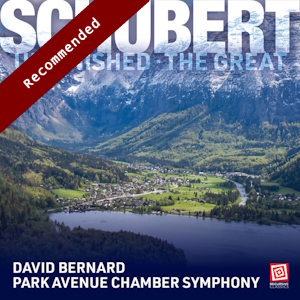
Franz Schubert (1797-1828)
Symphony No. 8 in B minor, D. 759 “Unfinished”
Symphony No. 9 in C major, D. 944 “The Great”
Park Avenue Chamber Symphony/David Bernard
rec. 2026, DiMenna Center for Classical Music, New York City
Recursive Classics RC6758911 [76]
This is the latest studio recording from this enterprising conductor, not to be confused with a live performance with the same programme and venue in February of this year, in which the David Bernard handed the baton for the Eighth to his son James.
The pairing of these two great symphonies is hardly new or unusual and the competition goes back decades to the likes of Furtwängler, Walter, Krips, Böhm, Szell, Karajan, Klemperer and Kleiber. I thoroughly enjoy Bernstein’s way with both symphonies, with the New York Philharmonic in the mid-60s and there is also his live performance with the Concertgebouw of the ‘Great’ in 1987 (see my review). More (relatively) modern accounts that I favour include Sinopoli but for that symphony I also go right back to the live, mono recording of Knappertsbusch in 1957 with the VPO. In other words, we are spoilt for choice. That is not to say that we should not welcome a new recording such as this, especially as it varies slightly in that David Bernard takes the exposition repeat in the first movement of the Eighth but omits the repeat in the both the first movement and the finale of the Ninth – an interesting choice, as most conductors, such as Szell and Bernstein, either omit them altogether, or do them all, like Colin Davis and Kna. As such, from the point of view of timings and repeats, the nearest point of comparison is with Sinopoli’s 1992 recording with the Dresden Staatskapelle.
I asked David Bernard about how he arrived at his decisions regarding the various repeats and have his permission to quote his response, which is interesting and persuasive:
“I take the exposition repeat in the first movement of Unfinished. The reason is that the juxtaposition of the material leading to the repeat (including the amazing tonic pedal over the dominant that was eliminated by editors, including Johannes Brahms, by altering the bassoon 2 and horn 1 parts because they could not understand it, only to have it restored in 1968 by Martin Chusid in his critical edition, which was then followed by Barenreiter) has a complete shift in context when performed prior to the first ending vs. the second ending. This is an incredible moment that requires the repeat to be reflected.
I do not take the exposition repeat in the first movement of the ‘Great’, because it interferes with its proportions and narrative – which is how I decide on repeats in general… the proportions of the development of material in the exposition are so broad, that taking the listener through a second traversal would take away from what was organically built the first time, so I do not take it. The only repeats I take in the entire symphony are in the Third Movement – in the Scherzo only the first time. I do not take any of the repeats in the Trio, nor do I take any repeats in the Finale.”
He is somewhat slower in the first movement of the Eighth compared with Sinopoli – who also takes that repeat but omits them all in the Ninth – but I have to say that the growling basses and Bernard’s steadier pulse in combination with the extraordinary immediacy of the recorded sound create a more menacing atmosphere than even Sinopoli. Every instrument seems to leap into focus from the darkly mellow horns to the bright flute and tension is sustained throughout in a way I have not previously heard it done. Bernard’s control over the whole fifteen-minute arc is immaculate and the playing superlative.
The switch in mood to the serenity of the Andante con moto is abrupt – there is virtually no gap between the movements and once again the sonority of the horns, the purring of the double basses and the purity of the contributions by the solo clarinet then oboe are all striking. There is real luminosity to the string underlay, too – this orchestra need fear no comparison with any of the great orchestras who have recorded these works. The initial power of the passage beginning the last three minutes reaches tragic proportions, then tension dissipates, harmonies clarify and the music subsides into gentle acceptance and resignation in the major key. This is all expertly managed.
The precision of David Bernard’s conducting and his orchestra’s adherence to his direction come through with admirable clarity in the grand, martial opening of the Ninth: individual instrumental strands are all apparent to the ear and the thrilling acceleration four minutes into the movement is very adroitly handled. As with the first movement of the ‘Unfinished’, he is rather more deliberate than Bernstein and Sinopoli who is more lyrical and ruminative, and Bernard’s rhythmic insistence pays dividends in terms of its almost pounding, obsessive, driven quality – but the absence of the repeat means that it doesn’t become “baggy”. The final restatement of the main theme is emphatic.
That rhythmic crispness is maintained in the second movement march and we are treated to some lovely woodwind solos beginning with the oboe’s famous melody over pizzicato strings, which is handed over to the clarinet. Schubert’s ingenious variations on the main theme are skilfully and deftly passed around the orchestra and each section plays with beautiful tone. The Scherzo is a rumbustious, rustic surge of energy played here with great verve; I particularly like how the flutes here pierce the dense orchestra texture. The fairground Trio provides a brief spell of relaxation – just a couple of minutes, without the repeat –in which we can admire the lyricism of the ensemble before the resumption of more earnest frolicking. The finale is enough to leave the listener breathless; its execution here is febrile but never out of control and builds inexorably to a gripping peroration.
All in all, this is a pairing of Schubert’s last two symphonies of sufficient quality in terms of playing sound and editorial choices to make it the first choice for anyone wanting a modern, digital recording.
Ralph Moore
Availability: Qobuz
Please note that it is expected that this recording will be available through Presto Classical shortly.