
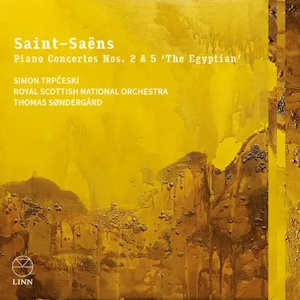
Camille Saint-Saëns (1835-1921)
Piano Concertos No. 2 & No.5 “Egyptian”
Simon Trpčeski (piano), Royal Scottish National Orchestra / Thomas Søndergård
rec. live 17 February & 8 June 2024, Glasgow Royal Concert Hall, Glasgow, Scotland
Linn CKD770 [51]
I am just going to say it. If somebody forced me to choose between the five piano concertos by Beethoven and the five by Saint-Saëns, I would choose those by Saint-Saëns. They might not be as ground-breaking or as architecturally cohesive as Ludwig’s, but Camille’s concertos are so packed full of vigour, life and sensationally good melodies that they feel like they are almost bursting at the seams. His fourth is the winner in the (admittedly rather niche) category of pieces of music I have never heard live but would most like to. So, I get disproportionately excited whenever a new disc of Saint-Saëns’s piano concertos comes around. That happens especially when I had been at the concerts from which the disc was drawn, as was the case here.
Simon Trpčeski was artist in residence with the Royal Scottish National Orchestra, my local orchestra, in the 2023-2024 season. That rather grand title meant only that he gave two concerts in their season, and those concerts featured these two concertos. He recorded them live at the Glasgow concerts – I went to the Edinburgh ones – and Linn released them in marvellous sound. I have a hilarious memory of being in a room with Simon Trpčeski at the interval of the concert that included No.5. He ended up shaking the hand of every adoring fan in the room as they left: he had inadvertently turned into what resembled the host of a wedding lineup.
Concerto No.2 leads the disc, and there is a wonderful fantasia-like feel to the first movement. There is a cruel quip that this concerto “begins with Bach and ends with Offenbach”, but while there is seriousness to this first movement, there is also lightness and freedom. Trpčeski enjoys himself enormously in the extended opening solo cadenza. You can imagine him settling into it in a way that gives him space to build to those titanic final chords, chords which the orchestra picks up with aplomb. The movement’s slower sections often feel like the piano is simply going for a stroll with its hands in its pockets, yet those can then find themselves succeeded by pile-driving double octaves of marvellous power. There is real punch to the orchestral playing to match this. There follows a thistledown scherzo that seems impossible to pin down. The finale that follows is a torrent of energy, but it proceeds with a smile on its face and a sly wink in its tone. The Dies irae-type theme on the winds and piano simply turns cartwheels around it, and the whole thing is tremendous fun. The tricky syncopations of the ending, as the piano turns somersaults around the orchestra, are executed with tremendous self-assurance, and final bars carry terrific punch.
The Egyptian concerto, No.5, has a breezy sense of quiet momentum and easy sway to its opening. Conductor Thomas Søndergård persuades the strings to lean into the slurs in just the right way. This is matched by a gently rhapsodic piano line which develops into something vigorous but never overweening, and it becomes beautifully dreamy towards the end. It is all rather delightful, like you can tell the composer was on holiday when he wrote it. The actual Egyptian element comes in the second movement: the piano develops impressive swagger which the light strings offset, and then finds tripping lightness to the major-key theme, answered beautifully by the orchestral violas. A bit of Middle-Eastern exoticism enters with the rapid-note succession in the middle and the quiet, discretely vanishing ending. The finale, when it comes, is hilarious, ending in an outrageous run of octaves, an orchestral hurrah and a round of applause.
So this is a lovely disc, very much worth exploring if you know and love these works, though some might quibble with the relatively ungenerous run time. Nutters like me will always want the complete set of concertos, of course, for which we can enjoy Rogé with Dutoit, Hough with Oramo or, recently and wonderfully, with Kantorow père et fils. These five works constitute a cycle you will never regret exploring. In the unlikely event that you do not enjoy them after all, you can always go back to Ludwig’s concertos as a consolation prize.
Simon Thompson
Buying this recording via the link below generates revenue for MWI, which helps the site remain free














And if I had to choose between all five Saint-Saens Piano Concertos and his Rapsodie d’Auvergne for piano and orchestra, I’d choose the latter. 10 minutes of bliss. What a wonderful composer he is.