
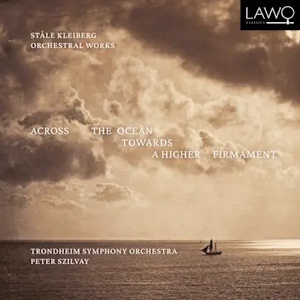
Orchestral Works
Ståle Kleiberg (b. 1958)
Trondheim Symphony Orchestra/Peter Szilvay
Reviewed as a digital download
Recording dates and locations not given.
LAWO Classics LWC1490 [57]
Ståle Kleiberg’s is a name I’ve seen mentioned on various classical music forums as a writer of accessible, tonal, contemporary music, but I had not had the opportunity to sample his music for myself until I came across this album. I know that he was born in Stavanger, is professor emeritus at the Norwegian University of Science and Technology in Trondheim and has been twice nominated for a Grammy.
One of his most respected works seems to be the Requiem for the victims of Nazi persecution (review). This is part of a trilogy of works inspired by Nazi atrocities, including his cello concerto Dopo (review), and the first piece on this present album, Lamento – Cissi Klein in memoriam. He has also received rave reviews for his chamber music: for example, the six works collected in the album Mezzotints (review). There is also a David and Bathsheba opera. The label 2L has made something of a speciality in recording Kleiberg, although here he’s branching out to a Norwegian label called LAWO, and he has a long-running partnership with the Trondheim Symphony Orchestra, which plays beautifully here. Kleiberg’s very serious, somewhat impressionistic music is impressively and thoughtfully written, and I think the album’s strengths lie in his ability to produce a range of orchestral colours.
Opening with the Lamento sets the tone for the album. The title refers to Cissi Klein, a Jewish girl born in 1929 in Norway, who was deported and subsequently murdered in 1943 at Auschwitz. In the 1990s, Trondheim elected her as a sort of ‘representative’ of all the victims of the Nazis who hailed from that city. There have since been several pieces of commemorative art in her honour.
Kleiberg’s Lamento was composed in the early 2000s, and has received a recording by the Trondheim Symphony Orchestra under Eivind Aadland in 2003 (review). The piece begins with an elegiac moment for solo cello, and then develops into something briefly more frantic and threatening. This dies away into an ominous slow section, which eventually builds back into an extended climax led by the brass, with thumping timpani creating a sense of dread. At the tail end of that section, we have some church bells leading to a reflective, tender close. Lamento – Cissi Klein in memoriam succeeds at a ferociously difficult task: it is touching, heartfelt, and grand without ever feeling mawkish or sentimental. In his review of the 2003 recording, Rob Barnett compares it to Alban Berg, and I think that’s apt. There is something late-Romantic in Kleiberg’s voice, and here, where it expresses deep grief for the untimely death of a young girl, the parallels with the Berg Violin Concerto are evident. That 2003 recording with Aadland runs for nearly fifteen minutes, incidentally, while here with Szilvay we are at 13:25, so he comes in at around 10% faster. That’s not insignificant, but I won’t pretend it makes a world of difference either. Listening to the two side by side, I thought Aadland was able to make a little more of those climactic moments. The pounding timpani in Aadland inspires awe, in Szilvay it sort of just sounds like a drum. But if Szilvay had really gone for the jugular here, it might have been emotionally exhausting. This brings me back to the question of choosing to re-record the Lamento and to place it first in the track listing. Nevertheless, as someone who hadn’t heard of the work at all before being introduced to it here, I’m not sorry to have it; what a poignant and finely-crafted piece.
I have not been able to find out what The Town and its People is about, but my reaction upon initially listening was that it might be commemorating another historical tragedy. When I went back later and heard it on its own, that impression completely vanished — programme order is so significant, isn’t it? As far as I can tell, this is the first recording of the work, which is cast in a single movement and runs for eleven minutes. In fact, the piece begins with a strangely pastoral gesture, and, apart from a few violin siren effects, it settles into a stately, gentle pace. The main theme is a sort of chromatic melody that almost sounds jazzy, were it not for the way it is played. There is some lovely writing for woodwinds towards the middle. The re-entry of the low strings sets up a brief stretch of fervent action including a syncopated climax. After this, there is a little more woodwind meandering, and we end with a return to the themes of the opening.
I’ve seen listeners compare Kleiberg to Ravel or Debussy, and there is, I suppose, something of Ravel’s love of orchestral colour paired with a sense of restraint here. I thought of Bax, with his lush chords, chromaticism, and free structure, and Delius for the rather still atmosphere. The Town and its People left me rather bemused. I cannot deny the skilful orchestration, but aside from the opening/closing chromatic theme, I can’t say the rest of it took. Maybe if I had known which town, or what was being said about it … and maybe that is a personal failing, for not being able to appreciate the music “as is”. There are many listeners who love Delius, and I think they might possibly get the most out of The Town and its People, but for myself, I wish it developed just a little bit more, or that something else happened in it, especially towards the second half. I also wonder if he’s considered scoring films— his music has that combination of richness and non-intrusiveness that I can imagine being a real asset in cinema.
At the heart of this disc lies Kleiberg’s third symphony, subtitled, Across the Ocean towards a Higher Firmament. It runs for 32 minutes here, substantially longer than his first two symphonies, both of which can be heard on the above-mentioned Aadland disc. Although it has many of the same tendencies as The Town and its People (perhaps unsurprising, given their close dates of composition), everything comes off much better here, and I attribute that to a wider range of moods and, thus, a larger palette of orchestral colours. The subject is Norwegian immigration to America in the 19th century, and so Kleiberg’s approach is both emotional and narrative: we open with yearning, progress to a struggle, and finish with a restrained triumph. The aural sepia-tone throughout might be Kleiberg’s attempt to reflect on the past-ness of this immigration, or it really might just be how he sounds. Either way, it works like a charm here.
The first movement, an andante marked Espressivo e rubato, is quite beautiful. He opens with pillowy string writing that is joined by the woodwinds for a very pretty chromatic melody with plenty of harp. After this opening section, things get rather dense, and a solo flute comes as a welcome relief. Towards the middle, there is a sense of resolve and – not quite excitement, but anticipation. This contrasts with more subdued, reflective passages. I think it does an admirable job of conveying many of the emotions someone might have felt before embarking on a migration. There is hope conveyed in the writing, but also trepidation and loss. In its twelve minutes, I never felt that it was dragging or running out of ideas.
The second movement is designated Tranquillo. Drammatico. Misterioso. Back-to-back slow movements is certainly a choice, but they are differentiated. Here, even the ‘tranquillo’ opening feels a little unsettled and nervous, and as things go on to get more, well, ‘drammatico’. For Kleiberg, this means slow-moving brass with piercing flutes. There are a lot of sections in this movement that remind me of golden-age Hollywood scoring, maybe for a scene that’s just about to set up a fight sequence but isn’t quite there yet. The ‘misterioso’ section towards the end sounds rather like a return to the opening – there’s a bit of string droning with fragments of motion. This second movement is also twelve minutes long, but I’m not sure that it’s as successful as the first.
The third movement is a Maestoso. Quasi corale, which does an admirable job of finishing things well, although not without some oddities in the opening. Things really kick off around two minutes in, with a passage that sounds like it should be the opening theme of a fantasy TV show. With this, we understand that within the narrative arc, Kleiberg is finishing with a sort of ‘gratitude for a safe journey’. The ‘corale’ in question recalls the idea of a Norwegian Lutheran hymn, then. I thought it was a lovely and sympathetic conclusion, and right until the end Kleiberg displays his masterful command of orchestration.
I thought the sound quality was very good, and that the Trondheim Symphony Orchestra is in top form. Kleiberg’s music would also show off an orchestra to its best advantage, of course. Szilvay was a new conductor to me, but he manages to achieve a perfect, transparent balance throughout— no mean feat. It is possible, however, based on comparative listening of the two recordings of the Lamento, that the music may have been hindered slightly by Szilvay’s placidity. I can’t say for sure, but Kleiberg might benefit from a more ‘fearlessly Romantic’ conducting style that would find a little bit more drama and expression in the music. That is, of course, getting into the realm of personal preference, and it is entirely possible that Kleiberg himself would not agree with me.
As I find myself saying rather often, I wish there had been a booklet. I have often gone from not-quite-getting to thoroughly loving a particular piece, musician, or composer because of a thoughtfully-written booklet essay, by someone who knows this music inside and out and is able to translate it for a newcomer.
Kleiberg is to be commended for developing a fresh voice that combines elements of Impressionism and late Romanticism. He is able to write serious, reflective music without ever becoming dull or hackneyed. I find his sensitivity to orchestral colour admirable, and his third symphony manages to pull off an emotional arc, as well. I suspect that there are many listeners out there who enjoy lush chords and a contemplative atmosphere who would especially take to him.
Aidan Gray
Buying this recording via the link below generates revenue for MWI, which helps the site remain free
Contents
Ståle Kleiberg (b. 1958)
Lamento – Cissi Klein in memoriam (2001-2002)
The Town and its People (2022)
Symphony No. 3 “Across the Ocean towards a Higher Firmament” (2023-2024)













