
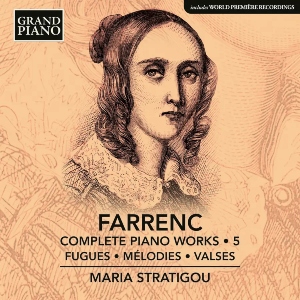
Louise Farrenc (1804-1875)
Complete Piano Works 5
Maria Stratigou (piano)
rec. 2024/25, Royal Northern College of Music, Manchester, UK
Grand Piano GP966 [60]
For the penultimate volume in this six-volume collection, Maria Stratigou turns to Louise Farrenc’s later piano music. For the most part, it moves away from the bravura variations and concert pieces that made up so much of her earlier work. A potted biography has appeared in previous reviews (GP912-13 ~ GP934 ~ GP942 ~ GP965). Suffice it to say that all the music here except Six Fugues comes from the years after she was made professor of piano at the Paris Conservatoire, only the second female to hold that position. The conservatoire dignitaries did not get carried away, of course: she was only allowed female pupils and was paid less than the male professors, but it remains a worthy achievement.
Let us start with Farrenc’s earliest music here. The manuscript from November 1833 contains fugues numbered four to eleven, of which the fourth and fifth are written on four staves; that leaves the six fugues recorded here. Her publisher husband Aristide Farrenc’s letters suggest that the pieces may have been among a group of preludes and fugues that he had plans to publish. Nothing came of that, and only these fugues remain in manuscript – of the proposed preludes no trace has been found. The fugues may have been Farrenc’s preparation for move into chamber and orchestral works after writing almost exclusively for the piano. They are certainly accomplished. From the jaunty F major and reflective E flat major, they seem to grow in stature to the gravity of the C sharp minor that exudes calm with its thoughtful subject and the noble E minor.
We move forward a decade to the A flat mélodie, a lovely song without words, poised and unfussy; it moves the theme to the left hand where it is repeated in a more decorated fashion. The B minor impromptu from the following year seems to be wandering into contrapuntal writing, and generally evokes a courtly minuet. Three more mélodies appeared in the late 1850s, though only the more adventurous second number was published. The first has the feel of John Field’s nocturne with its triplet underlay and genial nature. The second is a different beast; it starts in much the same vein but its melody is more complex, adorned with an increasingly abundant amount of Chopinesque decoration, florid bel canto in action. The third mélodie is different again, a hunting chorus in E flat with an agitated and dramatic E flat minor heart.
The light-hearted scherzo from the same period is a delightful piece, based on classical models rather than Chopin’s scherzi; one could imagine it in an early Schubert sonata. I like the humour of its ending, the running quavers left to scurry up the keyboard to a sudden quiet ending. Farrenc’s only known nocturne can be placed alongside her mélodies with its gentle barcarolle, lilting tune, layers of filigree decoration and dramatic minor key sections.
That leaves the two waltzes, more akin to Weber, though the opening dotted note theme of the first reminded me of Chopin’s Ecossaises. They are charming and elegant sequences of waltz in rondo form that do not roam too far harmonically. Requiring a polished but not too advanced technique, they would doubtless have been a hit with domestic music makers.
Maria Stratigou approaches all this with her usual deft touch. She brings us a different view of Farrenc’s piano music, one that has left the giddy world of the concert hall behind. It is an excellent addition to this interesting series, and a welcome respite before the final volume of her variation sets and of the series as a whole. That volume will focus on her more mature sets, including the Air Russe that was praised by Robert Schumann.
Rob Challinor
Contents|
Trois Mélodies Op.43 (1858)
Scherzo Op.47 (1858)
Valse Brilliante (No.1) Op.48 (before 1851)
Nocturne Op.49 (1862)
Valse Brilliante No.2 Op.51 (1864)
Six Fugues Op.22 (1833)
Mélodie in A Flat major (c.1842-1846)
Impromptu in B Minor (1843)
Buying this recording via the link below generates revenue for MWI, which helps the site remain free













