
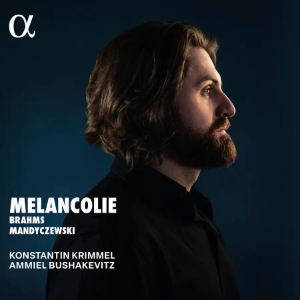
Melancolie
Konstantin Krimmel (baritone)
Ammiel Bushakevitz (piano)
rec. 2025, B-sharp studio, Berlin, Germany
Alpha Classics 1258 [74]
Johannes Brahms is one of the most familiar and important composers of the 19th century. Few, however, could tell you much about his friend and fellow Viennese citizen Eusebius Mandyczewski, born in the easternmost fringes of the Habsburg Empire near Czernowitz in what is now Ukraine. The son of an Orthodox priest, he retained a connection to the faith all his life, even after his move to Vienna. He studied music there, and benefited from a scholarship; Brahms himself sat on the rewarding committee.
Coupling the two composers makes sense, not least because both were immigrants to Vienna and both, therefore, had mixed identities as a theme in their backgrounds. That also makes baritone Konstantin Krimmel a good choice of exponent for their music: he grew up between Romania and Germany. Pianist Ammiel Bushakevitz has a mixed background, too: born in Jerusalem and raised in South Africa. The booklet note also makes the point that Mandyczewski’s Romanian songs are recorded in Romanian for the first time, which benefits from Krimmel’s bilingual skills.
None of this would matter were Mandyczewski’s music not worth discovering, but it is a compliment to him that you generally do not notice a dip in quality between his songs and Brahms’s. (They are interspersed here, a handful of Mandyczewski following a handful of Brahms.) True, there is a slightness to Mandyczewski’s songs in comparison to the profound emotional statements of Brahms. He tends to go for strophic, folky songs, often comprising a narrative of some kind. Brahms says more in the eight lines of Lerchengesang than Mandyczewski does in, say, the eighteen lines of Mândruliţă. Yet there is room for both, of course, and Mandyczewski’s songs are lyrical jewels. Krimmel sings them with total commitment, at his finest in the arching love lyric of La o copiliță, or in the cheeky flirtation of Cinel-cinel. There is some Schubertian nature-worship in Primăvara cea verzie, and classic Romantic defiance in În zadar, alongside the gentle confiding of Senin şi furtună. The excursions into dark melancholy, with which the disc ends, are not as convincing.
Krimmel’s dedicated approach to Mandyczewski feeds a nagging suspicion that it is his songs that are the disc’s real raison d’être, because next to them much of the Brahms feels dutiful and not really as committed. Expressive as Krimmel’s voice is, there is a breathy quality which becomes rather intrusive, particularly in Brahms’s songs, as though he is trying to confide so closely in the listener that he has to whisper some of the words. That gets in the way of softer songs like Unbewegte laue Luft or Die Mainacht. Even in the high passion of songs like Es schauen die Blumen or Meerfahft there is a sense of trying to emote so intensely that the artifice is too obvious to have an effect. Compared to Mandyczewski’s, Brahms’s variety of nature worship is, naturally, much deeper and more accomplished in Sommerabend, but it is not sung with as much excitement or engagement. While the songs of suffering are better, with a genuine range of expressive emotion to Mondenschein, the Brahms half of the disc is not as persuasive as the half dedicated to Mandyczewski.
So, it is difficult to recommend this disc wholeheartedly when Brahms’s songs have been persuasively recorded elsewhere, not least by baritones as majestically great as Fischer-Dieskau or, more recently, Christian Gerhaher and Florian Boesch. Mandyczewski’s songs are the USP, but the disc as a whole is not so much of a draw when the less familiar music is the more recommendable half. Flawless throughout, however, is Ammiel Bushakevitz’s deeply expressive piano line. He always finds the correct emotional temperature and plays up to it, on the whole, more consistently successfully than Krimmel’s voice does. It seems incidental to observe that the booklet includes full texts and translations.
Simon Thompson
Buying this recording via the link below generates revenue for MWI, which helps the site remain free
Contents
Johannes Brahms (1833-1897)
49 German Folk Songs, WoO 33: No. 29, Es war ein Markgraf überm Rhein
Auf dem Kirchhofe, Op. 105 No. 4
Unbewegte laue Luft (No. 8 from Acht Lieder und Gesänge, Op. 57)
4 Lieder, Op. 96: No. 3, Es schauen die Blumen
4 Gesänge, Op. 43: No. 2, Die Mainacht
4 Lieder, Op. 96: No. 4, Meerfahrt
6 Gesänge, Op. 3: No. 4, Lied aus dem Gedicht Ivan
Lieder (6), Op. 85, No. 1, Sommerabend
No. 2, Mondenschein
5 Gesänge, Op. 72: No. 3, O kühler Wald
4 Gesänge, Op. 70: No. 2, Lerchengesang
4 Lieder, Op. 96: No. 1, Der Tod, das ist die kühle Nacht
4 Lieder, Op. 46: No. 4, An die Nachtigall
Feldeinsamkeit, Op. 86 No. 2
Eusebius Mandyczewski (1857-1929)
Cântece romăneşti, Op. 7, No. 3, Lăcrimioare
No. 1, La o copiliță
No. 15, O Zi
Fa Mariţă
Cântece romăneşti, Op. 7, No. 17, Cinel-cinel
No. 5, Primăvara cea verzie
No. 12, În zadar!
Cântece romăneşti, Op. 7, No. 7, Mândruliţă
No. 9, Frumoasă copiliţă
No. 13, Senin şi furtună
Cântece romăneşti, Op. 7, No. 16, Mormântul
No. 18, Omul singuratic













