
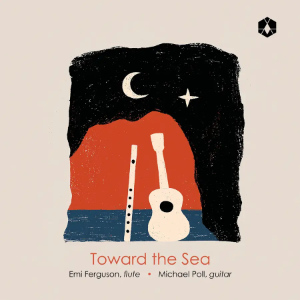
Toward the Sea
Astor Piazolla (1921-1992)
Histoire du Tango (1985, arr. flute and guitar)
Elizabeth Ogonek (b. 1989)
Altair (2012, arr. Poll & Ferguson)
Tōru Takemitsu (1930-1996)
Toward the Sea for alto flute and guitar (1981)
Emi Ferguson (flute)
Michael Poll (guitar)
rec. 2022, Stone Church Cultural Center, Gilbertville, USA
Orchid Classics ORC100494 [38]
This collaboration between guitarist and conductor Michael Poll and flautist Emi Ferguson offers three quite diverse works for those two instruments: the first a kind of mini-tour, in a series of four vignettes, of the history of the tango, the second inspired by one of the brightest stars in the night sky and the third an “oceanic”, three-movement work written for Greenpeace ‘Save the Whale’ campaign in 1981.
From the first airy notes and the thwack and thrum of the tattoo on the guitar body – a knock on the door demanding entrance to the house of ill repute – the sound here is extraordinary vivid and immediate such that the listener feels as if he or she is present in an intimate concert venue. The insistent rhythm is wild and vivacious, contrasting neatly with the lazy, sensuous cantilena of the second movement, Café; there are surely echoes of Debussy and Ravel in this languorous, long-breathed music. Nightclub is at first similarly lyrical but its central section is spiced with jazzier rhythms and harmonies; the coda is piquant and striking. The fourth and final movement is more overtly “modern” in its tonal language and key clashes, echoing Stravinsky and Bartók.
Altair is appropriately mysterious and suggestive of vast space, though somewhat shapeless and meandering compared with the taut structure of the preceding work. I find that it outstays its welcome as the unearthly spookiness is sustained over six minutes.
Takemitsu’s sea music is likewise somewhat amorphous; the flautist is often asked to employ flutter-tonguing to replicate or imitate the sound of wind over the guitar’s watery arpeggios – all highly atmospheric but the ear struggles to latch on to shapes or themes. It is hard to make much of a meaningful connection between the names of the movements with the music itself and the prevailing sentiment is doleful – and in comparison with the Piazolla tetralogy, rather unvaried in mood, even if the final movement, Cape Cod, is livelier.
An interesting and unusual programme, then, although my own preference leans very heavily towards the pictorial tangibility of the tango music, while others may better appreciate the otherworldly effusions of the works by Ogonek and Takemitsu. I must also concede that in my haste to post a review, I probably hadn’t given those works sufficient airing in order to let the music seep into my consciousness.
Ralph Moore
Buying this recording via the link below generates revenue for MWI, which helps the site remain free













