
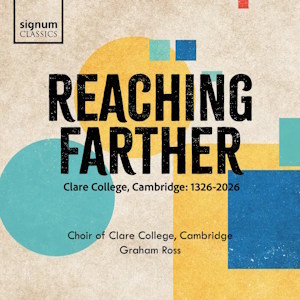
Reaching Farther
The Choir of Clare College, Cambridge/Graham Ross
Evie Perfect and Jacob Costard (organ)
rec. 2024-26, Fairfield Halls, Croydon & St Barnabas Church, Ealing, London
Texts and English translations included
Signum Classics SIGCD1013 [74]
Clare College is one of the most venerable of all the colleges which constitute the University of Cambridge; it was founded in 1326. This disc has been issued as part of the celebrations of the college’s 700th anniversary. Its choir is a more recent foundation. Indeed, as Graham Ross makes clear in his very useful booklet essay, the musical life of Clare College Chapel was significantly restricted until an SATB choir was established as recently as 1972. In the subsequent 54 years the choir, under the direction first of Peter Dennison and then his three successors, Sir John Rutter Timothy Brown and Graham Ross, the choir’s reputation has steadily risen and for quite some time it has been widely regarded as one of the leading Oxbridge collegiate choirs.
For this celebratory disc Graham Ross has had the happy idea of putting together a programme of music commissioned for and/or closely associated with the choir. Fifteen composers are represented here and only one, Denis Brown was born before the twentieth century. Indeed, almost all of the composers were born after the Second World War, four of them in our present century. All the pieces, except those by Matthew Martin, John Tavener, Cecilia McDowall and John Rutter here receive their first recordings. Since almost all the pieces will be unfamiliar to most readers, each merits separate commentary. The programme divides, broadly, into a similar structure to that of Evensong: four Introits are followed by several approaches to the Evening Canticles; then come two Anthems, a couple of Festive Motets and, very appropriately, three concluding Prayers.
I’ve admired a lot of music by Matthew Martin in the past. His Haec dies was commissioned by Ross in 2016. It sets Easter texts to music that is often spiky and rhythmically vital. Martin is a fine organist so it’s no surprise that there’s an important organ part, despatched with flair by Evie Perfect. A few calmer sections provide good contrast with the prevailing mood of celebratory energy. After so much vitality, the soft close, in which only upper voices and organ are used, comes as a bit of a surprise – in a good way.
Vivek Haria’s Lord, I cry unto thee, commissioned in 2021 was written in the shadow of the Covid lockdowns. Haria was then an undergraduate at Gonville and Caius College and his time at Cambridge must have been blighted by the Covid restrictions. Unsurprisingly, perhaps, his piece, which is a setting of two verses from Psalm 141, is slow-moving and intense. The piece is for unaccompanied choir and it strikes me as effective and impressive. Luca Zucchi read music at Clare and was a Choral Scholar. His Drop, drop, slow tears was composed in the 400th anniversary year of Orlando Gibbons, who set this same text. Zucchi’s composition is, I presume, a homage to Gibbons but it’s very much of the twenty-first century. He uses dissonances and chromatic harmony to excellent expressive effect, notably at the start of the third stanza of Phineas Fletcher’s poem (‘In your deep floods..’), where the high-lying, beseeching soprano line really caught my ear.
The final piece in the Introit section is Òrìşà bí òfun kò sí (There is no deity like Oesophagus) by Ayo Bankole. Graham Ross tells us that Bankole was an Organ Scholar at Clare between 1961 and 1964. In 1966, he returned to his native Nigeria but, tragically, he and his wife were murdered by Bankole’s half-brother in 1976. It seems that Ross had to make a good deal of effort to track down this piece but his efforts were worthwhile. Òrìşà bí òfun kò sí is a setting for double choir (upper voices only) of a Yoruba proverb. The piece is inventively written for the voices and here it receives a suitably lively performance. It’s good that this Clare alumnus has been remembered by Ross and his choir.
The first set of Evening Canticles we hear is by Héloise Werner, who read Music at Clare and was a Choral Scholar (2010-13). Interestingly, the two canticle settings weren’t commissioned together. The Magnificat, which is set for a cappella voices in Latin, was commissioned in 2023 to mark the 50th anniversary of co-education at the college – as was the piece by Cecilia MacDowall, which comes later in the programme. I’m afraid I don’t warm to it at all. As Graham Ross describes it, much of the setting “is hocketed with interlocking parts between the voices, which themselves freely alternate between unpitched whispering and pitched notes”. Other listeners will probably find more in it, but it’s not for me. The Nunc dimittis was commissioned in 2026 for the college’s 700th anniversary. Like its companion it is a cappella and in Latin. I like this much more. The music is gentle and radiant and it’s all sung – and much the better for it. Werner unifies her canticles by using the same ‘Glory be’ in each.
Graham Ross composed his own set of Evening Canticles in 2024. These are for choir and organ; the English texts are used. The music is much more obviously in the English tradition than Héloise Werner’s settings but, that said, Ross is very much his own man and no slave to the tradition. In the Magnificat I found the harmonic language and word painting both effective and intriguing. The ‘Glory be’ is ecstatic, though it ends quietly. The Nunc dimittis, which features an important bass solo, is dark and solemn at first. We don’t hear the sopranos and altos until ‘To be a light’, when their involvement imparts a luminosity and radiance to the music which is very pleasing. The same ‘Glory be’ is used. I think Thomas Alban must still be at Clare; Ross tells us that he began his studies in music there as recently as 2024 and, as a Choral Scholar, he sings on most of the tracks on this album. His Nunc dimittis, which I think is a standalone composition, is for a cappella double choir. Alban sets the text in Latin. The music is slow and solemn, even in the ‘Glory be’, and the harmonies are searching. This is, perhaps, a more introverted and less warmly voiced response to the text than I’m accustomed to hearing but it’s a skilful and interesting composition.
I don’t think I knew that William Denis Browne was a Clare alumnus. Browne, a close friend of Rupert Brooke, was one of that lost generation of highly talented men who perished in World War I; like Brooke, he was a casualty of the Gallipoli campaign in 1915. Today, he’s chiefly remembered by a handful of songs, including the outstanding To Gratiana dancing and singing (1913). I don’t think I’ve ever heard any music by Browne, other than his songs. His Evening Canticles were composed while he was still an undergraduate at Clare – were they ever sung in the college chapel during his student days, I wonder? They are largely homophonic and very much in the tradition of Anglican choral music of their time. The music is well written for choir and organ and I’m glad to have had the opportunity to hear them. The highlight in the Magnificat is, for me, the episode which includes a lovely soprano solo (‘He remembering his mercy’). The start of the Nunc dimittis is set to homophonic music which is touching in its simplicity. At ‘To be a light’ the music becomes big and confident. The ‘Glory be’ is common to both canticles.
The first of the two pieces in the ‘Anthems’ section is most unusual. Graham Ross explains that Giles Swayne’s The Dug-Out originated as the concluding song in a cycle for tenor and piano, The Kiss (1967). This cycle consisted of settings of poems by Siegfried Sassoon (1888-1967), himself an alumnus of Clare College. Forty years later, while acting as composer-in-residence at Clare, Swayne arranged the song for choir and organ, adding an epilogue and postlude in which a solo trumpet, played by Imogen Whitehead in this performance, sounds the Last Post. The text which Swayne sets here voices, I believe, the words of a soldier in the World War I trenches, addressing a dead comrade. It’s an interesting, thoughtful piece and one, moreover, in which, inevitably, there’s a lot of intensity and some bitterness. I’m very glad that the piece has been included, though I struggle to work out how it might fit into a liturgical context; even on Remembrance Sunday the imagery of the poem and the stark music might not be felt quite to fit.
Just recently, I reviewed a disc of music which Nico Muhly has written over the years for The Tallis Scholars. It would appear that he has had a similarly fruitful association with the Choir of Clare College. Reaching Farther was commissioned by Graham Ross for the college’s 700th anniversary. Muhly’s choice of texts was as discerning as it was perceptive. He has set words by three writers from the 16th to the 18th century, including some by Thomas Traherne. The chosen words enable Muhly to celebrate, as Ross puts it, “what it means to learn and study, and to be at university. As someone who had the privilege of a university education over fifty years ago, I found Muhly’s conception, as expressed by his chosen writers, genuinely moving. As I’ve found with other music by Nico Muhly, he has a natural facility for writing for voices and Reaching Farther offers another fine example of this. The piece is memorable and, in the sentiments it expresses, a most imaginative way to celebrate Clare College.
Under the heading of ‘Festive motets’ we hear John Tavener’s Rocking. This is a movement from a substantial (38-minute) Christmas sequence, Ex Marian Virgine which was commissioned by Clare College and premiered in 2008 by the choir under Ross’s predecessor, Timothy Brown in 2008, the year in which they recorded the complete work. That recording was reviewed by my late colleague Brian Wilson. I haven’t listened to that disc for quite a while but hearing this present, beautifully nuanced performance of what Graham Ross rightly refers to as “an exquisite miniature” made me keen to experience the full work again. Cecilia McDowall’s The Magi was commissioned to mark the 50th anniversary of co-education at Clare College. McDowall set a bespoke text by Nicholas Dakin (b 1949). the setting is for a cappella choir and McDowall’s energetic music allied to Dakin’s words covey a very good impression of the rigours of the Magi’s journey to Bethlehem. It’s a very good piece.
To conclude, we hear three pieces grouped together as ‘Prayers’. First comes Now the day is over by Joshua Pacey, a former Choral Scholar at Clare (2013-16). Pacey set words by a fellow alumnus, Sabine Baring-Gould (1834-1924). He was the author of hymns such as Onward Christian Soldiers but I know him best as the translator of the carols, Sing Lullaby and Gabriel’s Message. Pacey’s a cappella setting of Now the day is over is very lovely. The music is essentially homophonic and it catches beautifully the mood of simple faith expressed in the words. Joshua Pacey read music at Clare but Simon Hall was a student of Philosophy at the college (2022-25). Graham Ross relates that Hall contacted him and asked if he might show him a short choral piece that he had written; this was Lighten our darkness, a setting of the Third Collect for Evening Prayer. Remarkably, this was the first piece that Hall had written for voices, which makes his achievement all the greater. It’s a homophonic setting of great sensitivity. The harmonies are marvellous and they cloak lovely melodic lines. I was seriously impressed by this tranquil, serene piece. At the end, the word ‘Amen’ is sung repeatedly, as if the choir is reluctant to take their leave of us.
Such a programme would not be complete without a contribution from John Rutter, the second Director of Music at the college and on whose watch the Clare College choir first came to prominence outside Cambridge. His A Clare Benediction was written at the request of his successor, Timothy Brown; Rutter wrote the words as well as the music. It’s a quintessential example of the composer’s work, soothing, melodious and sincere. Graham Ross tells us that he always programmes it as the concluding item in the Clare College Graduation Service. This means that for those singers who are leaving, this little gem is the last music they sing as members of the Clare College choir; it must be a most affecting envoi for them, as it is for those of us who listen to this disc.
The Choir of Clare College is one of the jewels in the crown of this ancient college and it’s very fitting, therefore, that this disc is such a fine celebration of the college’s 700th anniversary. Ancient the college may be but, as this programme demonstrates in spades with its raft of recent commissions, the choir plays a very active part in keeping the college’s traditions renewed and right up to date. The disc also offers abundant proof of the very high quality of the choir’s singing under Graham Ross’s direction. The performances are impeccable but also, depending on what music is being sung, either sensitive or full of vitality. Evie Perfect and Jacob Costard, the Organ Scholars at the time of these recordings, share the accompanying duties; both of them make excellent contributions.
Fittingly, the recording has been engineered and produced by Sir John Rutter, who habitually deals with the technical side of the choir’s recordings. It’s great to see that he remains so engaged with the choir which he did so much to establish in its early days. The sound quality is excellent, as is Signum’s documentation.
John Quinn
Buying this recording via the link below generates revenue for MWI, which helps the site remain free

Contents
Matthew Martin (b 1976) – Haec dies (2016)
Vivek Haria (b 2000) – Lord, I cry unto thee (2021)
Luca Zucchi (b 2002) – Drop, drop, slow tears (2025)
Ayo Bankole (1935-1976) – Òrìşà bí òfun kò sí
Héloise Werner (b. 1991) – Magnificat (2023) & Nunc dimittis (2026)
Graham Ross (b. 1983) – Magnificat & Nunc dimittis (Clare Service) (2024)
Thomas Alban (b. 2005) – Nunc dimittis (2025)
William Denis Browne (1888-1915) – Magnificat & Nunc dimittis in A (1911)
Giles Swayne (b. 1946) –The Dug-Out (1967 / 2007)
Nico Muhly (b. 1981) – Reaching Farther (2026)
Sir John Tavener (1944 – 2013) – Rocking (2008)
Cecilia McDowall (b. 1951) – The Magi (2023)
Joshua Pacey (b. 1995) – Now the day is over (2020)
Simon Hall (b. 2003) – Lighten our darkness
Sir John Rutter (b. 1945) – A Clare Benediction (1998)













