
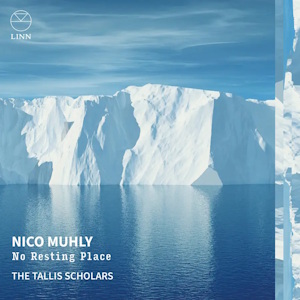
Nico Muhly (b 1981)
No resting place
A Glorious Creature (2023)
Recordare, Domine (2013)
Marrow (2017)
Prosperite (2023)
Rough Notes (2018)
No Resting Place (2022)The Tallis Scholars/Peter Phillips
rec. 2024, Merton College Chapel, Oxford, UK
Texts included
Linn CKD790 [55]
This is a remarkable release in quite a number of ways and one is that it has been issued on the Linn label. The Tallis Scholars’ first recording, their famous disc containing the Allegri Miserere and music by Mundy and Palestrina, was released, if memory serves me correctly, on the Classics for Pleasure label. Since then, I think I’m right in saying that all their recordings have been released on their own label, Gimell – on which the Allegri disc was later reissued (review). On the Linn website we read that “This album marks the start of a new collaboration between The Tallis Scholars and Linn.” I wonder if this means that Linn will handle all the group’s future releases.
As Peter Phillips remarks in an introductory note, The Tallis Scholars only sang Renaissance polyphony in their early years as an ensemble but over time they began to complement this repertoire with a select amount of contemporary music. Perhaps their most fruitful collaboration has been with the American composer, Nico Muhly. This album includes, I think, all the pieces that he has written for them to date; everything here is presented in premiere recordings. With one exception – which demands to be treated out of sequence – I’m going to consider the works in chronological order, even though this isn’t how they’re presented on the CD.
Muhly’s first collaboration with The Tallis Scholars was Recordare, Domine (2013). This is a setting of some verses from the Book of Lamentations, scored for SATB. It seems to me that Muhly caught, from the outset, both the sound and the spirit of The Tallis Scholars. Furthermore, I believe that this music, though undeniably contemporary and in no way derivative, would sit very well in a programme of Renaissance polyphony. Indeed, I’d go further and say that this piece definitely takes its place in the lineage of other, much earlier musical settings of the Lamentations. Muhly’s music is slow, meditative yet dramatic and the harmonic language is very intense. I found the way he sets the word ‘Jerusalem’ for the soprano voices particularly moving; this is a genuine lament. I think this is a fantastic setting.
Moving on to 2017, we hear Marrow. This is another SATB piece. The text is from Psalm 63 and the slightly unusual title comes from a line in the psalm which reads ‘My soul shall be satisfied, even as it were with marrow and fatness’. Muhly has set the words to strange, introspective music – I do not use the word ‘strange’ pejoratively. For the most part, the words of the psalm are sung by the male voices while the female voices contribute intriguing harmonies around the text.
Rough Notes for SATB comes from 2018. In it, Muhly sets two extracts from the journal kept by Captain Scott during his heroic but doomed expedition to the Antarctic in 1911-12. The composer writes in the booklet that here his music “is all to do with cold textures: austere pieces of counterpoint, unstable harmonies, and a sense of the inevitable”. The first section sets words in which Scott describes seeing the aurora australis in 1911; here, Muhly’s music conveys a genuine sense of awe and wonder. Around 4:03 there’s a complete change of tone as we hear the choir sing Scott’s words written as the explorers’ fate became inevitable (‘For four days we have been unable to leave the tent’). From here on, solemnity and word-painting combine. The setting of the very last line is especially moving as first the ensemble and then a lone soprano sing ‘These rough notes and our dead bodies must tell the tale’. Muhly’s piece is moving on many levels.
In complete contrast, A Glorious Creature (2023) is a setting of words by Thomas Traherne (c 1637-1674) in praise of the sun. The piece was written, at the request of Peter Phillips, to celebrate the 50th anniversary of The Tallis Scholars and, as Muhly comments, a piece that was “bright and radiant” seemed appropriate. The resulting piece, written for 10-part choir (SSSSAATTBarB), definitely meets that criterion. That said, the music isn’t always extrovert and ecstatic; there are also some highly effective episodes where the music is much more restrained and thoughtful. It’s a remarkable piece which I liked very much.
As well as the 50th anniversary of The Tallis Scholars, there was another noteworthy event in 2023: Peter Phillips celebrated his 70th birthday. Apparently, a party was held on a boat. Muhly relates that Phillips had said there should be no singing at the event. I guess it was never likely that such an injunction would be obeyed. Muhly composed Prosperite for the occasion, scoring it for the same forces as A Glorious Creature. He says that he felt that the music should be akin to a toast. The piece was duly rehearsed, in secret, for less than ten minutes before the partygoers embarked. Muhly discerningly chose to set a verse from Psalm 1, which begins ‘And he shall be as a tree, which is planted beside the runnings of waters’. The music dances joyfully. At the party, Muhly himself directed the singers; this time, Phillips conducts his own birthday present. It only lasts for 1:38 but it’s a delightful – and virtuoso – gift.
I said there was one piece that demanded to be considered out of chronological order. This is No Resting Place (2022). This is, by some distance, the longest piece on the programme; it plays for 24:42. Muhly says that Peter Phillips asked him to write a set of Lamentations, perhaps as a continuation of Recordare, Domine. At the time that the request was made, Muhly had been reading a lot about the immigrants who came from the Caribbean countries to the UK after the Second World War, who have become known as the ‘Windrush’ Generation. They suffered discriminatory treatment and Muhly paralleled their experience with that of the immigrants into the USA who came to be labelled the ‘Dreamers’. In the libretto for No Resting Place, which I presume Muhly compiled himself, he sets five verses (in Latin) from the Book of Lamentations, marrying each one with a brief extract from comments made by someone connected with the ‘Windrush’ Generation. As an aside, one of these five contemporary comments consists of some words by the senior Labour Party politician, David Lammy, MP. His thoughts earn their place by right in this libretto but it’s a nice coincidence that Lammy’s words should be included in a choral work because, years ago, he himself was a chorister at Peterborough Cathedral.
No Resting Place is another work scored for twelve voices. It’s a powerful score that should – and does – prompt reflection on the part of the listener. Interestingly, though, despite the fact that the members of the ‘Windrush’ Generation were very badly treated, this is not a score of rage. ‘Migravit Judas’, the third of the five movements – which play continuously – is jagged and much more dramatic than the rest of the music but otherwise the tone is predominantly regretful and thoughtful; this very restraint increases the impact, I believe. In each section, the Latin text is sung first by the choir to music that I might describe as traditional yet contemporary. The modern reflections are set in a very direct fashion. Usually, the contemporary words are sung by a single voice, wordlessly accompanied by the rest of the group; the exception is the final reflection, a setting of some words by the Bishop of Croydon, Dr, Rosemarie Mallett; these are sung by the full choir. As the piece draws to an end (tr 10 from about 3:40) Muhly sets the refrain ‘Jerusalem, Jerusalem, convertere’; the way that this segues seamlessly from Dr Mallett’s words is very affecting.
I think No Resting Place is a very successful work on several levels. The way Muhly has combined ages-old words of lamentation with contemporary expressions of sorrow and injustice works extremely well; nothing about the bringing together of the ancient and modern texts jars. Strong emotions are conveyed in the work – and rightly so – but unlike one or two other musical works which I’ve heard in which injustices are addressed, I never got the feeling that the listener was being harangued; in my view, that enhances the impact of the work. And, finally, much of the music is very beautiful. No Resting Place made a very strong impression on me and that impression was reinforced by the flawless and intense performance by The Tallis Scholars.
This is a most rewarding disc. Don’t, whatever you do, judge it by the relatively short playing time; this is a case where less means more. All the pieces are very impressive and it’s evident that the creative relationship between Nico Muhly and The Tallis Scholars has already been an extraordinarily fruitful one; I hope he’ll write more for them. The performances are consistently superb and Muhly’s music, though undoubtedly challenging to sing is also, I’m sure, very rewarding for the singers; there isn’t one ugly note or effect in this programme, instead, Muhly shows an intuitive understanding of how to write for voices – and, of course, for this particular collection of voices.
This may not be a Gimell release but that label’s production values are replicated here. The recordings were made in the group’s familiar venue, the Chapel of Merton College, and engineer Philip Hobbs, who is well experienced in recording them there, has once again produced recorded sound of great fidelity. The documentation, which includes a fine introduction to the pieces by Nico Muhly himself, is excellent
John Quinn
Buying this recording via the link below generates revenue for MWI, which helps the site remain free













