
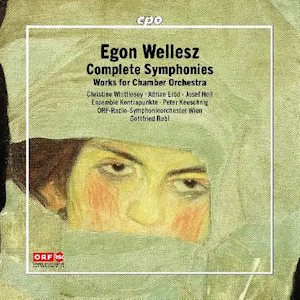
Egon Wellesz (1885-1974)
Complete Symphonies & Works for Chamber Orchestra
ORF-Radio-Symphonieorchester Wien/Gottfried Rabi
Ensemble Kontrapunkte/Peter Keuschnig
rec. 2001-09, Großer Sendesaal, Funkhaus ORF, Vienna
Texts and English translations included
cpo 555 739-2 [5 CDs: 330]
Egon Wellesz was an Austrian composer of Jewish background, who later converted, first to Protestant Christianity and later to Roman Catholicism. He was one of the first pupils of Schoenberg, who remained his friend and about whom he wrote a book, but was never counted as one of his disciples or considered a member of the New Viennese School, though he could have been. During the 1920s and most of the 1930s he had a flourishing dual career in Vienna, both as a musicologist with a specialist knowledge of Byzantine chant, and also as a composer mainly of operas. At the time of the Anschluss, Hitler’s take over of Austria in 1938, he was in England, where he remained. He obtained an academic position at Oxford university and, after a hiatus of five years, began to compose again. However, like some other Jewish composers who emigrated to Britain, such as Hans Gal, Berthold Goldschmidt and Matyas Seiber, his music gained little recognition in his adopted country. Most of his symphonies were premiered in Vienna, where he would have liked to return, but he was never offered another position there.
His nine symphonies all date from his time in England. He began very much in the tradition of Bruckner and Mahler, and echoes of their works can be heard in the earlier ones. However, all his symphonies are much shorter than theirs. Although his idiom changed over the years, there are strong similarities across all of them. The first symphony shows the pattern. The first movement begins with a sombre opening, features a lyrical second subject, a vigorous development and an elaborated recapitulation. Later, the sonata forms would become blurred with a tendency to continual development. This is followed by a lightly scored and fastmoving scherzo – Wellesz differed from the Schoenberg school in having, at least occasionally, a strong rhythmic drive. The finale is a Mahlerian threnody.
The second symphony, subtitled The English, was written in a deliberate attempt to write something which would be attractive to English audiences. The more Schoenbergian aspects of his idiom are abandoned and I even caught echoes of Vaughan Williams – the fourth and fifth symphonies – though Wellesz professed to have no interest in English composers. This is in four movements, and is the longest of the symphonies, lasting over forty minutes. It is in four movements, but again we have the sombre opening, the lyrical second subject and so on. The scherzo is playful and light-hearted, as is characteristic of most of Wellesz’s scherzos. There is a hint of Prokofiev about them. In this symphony we have a solemn adagio and a varied finale with three main themes handled in sonata form.
In the third symphony I particularly noted the pizzicato low strings in the Adagio and the rather Hindemithian finale. The fourth symphony, subtitled Sinfonia Austriaca, is rather similar, though here the solemn Adagio brings echoes of Bruckner and Wagner.
With the fifth symphony, Wellesz adopts a rather different idiom, less late romantic and much closer to the expressionism of middle period Schoenberg or of Berg, though of course he was writing much later than them. In fact he uses serial technique in this work, and continued to do so occasionally for the rest of his career. The wide intervals and pungent brass interjections are typical of this later manner. The scherzo is lively, as before, but this time somewhat sinister and the finale is another threnody.
I consider the last four symphonies together, because they are so similar to one another. However, they get better as they go on. Again we find the sombre and minatory openings, with the brass prominent, Otherwise, the textures are somewhat thinner than before, with a good deal of prominence given to woodwind solos. The most impressive of the opening movements is that of symphony 8, in an idiom very close to Berg and early Schoenberg. The scherzos continue to be light-hearted, strange and enigmatic in the sixth, playful in the seventh and ninth, and positively skittish in the eighth. The finales tend to be slow, or at least start slow, with the brass often prominent.
The Symphonic Epilogue is a single movement, which takes some time to get going. In the middle there is an exciting Allegro before a slower end. The idiom is that of the later symphonies.
This cycle has been a real labour of love by the conductor Gottfried Rabi. The scores, and also presumably the playing materials, were in poor condition, having mostly not been properly proofread or printed. He spent a good deal of time putting them into order before leading the orchestra through them. They cope really well, although in a few passages their playing sounds like inspired sight-reading, and one or two passages are slower than they should be. As for the works themselves, my opinion is mixed, Wellesz had good ideas, often arresting and sometimes beautiful. However, his symphonies are not integrated. There are too many changes of tempo and mood, so I tended to end up with the feeling that there was just one thing after another, which made the works seem longer than they are. However, if you are interested in what happened to the Austrian symphonic tradition after Mahler, this is one place to go.
There is a bonus disc, of works for chamber orchestra, which in practice often means just a handful of players. Sommernacht is an early work, in a late romantic idiom. It opens with a horn solo over a dreamy, shimmering accompaniment. The second half is given to a poem set as a declamation. It is an attractive piece. The little Movement for chamber orchestra lasts just over a minute but could be another of Schoenberg’s expressionist pieces. The Persichess Ballett is indeed a ballet and the scenario is given. This is a jolly little number, rhythmically buoyant and tuneful. The Suite for violin and chamber orchestra goes even further in this direction. There are four short movements, the whole taking less than twelve minutes and the idiom is neoclassical. Indeed, although this work dates from 1924, it seems to anticipate the idiom of Stravinsky’s violin concerto, which dates from 1931. All these works come from Wellesz’s Viennese period. The Four Songs of Return belong to his English period. There is a lyrical line in a free atonal but not especially dissonant idiom. The final Ode to Music is a late work, succinct and expressive.
The performances of the chamber works are assured and fluent; perhaps the players had had an opportunity to play them in public before recording them. Ensemble Kontrapunkte under Peter Keuschnig does a good job of them.
The recordings are all good and the sleevenotes very thorough. The five discs are neatly presented in paper sleeves in a smart box. The texts of the vocal works and translations are provided, though you have to search for them. If you want to explore Wellesz, this is the place to go.
Stephen Barber
Buying this recording via the link below generates revenue for MWI, which helps the site remain free

Contents
Symphony No.1 Op. 62 (1945-6)
Symphony No. 2 Op. 65 The English (1947-8)
Symphony No. 3 Op. 68 (1949-51)
Symphony No. 4 Op. 70 Sinfonia Austriaca (1951-3)
Symphony No. 5 Op. 75 (1955-6)
Symphony No. 6 Op. 95 (1965)
Symphony No. 7 Op. 102 Contra torrentem (1967-8)
Symphony No. 8 Op. 110 (1971)
Symphony No. 9 Op. 111 (1970-1)
Symphonic Epilogue Op. 108 (1968)
Sommernacht for Chamber Orchestra and Voice (1909 rev. 1912-3)
Movement for Chamber Orchestra (1920)
Persisches Ballett Op. 30 (1920 rev. 1924)
Suite for Violin and Chamber Orchestra Op. 38 (1924)
Four Songs of Return for soprano and Chamber Orchestra Op. 85 (1961)
Ode an die Musik for Baritone (or Alto) and Chamber Orchestra Op. 92 (1965)
Christine Whittlesey (soprano, in Four Songs), Adrian Eröd (baritone, in Sommernacht and Ode an die Musik), Josef Hell (violin, in Suite for Violin and Chamber Orchestra)













