
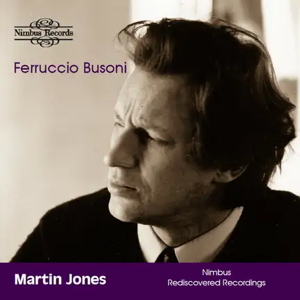
Ferruccio Busoni (1866-1924)
Ballet-Scene No.2 BV.209 (1895)
Six Pieces for Piano BV.241 (1895)
Indian Diary Book I BV.267 (1915)
Sonatina No.6, Chamber Fantasy on Bizet’s “Carmen” BV.284 (1920)
Three Album Leaves BV.289 (1921)
Ten Variations on Chopin’s Prélude Op.28 No.20 BV.213 (1922)
Martin Jones (piano)
rec. 1980, Wyastone Leys, Monmouth, UK
Nimbus Records NI7124 [68]
Earlier this year I wrote about Nimbus’s rediscovered Poulenc recital from Martin Jones, taped in Birmingham in 1972. Here is another find from the same archive. Jones recorded this Busoni programme in 1980. Six works span nearly four decades, from the Zweite Ballet-Scene of 1884, a teenage work, to the Chopin variations Busoni revised in 1922, two years before his death. Almost everything here shows Busoni inspired by somebody else’s material: Chopin, Bizet, a Bach chorale, Native American melodies, a Finnish ballad tune.
The recital starts with the second of the four Ballet Scenes (Jones had recorded No. 4 for Argo in 1973). As I say, it’s the work of a young man, but it has genuine polish and flair. It’s all about surface impressions, and Jones revels in the delicacy of the apparently magical tableau he’s required to depict. Rest assured, it’s considerably more demanding music to play than it sounds.
The Sechs Stücke of 1895–96 came at a pivotal point in Busoni’s compositional development, and both the opening rhetoric of ‘Schwermuth’ and the closing ‘Exeunt omnes’ are strongly reminiscent of another pianist-composer, Robert Schumann. Indeed, Jones plays the latter as if he’s been presented with the challenge of playing the finale to the Études symphoniques in 90 seconds. It’s very convincing. There’s fun too in the more ballet-inspired ‘Scherzino’, and a mysterious ‘Finnische Ballade’ invested with surprising darkness in this performance.
The four studies of the Indianisches Tagebuch use melodies given to Busoni by Natalie Curtis, the American ethnomusicologist whose The Indians’ Book had appeared in 1907. The same material had already produced the Indianische Fantasie for piano and orchestra. I’m not sure how obviously the reworked material reflects its sources but Jones’s playing of each of the studies has an engaging grandiloquence that comes off well.
The late pieces are intriguing. The Kammer-Fantasie is a dementedly difficult sonatina in which highlights from Carmen emerge in variously virtuosic forms. Jones plays it in an enjoyably deranged way, as a sort of inspired technical workout. The Drei Albumblätter are the least assuming music here and the most haunted. They form a suite assembled from other material rather than organically conceived. The first became the Arioso in (Busoni’s) Turandot; the second and third both found their way into Doktor Faust. The third takes Bach’s harmonisation of Christ lag in Todesbanden and promotes the tenor line into the top voice, where it becomes a theme in its own right. Jones captures the different mood of each perfectly and his realisation of the third has a spiritual depth that makes it stand apart from everything else on the disc.
The Chopin variations end the recital. They are actually the 1922 revision, BV 213a, not the 1884 original implied by the disc’s labelling of BV 213. In this later version the fugue is gone and a reduced number of variations (ten) run continuously. The famous theme from Chopin’s Prelude in C minor, Op. 28, No. 20 is clearly recognisable in the noodling of the opening bars before it is stated plainly, an arresting piece of theatre. Jones again relishes the variety and the technical challenge that comes with each. The compact contrapuntal writing is beautifully voiced, and he even makes a case for what sounds like a misplaced salon dance.
I assume this selection of largely unfamiliar pieces was conceived as a recital in 1980. But in any event, they work well as ordered here. Jones’s superb advocacy makes a compelling case for what a well-rounded keyboard composer Busoni was. The recorded sound is excellent. And although I enjoyed Adrian Farmer’s short interview with Jones and his note on the pianist’s long association with Nimbus, I’m sure many listeners would also have appreciated something about the programme itself. That 1973 Argo release had notes by the great Deryck Cooke. Those were the days.
Dominic Hartley
Previous review: Rob Challinor
Buying this recording via the link below generates revenue for MWI, which helps the site remain free













