
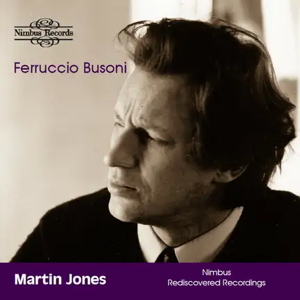
Ferruccio Busoni (1866-1924)
Martin Jones (piano)
rec. 1980, Wyastone Leys, Monmouth, UK
Nimbus Records NI7124 [68]
In my earlier collecting days, when my music collection was actually manageable, there were certain recitals I listened to frequently. They included two by Martin Jones, Virtuoso – Piano Showpieces (Nimbus NI5326), and a Radio Three recital, eagerly recorded on cassette, of transcriptions by Sergei Rachmaninov, Percy Grainger and Paul Pabst alongside Tchaikovsky’s Six Pieces Op.19. I was, and still am, fascinated by the golden age of the piano, and here was someone actually bringing those lost treasures to life. How special it is, then, to have this intrepid pianist’s rediscovered 1980 recital, recorded unsurprisingly in splendid sound.
The booklet includes a conversation between Jones and Nimbus music director Adrian Farmer. We hear the story of Jones’s early lessons, his rocky but ultimately successful time at the Royal Academy in London, later lessons with the great Guido Agosti and his introduction to Nimbus in 1972. His early visits produced Mendelssohn’s complete piano music on six CDs (NI1772) and the Poulenc recital which was the first of his rediscovered recordings (review). He recorded Rachmaninov and more Mendelssohn in the late seventies, and in 1980 returned with this enterprising release.
Most of Busoni’s vast output for the piano is now available, but at the time much of this would have been new to the catalogue; probably only the Carmen Fantasy, Indian Diary and one of the Album Leaves had previously appeared. Jones was evidently keen to increase Busoni’s discography. In 1973, he recorded the seven elegies and the fourth Ballet-Scene (Argo LP ZRG741). It is another ballet scene, the equally rare second one, that opens this recital. This wonderful and rather dazzling concert waltz, with a vivacious polka at its heart, has something of the riotous opening of the Carmen Fantasy to it. Those who think of Busoni as a serious, straight-faced composer should be prepared to think again after listening to this.
The same could be said of a couple of the works in the Six Pieces, notably Frohsinn (joy), a frothy but far from inconsequential fast waltz. This is Busoni letting his hair down, so it is no surprise that Jones chose to re-record the piece for inclusion in his Virtuoso disc. Schwermuth (melancholy), which opens the set, is chock-full of sweeping arpeggios, and has a heavy mournfulness that for me goes beyond melancholy. Scherzino is a remorseless little study in repeated notes for both hands. The Fantasia in modo antico shows Busoni’s love of counterpoint; an elegiac sarabande gives way to a toccata-like fugal section. In the Finnish Ballade – also cast in the form of a fantasy, quite dark-hued in mood – Busoni explores music inspired, one presumes, by his time in Finland where he met his soon-to-be wife Gerda Sjöstrand. The mood lightens in the final piece, a pompous and vigorous Exeunt omnes.
Jones continues with four works in Busoni’s mature style. He begins with Indian Diary, four movements based on Native-American tunes collected by Busoni’s one-time pupil, ethnomusicologist Natalie Curtis (1875-1921); he had already used some of them in his 1913 Indian Fantasy for piano and orchestra, dedicated to Curtis. The first piece is mysterious in its sliding chromaticism, and has elements of improvisatory writing in its mini-cadenza passages. The second is a short and virtuosic toccata. The third is reflective and heartfelt, though it does have uneasy moments, for instance the bitonality before the tranquil middle section. This unease can be heard in the central section of the final movement, but the mood is for the most part festive and heart-warming.
In the last of his six sonatinas, Busoni returns to opera transcription, a genre that he visited throughout his career – from the early fantasies on Goldmark’s Merlin or Cornelius’s Der Barbier von Bagdad to the masterful transcription of Siegfried’s Funeral March fromWagner’s Götterdämmerung.The protagonists from Bizet’s Carmen, a favourite of Busoni’s, are all here. Carmen’s devil-may-care swagger in the habañera, Escamillo’s egotistical posing and Don José’s lyricism are all introduced by the jostling, bustling festival crowd, and wrapped up in a dazzling catalogue of pianistic devices. But it is perhaps the haunting coda based on Carmen’s fate motif that makes the greatest impression.
There is a connection to opera in the three Album Leaves. The first, an air characterised by dotted rhythms and a melancholy mood, became an arioso in Busoni’s opera Turandot, while the other two made their way into Doktor Faust. The second is a short fugato with a chromatic subject that covers nine of the twelve tones in its first sixteen bars, and the third a choral prelude based on Bach’s Christ lag in Todesbanden.
Busoni based his Ten Variations on a Prélude by Chopin on an earlier, much longer set that he wrote in 1884 and dedicated to Carl Reinecke. Effective though that set was, Busoni returned to it nearly four decades later. He trimmed its half-hour length to a terse twelve minutes, and discarded many of the variations and the closing fugue. The result, a scintillating and breathtakingly virtuosic work, was published with a dedication to Busoni’s pupil Gino Tagliapietra.
From the opening bars, an uneasy re-harmonisation of Chopin’s prelude theme, Busoni brings this into his mature style, and he continues this with the variations. The first is similar to the 1884 version, a choral over rising thirds in the bass, but Busoni ups the tempo and makes textural changes as the third variation approaches. Again, there are similarities with his youthful work but this lasts just a few bars before he once more lets his hair down. The momentum seldom slows after this, with a kaleidoscopic array of keyboard colour and texture. A brief respite comes in the form of a cadenza-like fantasia, an idea taken from the first version, but here this leads to a finger-twisting gigue-come-scherzo finale.
The playing is first-rate. Had this recital been released at the time, it would surely have been recognised as a major addition to the Busoni discography. Indeed, it still does. It stands proudly alongside releases of his mature piano works by Marc-André Hamelin and others, and makes the best possible case for the relatively neglected earlier works. One can only hope that Busoni and Poulenc were not the only composers whose music lies in the untapped Martin Jones vault.
Rob Challinor
Other review: Dominic Hartley
Buying this recording via the link below generates revenue for MWI, which helps the site remain free
Contents
Ballet-Scene No.2 BV.209 (1895)
Six Pieces for Piano BV.241 (1895)
Indian Diary Book I BV.267 (1915)Sonatina No.6, Chamber Fantasy on Bizet’s “Carmen” BV.284 (1920)
Three Album Leaves BV.289 (1921)
Ten Variations on Chopin’s Prélude Op.28 No.20 BV.213 (1922)













