
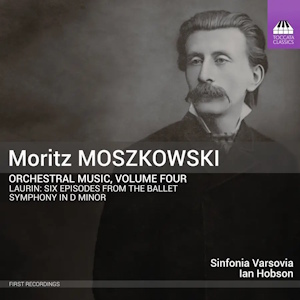
Moritz Moszkowski (1854-1925)
Orchestral Music – Volume Four
Symphony in D minor (1873)
Laurin: Six Episodes from the Ballet (1892-1895)
Sinfonia Varsovia / Ian Hobson
rec. 2022-25, Witold Lutosławski Concert Studio (S1), Polish Radio, Warsaw, Poland
Premiere recordings
Toccata Classics TOCC0615 [59]
Over the past seven years, the Toccata Classics label has issued three CDs featuring Moritz Moszkowski’s orchestral output performed by the Sinfonia Varsovia under Ian Hobson. Those discs have all been well received by my MusicWeb colleagues.
Jonathan Woolf found “much to like” in a “convincing” account of the early symphonic poem Johanna d’Arc. He was equally pleased, less than a year later, to have heard the second and third suites, music that caused him to describe Moszkowski approvingly as “a spinner of tunes and character, served up in ingratiating orchestrations that exist to please and titillate” and to characterise his orchestral output as “charming [and] uncomplicated”. If not actually titillated, Gary Higginson nevertheless thought the same performances of the suites “ideal” and considered that they “allow[ed] the music its best chance of finding an appreciative audience”.
Jonathan Welsh reviewed a further disc of the first suite, Prelude and fugue for strings, and Overture in D major with evident approval. Describing the overture as “confident, muscular… brimming with good tunes” and discerning, in the first suite, some “lovely orchestral writing… plenty of memorable tunes and some clever orchestration”, he concluded that he really needed to hear more of Moszkowski’s large-scale works. Having listened to the same disc, Jim Westhead thought that his own “high hopes [had] been largely fulfilled”.
Interestingly enough, Jonathan Welsh’s review had, in passing, made a plea for Hobson and his orchestra to turn their attention to Moszkowski’s early D minor symphony, a work only rediscovered, in manuscript form, as recently as 2009. This new release, the fourth in what appears to be an ongoing series, grants his wish and fills an important gap.
Moszkowski was something of a precocious composer. He wrote the D major overture when he was just 17 or 18 – at about the same time when he had joined Berlin’s prestigious Neue Akademie der Tonkunst as, rather amazingly, a member of the teaching staff. The ambitious symphonic poem Johanna d’Arc dates from his very early 20s. Moszkowski composed his one and only symphony between those two works, in the summer of 1873, when he was celebrating his 19th birthday.
A substantial piece, 36 minutes in this first-ever recording, the D minor symphony is conventionally structured in four movements. A synopsis on the CD’s rear cover describes it as “a strikingly assured work for a composer in his late teens… it owes a good deal to Schumann in its dancing rhythms, heraldic bearing and orchestral colours – and the scherzo might almost be by Mendelssohn on holiday in Poland”. Putting to one side the question of how a piece of music can exhibit “heraldic bearing”, that is a pretty accurate analysis as far as it goes. I think, though, that I would credit Moszkowski with a little more personality and individuality than the writer suggests.
The first movement, marked Maestoso – Allegro appassionato, più mosso, is the longest of the four. Its brief Maestoso introduction immediately demonstrates that, even as a teenager, Moszkowski was a master of effective orchestration. The following Allegro appassionato is immediately vigorous and declamatory. Although Schumann’s influence is very clear, Moszkowski’s already-noted skill successfully crafts a degree of transparency of orchestral texture that the older composer occasionally and notoriously failed to achieve. The movement’s quiet, thoughtful ending comes as something of a surprise. It indicates that even at that young age Moszkowski was thinking imaginatively and creatively, seeking to bypass anything in the way of musical clichés.
The second movement, marked Vivo, is appropriately driven, though a more relaxed section provides a moment or two of welcome contrast. Unsurprisingly, given Moszkowski’s Polish background and the contemporary taste for introducing “national” elements into music, there are also a few hints of folk tunes. Once again, it is the sophisticated orchestration that stands out – in this case with some particularly well-crafted writing for the woodwinds. That is also a feature of the atmospheric third movement Larghetto which, after its two generally propulsive predecessors, brings a few more rather welcome moments of contemplation. While the winds chirrup away attractively in pastoral fashion, the strings are given an attractive main theme rather elegiac in tone.
After a somewhat Mendelssohnian opening (think Midsummer Night’s Dream fairies), Moszkowski’s finale combines some of the best features that we have so far encountered. Cleverly balanced orchestration once again produces a fine amalgam – with transparently delivery always front and centre – of bustling strings, chirruping woodwinds and the occasional blast of declamatory brass. A very attractive flowing melody, elaborated over several reiterations, provides the obligatory “big tune” that effectively climaxes the whole work.
Moszkowski’s full-length ballet Laurin, depicting a struggle between a heroic knight and a wicked king of the dwarfs, is now lost, like so many other 19th-century ballet scores. We are fortunate, however, that the composer excerpted some of its best episodes to form an orchestral suite that he entitled Laurin: Six Episodes from the Ballet. Given that itdates from the 1890s, one might have expected something that reflects the influence of Tchaikovsky. However, as you will hear right from the opening Introduction and Dance of the Rose Elves, Moszkowski’s style is actually closer to that of the ballet compositions of Glazunov or even Drigo.
The March of the Dwarfs once again demonstrates Moszkowski’s knack for coming up with appropriate and effectively colourful orchestration. The accomplished way in which he can elaborate relatively simple themes into something more striking is shown in the Sarabande et Double (somewhat condescendingly described in a contemporary review as “a dainty bit of antique tone painting”). The suite concludes with an effectively moody Nachtstück and a climactic Bacchanale,maybe just a little too restrained and lacking in sensuality. (Glazunov demonstrated how to do balletic wild abandon rather better just a few years later in Raymonda.)
Laurin, even though it was composed in the composer’s maturity, is, I’m afraid, simply not as interesting a work as Moszkowski’s symphony. The latter is something of a real discovery. The quality of its orchestration is, as I have noted throughout, particularly impressive. I was not surprised to learn from Martin Eastick’s illuminating booklet essay that André Messager, himself an accomplished composer and orchestrator of ballet scores, advised Thomas Beecham to enrol with Moszkowski for lessons in that particular discipline in 1904. The symphony’s melodic invention is also notably strong. If you listen to it a few times, you will certainly encounter several ear-worm tunes that will lodge themselves annoyingly – albeit simultaneously pleasurably – in your brain.
Both the symphony and the ballet excerpts are expertly performed by the Sinfonia Varsovia under Ian Hobson. While the symphony majors, perhaps, on power and weight, Laurin, composed two decades later,requires a greater degree of delicacy and finesse. Hobson and his players expertly adapt to the requirements of each piece and deliver highly enjoyable performances captured in first-rate sound. Inspired not only by this very attractive new disc but also by my colleagues’ verdicts, I will be ordering the previous releases in this series without further delay.
Rob Maynard
Buying this recording via the link below generates revenue for MWI, which helps the site remain free













