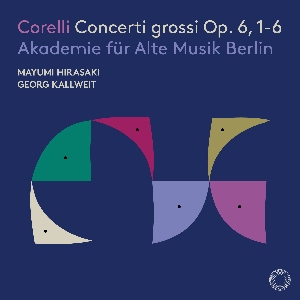
Arcangelo Corelli (1653-1713)
Concerti Grossi Op.6 No.1-6
Akademie für Alte Musik Berlin / Mayumi Hirasaki, Georg Kallweit
rec. 2024, Teldex Studio, Berlin, Germany
Reviewed as lossless download
Pentatone PTC5187234 [65]
Corelli’s twelve Concerti Grossi were probably written in the 1680s, but not published until the year after his death. They comprise a small solo group of two violins and one cello, and a tutti ensemble of the conventional four-part strings plus basso continuo. They became very influential, especially in Italy, Britain and Germany, though with plenty of competition from the more showy solo concerto, such as those of Vivaldi. Corelli’s Opus 6 set remained popular throughout the 18th century, being mentioned admiringly by Charles Burney in 1789.
I first met these works through the set by Capella Istropolitana on Naxos, one of the label’s early releases (their catalogue numbers begin with 8.550). They are anything but historically informed, but I still greatly enjoy their elegance. This set was followed by what I suspected would be its almost diametric opposite, that by Fabio Biondi and Europa Galante, renowned – infamous in some circles – for their wildly dramatic Vivaldi. I think Biondi is matchless in Vivaldi, but far less successful in almost every other composer, and so it proved with Corelli. I then tried the Avison Ensemble on Linn (review) and felt that it seemed to get the balance between elegance and energy about right. That was a 2012 release, and there have been a few sets released since then, but none that I’ve heard.
This 2025 release caught my eye when looking through the Pentatone catalogue, because I remembered colleagues favourably reviewing Handel’s Concerti Grossi from the same ensemble. It was not until I’d half-written this review that I found that MWI had already published a review of the Corelli. When I read it, I saw that I agreed with basically everything Curtis Rogers had already written, which makes the rest of this more difficult to write without repetition or deviation (or indeed hesitation – I do hope some of you pick up on this reference).
That balance mentioned above is crucial in Corelli; this music shouldn’t be overdone. It has a grace and sophistication that doesn’t need hyping; this is where Biondi went wrong, trying to add a little Vivaldi pizazz to it. The Akademie gets it spot on, and the textures are lighter than those for The Avison Ensemble, though player numbers are similar.
Curtis has mentioned some of his highlights, but for me, Concerto No. 4 is the highpoint of the recording; it is given the most sublime performance, totally sweeping aside others that I’ve heard. The transition from the brief opening Adagio into the Allegro is quite thrilling, the two sections given such contrast. The second movement Adagio reminded me, as it did Curtis, of the Largo from Vivaldi’s Winter, with an almost menacing slow tread in the violins, far more effective than the other versions I have. The archlute that weaves through is absolutely delicious. The two faster movements – Vivace and Allegro – are also distinguished from one another far better than the Avison Ensemble, the former truly sprightly, the latter elegant. This Concerto had never stood out from the others to me before, but without any sense of hyperbole, this performance is one of the best (of anything) I’ve heard in ages.
Not everything is perfect; the string tone can get a bit wiry at times, and it does seem to be more obvious in the odd numbered concertos. Why is this worth noting? The direction duties are shared between the Akademie’s two concertmasters Mayumi Hirasaki and Georg Kallweit, and it is the former who directs Nos 1, 3 & 5, and I felt they were not as successful as the other three. The booklet notes provide a good historical coverage of Corelli’s career, with some informative quotes from contemporary sources. The sound quality is very good, far more detailed than that for the Avison Ensemble, without the extraneous non-musical noises that such detailed sound frequently brings.
Like my colleague, I very much look forward to the remaining concertos being released.
David Barker
Previous review: Curtis Rogers
Buying this recording via the link below generates revenue for MWI, which helps the site remain free