
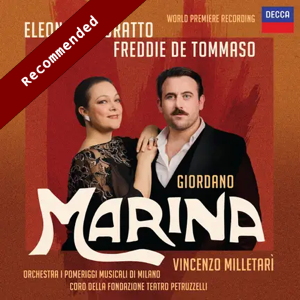
Umberto Giordano (1867-1948)
Marina – melodramma in one act
Marina: Eleonora Buratto (soprano)
Giorgio: Freddie De Tommaso (tenor)
Daniele: Nicholas Mogg (baritone)
Lambro: Mihai Damian (baritone)
Coro del Teatro Petruzzelli di Bari
Orchestra I Pomeriggi Musicali/Vincenzo Milletarì
Libretto and English translation
rec. live composite from performances 13-15 February, 2026, Teatro dal Verme, Milan, Italy
World premiere recording
Decca 576 7566 [53]
I quote here from the Presto website, it being as good a summary and introduction to this opera as any: “Forgotten for almost 140 years, the rediscovery of Giordano’s first opera ‘Marina’ is one of the operatic highlights of the year. Recorded at the world premiere performances at Milan’s historic Teatro dal Verme in February 2026… Giordano was just 21 when he composed this one act opera for a competition in 1888 eventually won by Mascagni’s Cavalleria Rusticana. Its plot is pure verismo: a story of love torn apart by war.”
Musicologist Andreas Gies discovered the surviving autograph manuscript in the Koch Collection at Yale University’s Beinecke Rare Book and Manuscript Library and then prepared the new critical edition used for the world premiere performances from which this recording is derived.
Neatly presented in a slim, cardboard sleeve-case with the Italian libretto and English translation – albeit in a miniscule font – it is obviously of interest to operaphiles who will be familiar with Giordano’s masterwork, Andrea Chénier, and possibly also acquainted with Fedora (see my surveys of recordings of both).
Let’s be clear, however: it is a youthful work – essentially juvenilia, begun when Giordano was twenty – lasting well under an hour and in no sense the equal of his one enduring success. Giordano went on to write a dozen or so more operas but apart from Andrea Chénier, only Fedora and even less often, Siberia, are sporadically staged; the rest are verismo rarities heard in festivals and given the occasional recording.
Very little of the music here is prescient of those later operas. Its martial opening and content remind me of another short, verismo opera set in wartime with a violent outcome, Massenet’s La Navarraise, but that was in fact written three years after Marina. The first solo voice we hear is that of spinto soprano Eleonora Buratto and this is a role to which she is well suited. She has volume, temperament, ringing top notes and a serviceable lower register – it is a voice which perfectly matches the requirements of verismo and I can happily overlook her slightly obtrusive vibrato given the amplitude and commitment of her singing. Things such as the floated top B concluding her opening aria are beautifully done and she copes well with the climactic top C concluding Part I. The psychology of the eponymous main character is engaging, and again reminds of similar conflicted and neglected heroines indulging in escapist fantasy and desperate for true affection, such as Nedda in Pagliacci and Giorgetta in Il tabarro.
Tenor Freddie De Tommaso is as I have heard him live in the theatre: slightly husky, baritonal and not especially nuanced of tone, but he is possessed of a robust, steady sound with secure, if slightly effortful top notes. He makes a credible wounded hero. The difficult diminuendo on a top B-flat he employs to close his aria opening Part II is courageous and he gets away with it even if the execution is not the most elegant. Of the two baritones, Romanian Mihai Damian has the neater, more attractive voice with a pleasing Italianate bite in it; he is a singer to watch. The Daniele is a little woolly, without much heft and a tendency to sound laboured, with too much beat and not enough centre, as his top F-sharp which ends the opera confirms.
The composer might have been inexperienced but he already demonstrates a firm grasp of his craft here. The exchanges between the various characters are sharply delineated; the music is economically dramatic, without longueurs and there is plenty of melody. The second part is under twenty minutes and contains a passionate love duet, culminating in a belter of a joint top B on “Addio”. Furthermore, one cannot help but speculate that despite the few obvious correlations between Marina and Andrea Chénier, there is some consonance between the depth of emotion of Marina’s “Conobbi appena mia madre” (I barely knew my mother) and Maddalena di Coigny’s “La mamma morta” (My dead mother); it already brings out the best in Giordano’s youthful invention.
Conductor Vincenzo Milletarì maintains a firm grip on proceedings, sustaining tension admirably; his orchestra and chorus are alert and energised. The chorus has quite a lot to do, both offstage and on, and their contribution is laudable.
This is a taut, gripping drama, excellently sung and beautifully recorded. There is surely no barrier to it becoming part of a regular double-bill paired with similarly violently violent verismo operas such as the two mentioned above or with a wholly contrasting work such as the gentle Zanetto (review).
Ralph Moore
Buying this recording via the link below generates revenue for MWI, which helps the site remain free













