
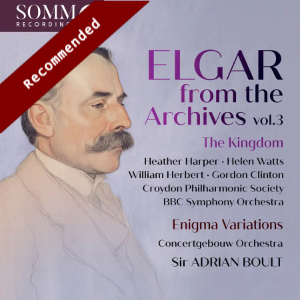
Sir Edward Elgar (1862-1934)
Elgar from the Archives Volume 3
The Kingdom, Op. 51 (1906)
Enigma Variations, Op. 36 (1898-99)
Heather Harper (soprano), Helen Watts (contralto), William Herbert (tenor), Gordon Clinton (baritone)
Croydon Philharmonic Society
BBC Symphony Orchestra (Kingdom), Concertgebouw Orchestra (Enigma)/Sir Adrian Boult
rec. live, 29 February 1940, Concertgebouw, Amsterdam (Enigma); 29 May 1957, Royal Festival Hall, London (Kingdom)
SOMM Ariadne 5048-2 [2 CDs: 120]
I am somewhat late in coming to the party when it comes to reviewing releases in SOMM’s series Elgar from the Archives; colleagues have already had their say on the earlier releases, including this present one. However, I can’t think of a better place to begin a consideration of the series than with this important performance of one of the Elgar works that I esteem the most, The Kingdom. In fact, I’m familiar with this particular performance because the CRQ Editions label issued it in 2018 (CRQ CD 353-354). I’m not sure that CRQ’s version is still available but I’ll make some brief comparative comments later.
As Andrew Neill tells us in his elegant and informative booklet essay, in 1957 the BBC broadcast live performances of all three of the major Elgar oratorios to mark the centenary of the composer’s birth. I’m not sure who conducted The Dream of Gerontius; Sir Malcolm Sargent was entrusted with The Apostles (the performance is due for imminent release by SOMM) and Sir Adrian Boult was on the rostrum for The Kingdom. If the performance of Kingdom sounds well run-in that’s probably because the Royal Festival Hall audience was getting the benefit of a prior performance involving many of the same forces. As Nigel Simeone relates in his invaluable book, Edward Elgar and Adrian Boult (2025), Boult conducted the work in Croydon on 4 May 1957; the only changes of personnel for the Festival Hall concert were that the Australian, William Herbert was the tenor soloist in place of John Mitchinson, who had sung in Croydon, and the LSO, which played in Croydon, was replaced by the BBC Symphony Orchestra.
Simeone reproduces some press comments on the Festival Hall performance. Charles Reid, who covered it for the News Chronicle, was rather sniffy, drawing attention to the “many empty seats” and commented: “Never have I known so important a centenary observance open with so little panache… surely a more stimulating programme choice could have been made”. (It occurs to me to wonder how many performances of the work Reid had actually heard.) The critic who attended on behalf of The Times was much more positive. He drew attention to the fact that not only Sir Adrian, but also Alan Kirby, the founder of the Croydon Philharmonic Society choir – he had stepped down as conductor the previous year on health grounds – were enthusiasts for The Kingdom. He – I assume it was a male journalist in those days – went on to say “this was a remarkably satisfying performance. Sir Adrian Boult sees more in this oratorio than does practically any other conductor, and it was altogether to the good that he should have been in charge of this centenary performance”. Readers will easily guess with which of these two journalists I agree and I venture to suggest that anyone who listens to this recording will feel that The Times critic nailed it. He went on to praise Boult’s conducting and the work of the choir. I concur with all that. My only quibble would be that the reviewer said “This was a performance distinguished above all by the work of the chorus and the orchestra”; I think that’s rather unfair on the solo quartet.
I first got to know The Kingdom in the early 1970s when, as a student, I first heard the EMI recording which Boult made in 1968; that was the premiere recording of the score. That recording is still a favourite with me, not least because two of Boult’s soloists, Margaret Price and John Shirley-Quirk, were peerless. I very deliberately have not gone back to that recording now to make comparisons, chiefly because it was made under studio conditions.
The review in The Times singled out the Croydon Philharmonic Society choir for special praise and I think that was entirely justified. I have commented several times in the past when reviewing recordings of choral music that the standard of amateur choral singing has risen significantly in the last forty years or so. I still believe that to be the case but the Croydon singers prove to be an exception to the rule. Over the last thirty years or so I’ve had the good fortune to sing in several performances of this great oratorio and so I like to think that I know it well. Following this performance in my vocal score, I was astonished at how scrupulously faithful the choir is to all of Elgar’s markings, especially the dynamics; it makes such a difference. In addition, the sound that the choir makes is excellent, as is their diction. All sections of the choir sing very well but I was particularly pleased to hear the tenor section making a highly effective contribution.
Boult had the benefit of a fine solo quartet. William Herbert, a singer new to me, makes a good impression in the role of St John. In Part III, ‘Pentecost’, he appears to miss the first two beats the first time he sings ‘When the Comforter is come’ but he immediately recovers and this is a minor blemish. Elsewhere, his clear, ringing voice gives consistent pleasure and in Part IV, he excels in his lyrical solo (‘Unto you that fear His Name’), which flows into a duet with Gordon Clinton, to which he makes a fine contribution. Helen Watts, ever dependable, blends very well indeed with Heather Harper in Part II, ‘At the Beautiful Gate’; both ladies are excellent here. Later, Watts is dramatic and involving in several recitative passages, not least her compelling narration at the start of Part IV, ‘The Sign of Healing’.
The soprano solo role includes one of the most memorable passages in all of Elgar’s vocal music, the wonderful ‘The sun goeth down’ in Part IV. Until I first heard this 1957 recording on the CRQ discs, I didn’t think any singer would – or could – ever match the outstanding performance given by Margaret Price on Boult’s 1968 recording. For me, Price encompasses every facet of this solo, whether slow and meditative or dramatically ecstatic. My goodness, Heather Harper comes close, though, and, indeed, there’s a powerful case to be made that her achievement is even greater since the Price performance was set down under studio conditions whereas Harper’s is a one-off account, caught on the wing. (It’s interesting to note that both of these great singers were at a similar stage in their careers, at least in age terms, when they made their respective recordings; both were 27.) The solo opens in rapt contemplation, the voice ushered in by a delicate violin solo, here exquisitely played by Paul Beard. Harper seamlessly carries on the mood established by Beard in a wonderfully controlled, contemplative piece of singing. Later in the aria, she soars majestically in the rapturous section, beginning at ‘How great are Thy signs’. Then Harper and Beard bring the aria – and Part IV – to a serene, meditative conclusion. This is a remarkable, compelling passage of singing, which crowns Hearther Harper’s distinguished contribution to the oratorio as a whole.
The baritone soloist has an even bigger role and we know we’re in very good hands as soon as Gordon Clinton begins to sing. Like his colleagues, he is fully attentive to Elgar’s dynamic and other markings and he appreciates they’re there for a reason. So, his opening phrase in Part I (‘Peace be multiplied unto you’) is marked piano. Because Clinton sings it that way he conveys Peter’s humility. Almost all of Peter’s music in the following pages is marked piano or less – and is sung in that way. That means that when Peter sings ‘Men and brethren’ (marked mf) and explains that Judas must be replaced as a disciple, the way Clinton obeys the dynamics (and Elgar’s additional marking con dignità) establishes him at once as the leader. Later on, Clinton’s delivery of the great monologue in Part III (‘I have prayed for thee’) is memorable. I admired every aspect of his performance. He may not sing with the fervour of Shirley-Quirk on the 1968 recording, but he brings other qualities to the role; he’s a conspicuous success.
Sir Adrian Boult is in complete command of the score. I was interested to read in Andrew Neill’s essay that in this performance Boult takes nearly a minute longer over the marvellous Prelude as compared with his EMI recording (8:39 in 1957, 7:48 in 1968) but Neill is right to observe that the earlier performance doesn’t feel slower; indeed, as I listened I detected great urgency at times, though elsewhere in the Prelude, Boult’s tempo selection is sufficiently broad to emphasise the majesty of the music. Throughout the oratorio, he obtains splendid playing from the BBC Symphony Orchestra; richly sonorous when required but also very capable of refinement and delicacy. During the whole performance there’s a sense of rightness about every aspect of Boult’s direction. And Neill references the occasions when he ‘lets the music off the leash’. That certainly happens when the Holy Spirit descends on the apostles. Urgency is also in evidence at times in the great ensemble which concludes Part III. This extended passage, beginning when Peter sings ‘Repent, and be baptised’, is truly inspired and the entire company, singers and orchestra, rises to the occasion splendidly and with fervour.
This is a highly committed, memorable and moving account of The Kingdom and we’re able to enjoy and appreciate it to the full thanks to Lani Spahr’s expert restoration of the BBC broadcast sound. I made some comparisons with the CRQ Editions transfer, made by Ian Jones. He did a good job but I think that Spahr’s efforts are even more successful. Overall, he has produced a richer sound. As an example, in the Prelude the violins sound rather edgier on the CRQ disc and the timpani are not as well defined as is the case on SOMM. Lani Spahr has given the chorus greater presence and in the great ensemble at the end of Part III there’s much better definition to the overall sound on the SOMM disc. These comparisons may be academic because I’m not sure that the CRQ version is still available; if it is, you’ll only be able to obtain it now as a digital download. I mention the comparisons because if, like me, you have the CRQ set you may be wondering whether you should upgrade. There are two compelling reasons why you should. Firstly, you’ll hear The Kingdom in better sound. Secondly, there’s the question of the coupling. The CRQ release offered the 1971 live premiere of the Cello Concerto by Havergal Brian, played by Thomas Igloi and conducted by Boult. That is valuable in archive terms but, let’s put it this way; I haven’t listened a second time to it. SOMM, however, offer us something rather remarkable.
I think there’s a case to be made that Lani Spahr’s achievement in restoring Boult’s 1940 performance of the ‘Enigma’ Variations surpasses even his work on The Kingdom. A little background is needed, for which I’m indebted to Andrew Neill. In February 1940, Britain was in the sixth month of its war with Germany. However, it was still possible for Boult to travel to Holland to conduct the Concertgebouw Orchestra. His programme included Bliss’s Music for Strings and ‘Enigma’. (I wonder if the Bliss performance survives). I was intrigued to learn that the Concertgebouw Orchestra had, by this date, already played Elgar’s masterpiece nearly 30 times; Mengelberg had first performed it with them as early as 1902. Small wonder, then, that the orchestra plays the piece so well. What we hear on this CD is a very considerable account of ‘Enigma’ and we can experience it in sound the quality of which is, frankly, astonishing for its age. I’m sure it’s the case that the engineers working for the Dutch public broadcaster, AVRO did an excellent job in the first place but Spahr has presented this performance in excellently restored sound. Frankly, we have no right to expect an 86-year-old orchestral recording to sound like this. Not only does the orchestra sound far better than I anticipated but also one gets a sense of the acoustic of the Grote Zaal in the Concertgebouw.
The recording preserves a fine performance. Boult conducts with all the understanding and empathy for the music that you’d expect; I was rather disconcerted by his very measured pace at the start of ‘E.D.U’ and again when that material reappears but otherwise, as with his Kingdom performance, everything just seems right. I liked the crisp timpani in ‘Troyte’ – one usually gets a much more muffled timpani sound in recordings of this vintage. I also admired the way the Dutch players respond to Boult’s noble conception of ‘Nimrod’; there’s dignified eloquence and then, at the climax, fervour. Equally pleasing is the delicacy and charm with which ‘Dorabella’ makes her appearance. ‘G.R.S. flashes across our sight in a fast and furious manner and I love the cello sound in ‘B.G.N.’ The finale brings the only relative disappointment. That’s not, I hasten to say, in respect of the playing – although I noticed a little bit of scrappiness on a couple of occasions in this episode – but, rather, it’s the place where the recording shows its age. After what must have been a memorable performance, the Dutch audience give the musicians a warm reception. I’m not sure if this performance has been issued commercially before but it is one that was well worth releasing, especially in such a fine restoration.
This is a release of great importance for all Elgar lovers – and, indeed, for admirers of Sir Adrian Boult. Both of the performances compel our attention and Lani Spahr has worked his customary magic on the source material. If you listen straight through to this pair of discs you will invest slightly under two hours of your time. I dread to think how many painstaking hours Spahr has dedicated to restoring these two recordings; it has been worth every minute of his time. The set is graced by a splendid essay by Andrew Neill. On this occasion SOMM have not printed the text of The Kingdom but I think that’s fair enough; almost everyone who purchases this set will already have at least one recording of the work, complete with libretto, in their collection. In any case, SOMM provide a QR code through which you can access the text online.
This is a set of great importance. If you love Elgar’s music, don’t hesitate.
John Quinn
Previous reviews: Dominic Hartley ~ Nick Barnard
Buying this recording via the link below generates revenue for MWI, which helps the site remain free













