
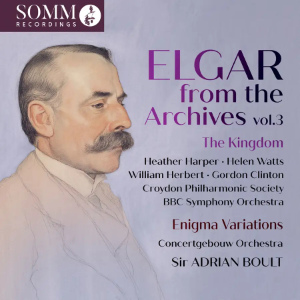
Sir Edward Elgar (1862-1934)
Elgar from the Archives Volume 3
The Kingdom, Op. 51 (1906)
Enigma Variations, Op. 36 (1898-99)
Heather Harper (soprano), Helen Watts (contralto), William Herbert (tenor), Gordon Clinton (baritone)
Croydon Philharmonic Society
BBC Symphony Orchestra (Kingdom), Concertgebouw Orchestra (Enigma)/Sir Adrian Boult
rec. live, 29 February 1940, Concertgebouw, Amsterdam (Enigma); 29 May 1957, Royal Festival Hall, London (Kingdom)
Reviewed from an AAC download: 44.1 kHz/24-bit
SOMM Ariadne 5048-2 [2 CDs: 120]
Robert Anderson, writing of The Apostles, described Elgar’s method of libretto construction as ‘improvisatory… daring, risky, very Elgarian’. The same is true of The Kingdom. Its text reads less like a libretto than a devotional collage. Verses from the Psalms, the Gospels, the Epistles and the Acts of the Apostles jostle against one another within single passages, their different registers and rhetorical purposes imperfectly reconciled. Mary’s great scena, ‘The sun goeth down’ —the emotional heart of the work— draws on four distinct scriptural sources by my count, and while the music binds them into something searingly beautiful, the words themselves can feel as though they are pulling in different directions. Elgar chose the King James Bible partly for diplomatic reasons (Newman’s Catholic verse had caused Anglican hackles to rise after Gerontius), but the archaic Jacobean English adds a further layer of stiffness to an already awkward assemblage. One sometimes wonders whether the text would have benefited from a more ruthless editor, or simply a collaborator with some feeling for dramatic speech.
And yet the music, at its best, transcends all of this. SOMM’s release of Boult’s 1957 performance, broadcast live from the Royal Festival Hall for the Elgar centenary, makes the case for The Kingdom as powerfully as any I have heard. Boult was, by his own account, a greater admirer of this score than of Gerontius, and you can hear that conviction in every bar. The pacing is superb: the Prelude, taken a shade more expansively than in his later EMI recording, builds with a cumulative intensity that is genuinely thrilling, and the great Pentecost scene, ‘He Who walketh upon the wings of the wind’, has an exhilarating momentum that the studio version, fine as it is, doesn’t quite match.
The soloists are excellent, and in ways quite distinct from that famous EMI recording with John Shirley-Quirk and Margaret Price. Gordon Clinton’s St Peter is imperious and commanding where Shirley-Quirk is more inward and reflective — a different conception entirely, but wholly convincing on its own terms. Heather Harper’s ‘The sun goeth down’ is luminous, more ardent perhaps than Price’s cooler, more perfectly shaped account, and no less moving for that. Helen Watts and William Herbert make rather more of their subsidiary roles than one might expect, and the diction throughout from all four soloists is immaculate. The Croydon Philharmonic Society, inheritors of a tradition that Elgar himself had shaped and admired, sing with a notable responsiveness to dynamics and text.
The coupling is an absolute treat. In February 1940, at the height of the Phoney War, Boult flew to Amsterdam and conducted the Concertgebouw Orchestra in a broadcast performance of the Enigma Variations. This was an orchestra that knew the work well— Mengelberg had introduced it in 1902 — and it shows. I don’t think I’m imagining a subtly different orchestral character here: a greater weight and warmth to the strings, a more Continental blend in the winds, a quality of objectivity in the phrasing that sets it apart from the English performances. There is also a tautness and a directness to this reading that reminded me, more than once, of Elgar’s own recorded accounts. Boult made fine recordings of Enigma throughout his career, but this Concertgebouw performance is a notable addition.
And Lani Spahr does it again: the remastering of these recordings from his personal archive is superb throughout, achieving a clarity and presence that one simply does not expect from sources of this vintage. Andrew Neill’s booklet notes are thorough and informative, though I confess I would have preferred rather more on the context and circumstances of these specific performances and rather less by way of analytical synopsis of works that most listeners will already know.
Dominic Hartley
Other review: Nick Barnard and John Quinn
Buying this recording via the link below generates revenue for MWI, which helps the site remain free













