
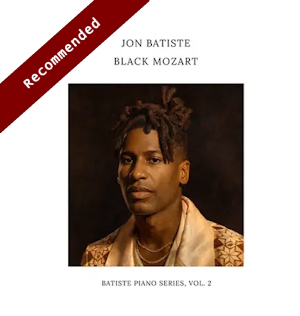
Black Mozart
Jon Batiste (b. 1986, piano) rec. 2026(?), Jefferson Parish Studios, Jefferson Parish, USA
Reviewed as a digital download
Decca 5784105 [35]
Jazz and Classical are two conceptually different genres, but nearly always whenever they get together, it seems that sparks fly.
Most fans of 20th century classical music will know of the influence jazz had on European composers such as Ravel, (early) Hindemith, Stravinsky, Milhaud, Honegger, Krenek, Schulhoff, Martinů, Shostakovich, and Kapustin – to say nothing of American-born composers such as Joplin, Grant-Still, Gershwin, Copland, and Wild. What is so exciting, in my opinion, is that all of these artists found something different in Jazz, and brought a different aspect of it into their works.
The flip side of the coin is equally true. Many of the greatest jazz musicians found plenty to interest and inspire them by listening to classical records. Duke Ellington, Charles Mingus, and Miles Davis all engaged in dialogue with their favourite genres and composers, and if it were not for the tyranny of genre labels, I think all three could be considered “American classical composers” – our Smetana, Vaughan-Williams, or Granados. Any objection to this based on the improvisatory nature of Jazz went out the window when aleatoric music became a part of the Classical canon in Cage, Boulez, Stockhausen, etc.
There are two other recent albums to pursue if this interests you: Milestones by O/Modernt Chamber Orchestra (review) which comprises arrangements of Josquin des Prez, Igor Stravinsky, and Miles Davis. One effect of listening to this fantastic album is realising that, after all, these artists can comfortably stand shoulder to shoulder. Not that they are exactly the same, of course, but that they are not quite as far apart as you might think. Then there is Symbiosis: Tribute to Bill Evans(review) which features three pieces of contemporary classical music either composed for Bill Evans or based on his music. Evans built his pianistic style off of a mixture of Debussy and jazz, so he works wonderfully well in this sort of project.
Jon Batiste is my favourite type of artist: someone who has an infectious love for a wide variety of music and talent to spare. Skimming his Wikipedia biography, you will find him carrying off awards for music either written or performed in about two dozen different categories: jazz, classical, R&B, hip hop, film scoring, funk, rock, soul; the list is dizzying. He has worked alongside JID, Stevie Wonder, Prince, and Willie Nelson, and has served as the youngest ever music director on The Late Show with Stephen Colbert. When Columbia University gave him an honorary doctorate in music earlier this year, they summed up his career so far with what seems to me a particularly apt phrase: “musical creations that defy categorization and express the joy and the pain of being alive.”
This present album is volume two of a project Batiste is calling the “Batiste Piano Series”. Volume one was Beethoven Blues, which came out in 2024. In both cases, Batiste takes some of the most famous and recognisable melodies by the named composer and reinterprets them with elements of jazz, blues, and Latin music. As a side note, Batiste is doing the same sort of project with a two-part Thelonious Monk series. Batiste’s playing owes a lot to Monk: the rhythms, open spaces, and percussive approach are all very Monk. The recording is crystal clear and reasonably close; it sounds like state-of-the-art sound quality to my ears.
I heard, and enjoyed, Beethoven Blues last year at some point, but there’s something about Mozart’s music, I think, that makes this technique work even better here. My hypothesis is that the playfulness, wit, and humour in Mozart’s music make this sort of reimagining sound natural. I’m not saying that Beethoven lacks those traits – far from it. But few composers revel in that sense of musical play like Mozart. That makes Mozart and Batiste something of a dream team.
Black Mozart kicks off with the opening theme from Piano Sonata No. 16 (K. 545), the Sonata Facile. In Batiste’s hands, as Facile-Batiste, it is no longer a simple study for beginners but a sort of early blues riff that transports you abruptly from 1780s Vienna to 1920s America. Batiste injects slower, dreamier sections for contrast. It is remarkable how much depth and sheer musical joy this track has – I found myself laughing out loud.
Alla Blues and Alla Turc Movement take up the next six minutes. Batiste does something quite clever here: he begins with the extreme end of the variation and slowly moving back towards the original Rondo from K. 331. Once you hear it, you’ll wonder why it never occurred to you that it could be so bluesy. It’s as if Batiste discovered something that was staring us in the face all along. He follows this up by playing the original movement fairly ‘straight’, until right at the end when he unleashes the Batiste touch, although it must be said that he tweaks the rhythm quite a bit.
Shine and Twinkle are, of course, both based on the Twelve Variations on Ah vous dirai-je, Maman (K. 265/300e). How fitting, really, because this whole disc is a sort of ‘variations’ exercise, the kind of which Mozart was fond. For Batiste, this melody has real depth: he avoids the obvious trap of treating it like a children’s ditty and instead does something so surprising with it that I needed to actually check the tracklist to figure out what he was doing. Only at the end of Shine does it become clear.
The next track, Processional, is the only one that doesn’t feature Mozart’s name as co-composer, so I take it that within the flow of the album, we are taking a break for something that draws on Batiste’s New Orleans background, theoretically evoking the rhythm of a street parade, albeit slowed down to something that sounds rather dejected – it’s more Pavane pour une Infante Défunte than anything by Gottschalk, for example.
We move from that right into Country Zart, which might take even the dedicated Mozartean a second to place. That’s right: it’s the Marriage of Figaro Overture (K. 492) in a sort of Harlem ‘Stride’ adaptation. It’s a head-banger of a piece (as is the original overture, frankly), and I can only call this one a stroke of genius.
Molto faithfully adapts the first movement of Symphony No. 40 (K. 550). I actually don’t know if I’ve ever heard a piano transcription of K. 550, but surely it’s ripe for one, if Molto is anything to go by. The forward driving rhythms are delightful. Batiste uses this to pivot into the longest track on the album, Molto in Cayo Hueso (meaning Key West, the string of islands off the Southwest coast of Florida). Here, Batiste takes the G minor symphony for a Latin dance lesson, and if the result doesn’t make you want to get up and move, then nothing will. This also contains some of his most virtuosic jazz soloing: Molto in Cayo Hueso is hot.
We end with the slow movement from Piano Concerto No. 21 (K. 467) reimagined as a slow, heartfelt gospel track. It’s a triumphant victory lap for Batiste and, I think, reminds the listener that this has been more than merely an exercise in having a good time – although it has also been that.
In Batiste’s interview with Ebro hosted on Apple Classical, Batiste discusses this album in explicitly political terms. Bringing Mozart’s most famous themes into genres created by Black Americans is, for Batiste, a corrective to the racist tendency to denigrate jazz, blues, etc., as in some way ‘inferior’ to classical Music. But his approach is not didactic. It is, above all, motivated by a love of music in all of its forms. “I do it all, actually, from love,” Batiste says. That’s very clear from listening to this album. Black Mozart is a good disc for people who delight in music. That’s the bottom line.
Aidan Gray
Buying this recording via the link below generates revenue for MWI, which helps the site remain free

Contents
Facile-Batiste
Alla Blues
Alla Turc Movement
Shine
Twinkle
Processional
Country Zart
Molto
Molto In Cayo Hueso
Gospel Andante














How is this for synchronicity? As a treat for the Mrs, we had dinner last night watching “The Devil wears Prada 2”. At the exact moment I was having a sneaky browse on my ipad who should appear on screen at Miranda’s sleak and excusive garden party but the man himself! A neat cameo. He clearly hits the spot for Miranda in haute couture, I can well imagine Meryl Streep digging his music too!
That’s so funny, Philip! Love when the universe gives us a well-placed coincidence like that.