
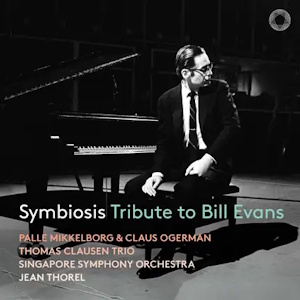
Symbiosis – Tribute to Bill Evans
Palle Mikkelborg (b. 1941)
Bill Evans Suite (1969)
Thomas Clausen (b.1949)
For Pi (2023)
Claus Ogerman (1930-2016)
Symbiosis (1974)
Thomas Clausen Trio
Anders Malta (trumpet)
Singapore SO/Jean Thorel
rec. live, 5-7 January 2023, Esplanade Concert Hall, Singapore
Reviewed from a FLAC download 96kHz/24-bit
Pentatone PTC5187510 (80)
This new release from classical label Pentatone featuring a major symphony orchestra is all about jazz. Specifically, a programme that engages with one of the more beguiling aspects of Bill Evans’s career, his recurring fascination with the encounter between piano trio and orchestra, which occupied him intermittently from the early 1960s through to the mid-1970s. Three quite different tributes are placed side by side here: the revival of an unfamiliar 1969 suite by the Danish trumpeter and arranger Palle Mikkelborg, which combines arrangements of Evans tunes with one new movement; a new piece composed in Evans’s own style by the Danish pianist Thomas Clausen, who leads the trio throughout; and a reconstructed score of Claus Ogerman’s Symbiosis — a work Evans recorded in 1974 but which has never been performed live in full until now, because the orchestral parts were not preserved. Three modes of tribute, then, and the disc is as much an exercise in rescue and recovery as it is a celebration.
The disc starts with the Bill Evans Suite by Palle Mikkelborg, not a name that everyone will know, but within Scandinavian jazz he has been an important figure for over six decades. His international reputation rests chiefly on Aura, the Miles Davis album that he composed in 1984, and which Davis recorded the following year, to eventual Grammy-winning acclaim.
The origins of the Suite lie in an invitation to Mikkelborg to arrange and conduct a television project entitled Waltz for Debby. The forces were to be Evans’s working trio — with Eddie Gomez on bass and Marty Morell on drums — combined with the Danish Radio Big Band and members of the Royal Danish Orchestra. Mikkelborg, who had met Evans the previous year, accepted with alacrity. The Suite consists of arrangements of a selection of Evans’s compositions with the exception of ‘Treasures’, written for the occasion by Mikkelborg, and which Evans liked enough to conduct it himself. The session was recorded in Copenhagen in November 1969 and then broadcast on Danish television. Thereafter it disappeared from view for more than half a century, until the release in 2023 by Elemental Music of Treasures: Solo, Trio and Orchestra Recordings from Denmark (1965–1969) which brought the recording of the Suite to light after it was found in a private collection.
I find the Suite competent rather than inspired on the Treasures release. Mikkelborg handles the material with care and evident love, but there is a directness of statement in several of the movements that does not do full justice to Evans the composer. Take ‘My Bells’, which Claus Ogerman had already arranged in the 1965 Bill Evans Trio with Symphony Orchestra album. Ogerman’s harmonic ear is more subtle than Mikkelborg’s: he catches something of the modal voicings that Evans himself had first used in ‘So What’ (Kind of Blue) on which ‘My Bells’ is built. Mikkelborg, by contrast, presents the melody in so direct a form that I could not quite banish an unlikely but persistent association with the ‘Troika’ from LieutenantKijé. ‘Treasures’ itself, the movement Evans apparently so liked, seems unexceptional to me. It’s a pleasant enough setting with good trumpet writing at its centre, but not a piece that would stand out if one came across it without knowing its history. Evans, for his part, plays throughout the Suite well within himself. There are some lovely moments — he is after all Bill Evans — but this is far from his most memorable playing.
I should add that in the celebratory framing of the Suite in the booklet notes that accompany the Elemental set we learn that other arrangers and composers told Mikkelborg his work with Evans was better than Aura. I can’t agree. Aura is a far more adventurous and daring piece, with a formal reach and a harmonic boldness that the Suite does not match. Aura also has a conceptual integrity — the use of the colour spectrum as a compositional matrix — that holds it together in a way the Suite, a more miscellaneous sequence of arrangements plus one original, does not attempt.
All of which said, this new Singapore performance of the Suite is in many respects a triumph. The sound is much superior, naturally — better balance, better presence, better definition in the big band writing. The Clausen trio is superb: Thomas Clausen himself plays with a tact and musicality that honours Evans without aping him, and Thomas Fonnesbæck’s bass is particularly alive. The texture is generally even more lush than on the 1969 recording, and this tends to work in the music’s favour rather than against it. Anders Malta’s trumpet playing on ‘Treasures’ is outstanding. He takes his solo with an expressive directness that reminds one of Mikkelborg’s own 1969 reading while bringing a different colour to it. On the whole this is a new realisation that made me hear things in the Suite I hadn’t quite registered before. One might still conclude, as I do, that the music is the least interesting thing on this disc. But it is beautifully served by its performers.
Claus Ogerman is another figure who does not quite get the recognition he deserves outside specialist circles. A German-born composer and arranger who made his name in Berlin and then in New York, he spent much of his career producing some of the most sophisticated orchestral writing in American popular music as well as concert works of real ambition. His three collaborations with Evans span a decade, from the light orchestral style of the 1963 Plays the Theme from ‘The V.I.P.s’, through the more ambitious 1965 Bill Evans Trio with Symphony Orchestra and on to the full concerto scale of Symbiosis, released by the legendary German jazz label MPS in 1974.
Symbiosis has been a favourite of mine for a long time. The start of its appeal is that wonderful cover photograph — Evans in full mid-1970s plumage, beard and all, in a brown and orange striped shirt whose colours the sleeve design picks up and frames him with. It’s of its moment in the most pleasing way. But the music is a different matter altogether from the cover’s period charm. I’d argue that Symbiosis is a masterpiece, and certainly the most completely successful of Evans’s orchestral experiments. It is formally and harmonically a world apart from the Mikkelborg Suite. Ogerman thought in whole structures: the work is in two movements, sharply contrasted, and he described them as ‘entirely opposed night pieces’, with the tranquillity of the second movement releasing the tension of the first. The two movements share a structural spine — the second is, in large part, a slowed-down reworking of a semiquaver saxophone passage from the first — and this gives the work an architecture that rewards repeated listening.
Evans switches from a Steinway to a Fender Rhodes electric piano and then back in the course of the work, a move which in lesser hands could have felt like a period affectation but here feels entirely coherent. The two instruments inhabit different sonic worlds and Ogerman’s writing knows exactly what each is for. Broadly the Rhodes is the vehicle for the more turbulent, fusion-inflected passages from the middle of the piece, the Steinway for the more reflective and classically poised ones. The orchestral writing is wonderfully accomplished throughout. The wind and tuned percussion scoring in the first movement is particularly inventive, full of small gestures that repay attention, and the final section of the second movement modulates into what I can only describe as an almost Coplandesque mode, opening up into a modal, widely spaced lyricism that makes for a beautiful close.
MWI readers might be interested to know that one admirer of Symbiosis was Glenn Gould. Ogerman had introduced Evans to Gould after Symbiosis came out, and Evans sent Gould a copy of the album. Gould’s response to the work — praising the through-composed sections for their ‘staggeringly inventive harmonic imagination’ and ‘enormous sweep and drive’ — seems spot-on to me.
What, then, of the new Singapore version? The first thing to say is that the reconstruction itself is a considerable achievement. The full orchestral parts were not preserved after the 1974 sessions and Ding Jian Han, working with the SSO’s Hans Sørensen, spent nine months rebuilding the score from the album recording and a surviving piano reduction. Ogerman’s later Two Concertos, which quotes passages from Symbiosis, provided cross-reference clues for instrumentation. The first performance took place in Singapore in January 2023. It was the first time the work had ever been heard complete in front of an audience, and the recording we have here is taken from those sessions.
The performance is good, but with a higher bar to clear than the Mikkelborg. For one thing, the sound on the original MPS recording is very well engineered and stands up well in comparison to the Pentatone release. And there are some features of the new account I did not entirely warm to. For example, the woodwind playing in the second section of the first movement is more deliberately accented than I would want, which disturbs the sense of a continuous harmonic flow that Ogerman’s writing depends on. More significant is the Fender Rhodes, which here sounds different from the original — less rounded in tone, less prominently balanced against the orchestra. I think this is a mistake. The point of the Rhodes in Symbiosis is precisely that it does not blend: it asserts itself, it colours, it brings a particular charge to the music that stands in deliberate contrast to the acoustic piano’s place elsewhere. If the Fender retreats even slightly into the mix it loses the dramatic function Ogerman gave it. The performance is also, on the whole, a little more driven than the 1974 original — conductor Jean Thorel and the excellent Singapore Symphony players perhaps unconsciously imposing a degree of forward tension where the music would breathe better if left to find its own pace. There are lovely moments, though, and Clausen’s playing at the start of the second movement is genuinely gorgeous, phrased with a quiet poise that catches the tranquillity Ogerman described. Overall, this is a skilful reconstruction that will serve future performers and audiences well, particularly in the concert hall. Recorded, however, it is always going to be measured against the original, and the original will continue to dominate. Evans is Evans.
Between the Mikkelborg and the Ogerman comes Thomas Clausen’s short elegy For Pi, a ballad composed in 2023 in the style of Evans and dedicated to his ex-wife and the mother of his daughters, known to those closest to her as Pi, who took her own life in 2006. Stylistically it fits like a glove — which is, after all, what Clausen was after. The reference points, as he acknowledges, are late-fifties Evans: the mood-world of ‘Peace Piece’ from Everybody Digs Bill Evans, and the harmonic world of Kind of Blue, on which of course Evans played a central role. Clausen orchestrated the piece in an astonishingly short time — two hours in a Singapore hotel room during the week of performances — and the orchestration is accordingly simple, focused on strings and trio with Anders Malta’s trumpet and Evgueni Brokmiller’s flute floating above. It is a lovely, poignant piece, and you need not have read Clausen’s heartbreaking note in the booklet to feel that something personal is being said. That it took its place in the concert programme at all is a mark of how closely integrated the project is at the personal as well as the musical level. I thought it by some way the most affecting thing on the disc.
This is a fascinating experiment, and I am glad it exists. Pentatone’s booklet notes however are disappointingly thin. The Mikkelborg Suite gets barely two sentences of contextual text, and there is nothing at all about the circumstances of the 1969 recording, its rediscovery, or the reasons the Suite is worth hearing at all. For a project that is so much about recovery and historical context, this is a missed opportunity. The sleevenotes for Symbiosis are fuller and do a decent job of explaining the reconstruction, but they have little to say about the work’s place in Evans’s own trajectory. Anyone coming to either piece fresh will need to go elsewhere for the context, and I hope what I’ve written above will have supplied some of it. The disc is certainly worth hearing in its own right. But if you have not heard the 1974 Symbiosis, you should seek it out first. Whatever else this Singapore reconstruction achieves, it has reminded me how fine that original recording is.
There is a quote from Evans at the start of the Pentatone booklet. ‘When you begin to teach jazz, the most dangerous thing is that you tend to teach style’. It articulates the precise question that any tribute album of this kind has to answer. If the thing that makes Evans a genius is not style but something that underlies it, then a tribute disc cannot simply imitate him. What it can do is present music of and around him in a way that gives the listener fresh angles on what he did. On that rather severe criterion, this disc succeeds more often than it fails.
Dominic Hartley
Buying this recording via the link below generates revenue for MWI, which helps the site remain free













