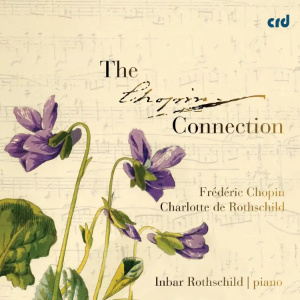
The Chopin Connection Vol.1
Charlotte de Rothschild (1825-1899)
Four pieces for piano (publ. 1860)
Frédéric Chopin (1810-1849)
Three Waltzes Op.64 (1846-1847)
Four Mazurkas Op.67 (1835-1849)
Rothschild version of Op.67 No.4 (1847)
Two Nocturnes Op.48 (1841)
Ballade No.4 in F Minor Op.52 (1842-43)
Inbar Rothschild (piano)
rec. 2025, Menuhin Hall, Stoke d’Abernon, Cobham, UK
CRD 3564 [57]
In this recital – and in a second volume for future release – pianist Inbar Rothschild sheds light on two much earlier Rothschilds, Charlotte and her daughter Mathilde, patrons of the arts and, for a short time, pupils of Chopin. Each disc pairs their music with works by Chopin featuring the pieces dedicated to Charlotte. On the current disc, this includes the F minor ballade and the C sharp minor waltz.
Charlotte de Rothschild’s four pieces were published in 1860 with the words par Baroness Nathaniel de Rothschild across the front cover. Yet some ninety years or so later her nocturne and waltz in A minor were attributed to Chopin. There is a strong suggestion that Chopin offered her advice on these compositions, and copies were doubtless found amongst Chopin’s papers. So, it is not that surprising that these two very Chopinesque pieces could be mis-attributed.
The four pieces are a nocturne in C minor, a polka also in C minor, and waltzes in A minor and in F minor. The cantilena of the nocturne is actually rather beautiful. While the piece does not have the dramatic central section like most of Chopin’s nocturnes, there are many harmonic and decorative touches that come straight out of the Chopin canon. The brief polka in two sections is slighter but still elegant, as is the final waltz in F minor; its opening theme has some of the Pole’s melancholy without exploring his depths of emotion or rich keyboard texture. The A minor waltz, altogether more satisfying, might still convince many people in a blind test. I feel Chopin would have been happy to have written its melody, and the harmonic change into the major key recalls similar instances in his waltzes and mazurkas. Charlotte went on to study painting and, though by no means a major artist, she has been recognised more for this side of her art than her music. It is good, then, to place her tiny output alongside that of the composer who influenced her so much.
After these rarities, we are on familiar ground. The op.64 waltzes are spacious and individual, as the little accelerandi in the first demonstrate. Rotschild is elegant in the lyrical section of the C sharp minor waltz, though she comes out of the middle section a wee bit abruptly; she does find character in each of the faster-scale sections. The third waltz is perhaps most successful with a journey from its almost improvisatory introduction to the vigour of its ending.
The op.67 mazurkas were published posthumously in 1855 by Chopin’s friend and musical executor Julian Fontana. Rothschild plays very stylistically. She captures their wide-ranging moods well, whether in the melancholy second, written in Chopin’s final year, the subtle lilt of the third or the earthiness of the first. As a bonus, she includes a second version of the final mazurka taken from Charlotte’s Livre d’Or; it includes some textural changes, bass notes where the printed version has rests for example or the twist of figuration into the A major section. Rothschild has a lovely mastery of touch in these dances, as she does in the two nocturnes that follow. I might ask for a little more drama in the D flat section of the nocturne in F sharp minor but there is no issue with the sense of movement through the line in the outer sections.
Charlotte de Rothschild was also the lucky dedicatee of Chopin’s final ballade which closes Inbar Rothschild’s recital. It was possibly a wedding gift for Charlotte’s marriage to her cousin Nathaniel de Rothschild in 1842. Rothschild gives another impressive performance, intimate in the counterpoint, and with wonderful sweep though the more overtly passionate later music.
This is an excellently planned and executed recital. Charlotte de Rothschild’s music relies heavily on her teacher’s muse. One wonders if Chopin actually was more inspired by, and gave more time to, the nocturne and A minor waltz – which resulted in their sounding so much like his own music. Whatever the case, Inbar Rothschild plays splendidly. She offers us a chance to hear Charlotte’s music in context, and give it the credit it deserves. Presentation is very good: the disc is adorned with botanical images, and the quality of the printing is excellent. I really look forward to the follow-up release which brings premiere recordings of twelve short pieces by Mathilde de Rothschild.
Rob Challinor
Buying this recording via the link below generates revenue for MWI, which helps the site remain free