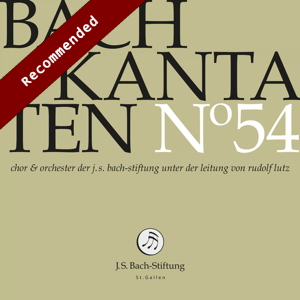
Johann Sebastian Bach (1685-1750)
Cantatas Volume 54
Cantata BWV 76 “Die Himmel erzählen die Ehre Gottes” (1723)
Cantata BWV 101 “Nimm von uns, Herr, du treuer Gott” (1724)
Choir and Orchestra J.S. Bach-Stiftung / Rudolf Lutz
rec. live, 18 November 2022 (BWV101), 24 May 2024 (BWV76), Evangelischen Kirche, Trogen, Switzerland
Reviewed as lossless download
JS Bach-Stiftung C760 [57]
That this is the fifty-fourth volume of a series of Bach cantata recordings of which I was unaware is somewhat embarrassing. However, it would seem that my colleagues have also been similarly oblivious, with one exception, as far back as 2011 from a reviewer who has not written for us for a long while (review). This was of three filmed performances on DVD – there are more than 100 available for purchase – and not therefore part of the numbered series of audio recordings.
The J.S. Bach-Stiftung (Foundation) is an organisation based in St Gallen, Switzerland, founded in 2006 with the intention of performing and recording all Bach’s cantatas – one live performance per month – with a planned completion date of next year. So better late than never for catching up with it. The very comprehensive booklet notes describe the Foundation’s intention as striving “to raise the profile of Bach’s vocal works”. Given the number of cantata recordings, including complete cycles, in existence already, I’m not sure the profile is all that low. Nevertheless, commitment to such a major undertaking is welcome. My reference for these works as a collection is the Suzuki/BIS series, but I’m always on the lookout for excellent individual performances.
BWV76 is a substantial work, comprising two parts and fourteen movements, for SATB and choir, and is a very significant one in Bach’s career, being his first at the Thomaskirche. Lutz is a couple of minutes quicker than Suzuki across the more than half an hour span, but the difference in individual movements is not especially apparent.
The more obvious difference between the Lutz and Suzuki versions is the choice of keyboard continuo, Lutz opting for a very jangly harpsichord while Suzuki uses a chamber organ. In the opening chorus, which made an immediate and very positive impression, the harpsichord helps to lighten the texture, but in the tenor aria “Hasse nur, hasse mich recht”, where the accompaniment is stripped back to cellos and keyboard, Lutz’s harpsichord sounds like something from the silent movie era or a ghost train ride at the circus. Suzuki’s choice of a chamber organ gives the movement much more gravitas.
In both works, Lutz uses mezzo Margot Oitzinger, whereas Suzuki has a counter-tenor in Robin Blaze. While both sing very well, I did prefer the warmer sound of the female voice. The virtuosic aria for bass “Fahr hin, abgöttische Zunft!” seems to stretch Peter Kooij at times, but he sounds more like a bass than Chiyuki Urano for Suzuki, who seems more like a tenor singing at the bottom of his range.
In BWV101, the opening chorus offers up contrasting approaches from Lutz and Suzuki. The latter is almost two and a half minutes slower, and Lutz’s more joyous and energetic reading wins out very comfortably over Suzuki’s overly reverential one. There is not much difference in the remaining movements, and indeed Suzuki is a little quicker in most. In the tenor aria “Handle nicht nach deinen Rechten”, Lutz uses what is apparently the second version of the score where there is a weaving solo part for violin, whereas Suzuki has this part played by transverse flute. Apparently, this was how the original performance was scored, because Bach had access to a virtuoso flute player. When the cantata was repeated a year or so later, that player was no longer available. The violin part is what is shown in the score I have, and I have to admit a preference for it, though there is no question the flute version is quite striking.
My colleague John Quinn and I established a friendly rivalry as he preferred the cantata recordings of John Eliot Gardiner on Soli Deo Gloria which were being released at a similar time to those of Suzuki; we could see the qualities in each, but John preferred the dynamism of Gardiner, while I liked the gentle, more serene Suzuki approach. Where does Lutz fit in? On the admittedly small sample of these two cantatas, I would put Lutz closer to Suzuki than Gardiner in terms of dynamics, while his tempos are, more often than not, a little quicker. The Lutz performances have a lighter texture, which I assumed meant fewer players and singers than Suzuki, but it turns out to be the opposite. In BWV101, Lutz has twelve strings to Suzuki’s nine, and twenty in the choir, compared to Suzuki’s twelve.
The performances are historically informed, and the instruments appropriate to Bach’s time. However, it is not aggressive HIP; only on a few occasions did I detect some rawness in the strings. Performances are generally excellent from all concerned.
The miking is quite close, which makes for a very vivid sound, but also means we hear the wind players and singers taking gulps of air during extended sequences. While they are live performances, you would not know the audience was there. The booklet notes are as good as you would ever wish (they are worth a Recommended nomination by themselves). Each cantata is allocated a three page analysis, which is informative for all levels of reader, plus three other extended articles, only one of which would seem to be a constant across each volume.
I should mention that the cost of the CDs (available from the Foundation) is substantial – around £30. The cost is hardly surprising, given the scale of the enterprise and the small size of the Foundation. Downloads (from Presto) can be better value but this volume is not currently available there, only the individual cantatas and neither is supplied with the superb booklet.
You will have gathered by now that I have been very impressed. The performances are the equal of Suzuki’s, better in some places, not quite in others. If you love the extraordinary creation that is Bach’s collection of cantatas, regardless of how many recordings you already have, and in which camp your affections reside, you owe it to yourself to listen to some (or indeed all) of these Swiss recordings. I intend to follow up with some of the other volumes containing my favourites.
David Barker
Soloists
BWV76
Stephanie Pfeffer (soprano), Margot Oitzinger (mezzo), Daniel Johannsen (tenor), Peter Kooij (bass)
BWV101
Miriam Feuersinger (soprano), Margot Oitzinger (mezzo), Daniel Johannsen (tenor), Wolf Matthias Friedrich (bass)