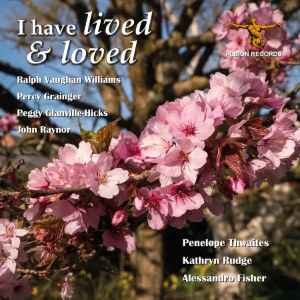
I Have Lived & Loved
Alessandro Fisher (tenor), Kathryn Rudge (mezzo-soprano)
Penelope Thwaites (piano)
rec. 2024, Potton Hall, UK
Albion Records ALBCD066 [71]
A couple of my colleagues beat me to the draw in appraising this album, so I put it to one side. However, the recent experience of hearing Roderick Williams sing Elgar’s Sea Pictures at the Three Choirs Festival (review) prompted me to return to this disc, which offers the first commercial recording issued by a label of Songs of Travel sung by a female singer. Though I have heard female singers in selected items from this cycle, I have never heard the complete work sung other than by a male voice. Consequently, one must cast aside old ‘muscle memory’ and, as with Williams in Sea Pictures, try to listen with unprejudiced ears. Actually, neither Elgar’s cycle nor Songs of Travel is gender specific – though a few of Robert Louis Stevenson’s poems imply the male gender and I noticed that in her excellent booklet essay Penelope Thwaites consistently refers to the protagonist of Stevenson’s poems in the masculine. However, I don’t believe there’s any reason in principle why either cycle should not be sung by a singer of the opposite gender to that to which we have become accustomed. In the aforementioned Elgar performance, I noted some instances where the baritone voice could not achieve the cut-through against the orchestra that we might experience from a well-focussed mezzo voice; however, such practical constraints do not arise when, as here, a singer is working just with a pianist.
Kathryn Rudge is a singer whose work I’ve admired in the past. Examples include her 2019 recording of Sea Pictures and The Music Makers (review); an earlier recording of some of Elgar’s orchestral songs (review); and also her advocacy for songs by Hamilton Harty (review). Bearing in mind these past experiences, I was keen to experience her in Songs of Travel. She makes a very good impression in ‘The Vagabond’: her diction is crystal clear and she deploys just enough vibrato to warm the tone without compromising clarity. Her voice falls very pleasingly on the ear. All these positive features will recur both throughout the cycle and, indeed, during her other contributions to this programme. I like the purposeful, steady tread at which this first song is taken. Both Rudge and Penelope Thwaites invest ‘Let Beauty Awake’ with warmth and a sense of rapture. ‘Youth and Love’ is expressively sung and the piano part is ideally voiced. ‘In Dreams’ has melancholy and introspection while ‘The Infinite Shining Heavens’ is nicely poised. Having noted all these positive virtues, though, I have to say that as the cycle unfolded, I began to feel that while Kathryn Rudge was articulating the songs with good expression, that expression seemed a bit uniform. That impression was confirmed in ‘Whither Must I Wander’; yes, the performance is expressive but I’ve heard other singers give more – and more variety. In terms of greater expressive variety and nuance I think of recordings by such singers as John Shirley-Quirk (review), Roderick Williams (review), or Anthony Rolfe-Johnson (review). (Bryn Terfel’s DG recording has been much praised by others, but it’s definitely not for me; he overwhelms the songs – and other items on the programme – and the result is rather like Wotan meets Vaughan Williams.) The opening of ‘Bright is the Ring of Words’ is one instance where I miss the sheer presence of a male voice; Ms Rudge’s opening is strong but not as ringingly declamatory as some I’ve heard. I will never understand why VW suppressed ‘I Have Trod the Upward and the Downward Slope’ during his lifetime; it is such a satisfying conclusion to the cycle. Here, Rudge and Thwaites make it just that.
I liked Kathryn Rudge’s account of Songs of Travel in which she’s perceptively partnered by Penelope Thwaites. It doesn’t dislodge my three longtime favourite versions, for the reasons I’ve mentioned, but I know that I’ll return to it. Ms Rudge has proved conclusively that VW’s cycle should by no means be regarded as the preserve of tenors and baritones.
From this point onwards in the programme Kathryn Rudge is joined by tenor Alessandro Fisher. In 2022, he made a very favourable impression when I attended a recital in which he performed On Wenlock Edge and gave the world premiere of Ian Venables’ fine cycle Portraits of a Mind. That impression was reinforced when he committed both cycles to disc (review). His first contribution to this present CD is a group of three solos from operas by VW. From The Poisoned Kiss we hear ‘Dear Love, Behold’, a delightful, expressive serenade which Fisher does extremely well. If anything, he’s even finer in ‘See the Chariot at Hand’ from Sir John in Love; here, his ardent, ringing delivery makes the best possible case for this number. He also gives us ‘The Devil and Bonyparty’ from Hugh the Drover, entering right into the spirit of the music and characterising the piece strongly.
We then move away from VW to two composers whose music was new to me. I was interested to learn that Peggy Glanville-Hicks had what may be a unique distinction: she was a pupil both of VW and, subsequently, of Nadia Boulanger. Come Sleep is described as an early work (I think it may date from 1931). Of course, John Fletcher’s poem was set unforgettably by Ivor Gurney; if Glanville-Hicks’ song doesn’t match Gurney’s incomparable setting it’s still a very good musical response to the text. ‘How Soon Will All My Lovely Days Be Over’ comes from Glanville-Hicks’ 1963 opera Sappho. There is a recording of the complete work (review), which I’ve not heard, but Penelope Thwaites tells us that the work has never achieved a staging. Here, the aria is given in an arrangement for voice and piano by Marshall McGuire; this is the first recording of the version. Beginning in deep melancholy, the music soon rises to impassioned eloquence. Rudge gives a vivid performance. John Rayner, of whom I’d not previously heard, was not a VW pupil but the senior composer encouraged him and sponsored a Wigmore Hall recital of his songs in 1948. Presumably in gratitude, in the same year, Raynor dedicated Spring to VW. Alessandro Fisher brings out the vernal eagerness in the music – what a ring he achieves on the final note of the song! Down by the River is a later piece; it dates from 1962. This is a setting of a Sussex folksong which has, in Penelope Thwaites’ words, “an elaborately chromatic accompaniment”. In fact, I don’t find that the accompaniment, for all it is elaborate, overwhelms the song in the way that sometimes happens in Britten’s folksong arrangements; perhaps that’s due in no small measure to the way Fisher commands our attention – and the expert way in which Thwaites judges the accompaniment.
The programme ends with a group of Percy Grainger settings. These are nicely varied and without exception they’re well performed. Kathryn Rudge puts across the narrative of Bold William Taylor very effectively. I also liked Fisher’s touching delivery of Fair Young Mary. Towards the end of the programme the singers combine in three duets; I was amused by their portrayal of a disputatious married couple in the typically idiosyncratic Hubby and Wifey. Up-Country Song is the composition also known as Colonial Song. Here, Penelope Thwaites is very much to the fore and the two (wordless) singers combine very well with her at various points in the piece.
I enjoyed this disc very much. The performance standards are very high and so is the standard of the documentation (as is Albion’s wont); Penelope Thwaites is as sure a guide to the music when she writes about it as when she is seated at the piano. Producer Tim Burton and engineer Deborah Spanton have recorded the performers very successfully.
John Quinn
Previous reviews: Nick Barnard ~ John France
Buying this recording via the link below generates revenue for MWI, which helps the site remain free
Contents
Ralph Vaughan Williams (1872-1958)
Songs of Travel (KR)
The Poisoned Kiss: Dear Love, Behold (AF)
Sir John in Love: See the Chariot at Hand (AF)
Hugh the Drover: The Devil and Bonyparty (AF)
Peggy Glanville-Hicks (1912-1990)
Come Sleep (KR)
Sappho: How Soon Will All My Lovely Days Be Over (KR)
John Raynor (1909-1970)
Down by the River (AF)
Spring (AF)
Percy Grainger (1882-1961)
Bold William Taylor (KR)
Weaving Song (KR)
Died for Love (KR)
Dedication II (AF)
Fair Young Mary (AF)
A Reiver’s Neck-Verse (AF)
Under A Bridge (AF, KR)
Hubby and Wifey (AF, KR)
Up-Country Song (AF, KR)