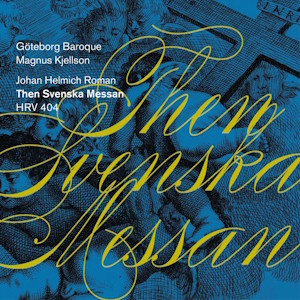
Johan Helmich Roman (1694-1758)
Then Svenska Messan (HRV 404)
Anna Jobrant (soprano), Amanda Flodin (contralto), Karl Peter Eriksson (bass)
Göteborg Baroque/Magnus Kjelsson
rec. 2020, Christinae Church, Göteborg, Sweden
Texts and translations included
Reviewed as a download
Nilento Records NILCD2103 [47]
Johan Helmich Roman is generally considered the ‘father of Swedish music’. This is not an assessment from later times such as the nationalist 19th century. His first biographer, Abraham Abrahamsson Sahlstedt, stated: “The Royal Intendant Roman can be called the Ancestor of Music in our country. Under his leadership many gifted geniuses were lifted up; the Swedish Orchestra entered a new day… The Swedish Youth was uplifted, and became more and more inspired to take part in this enjoyable pastime.” (1767) Roman was the first native composer of international importance.
He was a child prodigy at the violin, playing at the age of seven in the court orchestra in which his father was a violinist. From 1715 to 1721 he stayed in London, where he was sent by King Charles XII to perfect his skills. There he played in the orchestra of the Royal Academy of Music under George Frideric Handel as one of the second violinists. He also became acquainted with famous masters of that time, like Giovanni Bononcini, Francesco Geminiani and Francesco Maria Veracini.
When he returned to Stockholm, he was appointed deputy Master of the Swedish Royal Chapel with the task of building up musical life; in 1727, he was promoted to chapel master. The situation in the Swedish capital was very different from London: there were neither public concerts nor opera performances. According to Eva Helenius, the author of the liner-notes to the present disc, Roman aimed at improving the quality of music at the court and the musical education in Sweden at large as well as the use of Swedish in all vocal music.
As a result of his travels, Roman had become strongly influenced by the Italian style. However, at the court the French style was dominant. That is an interesting fact: at the end of the 17th century many rulers across Europe were impressed by the splendour of Versailles under the rule of Louis XIV, and wanted their court composers to write and perform music in the French style. Apparently, that was also the case at the court in Stockholm. Roman put much effort into the change of style, which met considerable resistance, but in the end, he succeeded, also thanks to the support of the Queen.
The disc to be reviewed here focuses on a lesser-known part of Roman’s oeuvre, although the ‘Swedish Mass’ is one of his better-known works. In 1731 he gave the first public concerts in Sweden with a performance of Handel’s Brockes Passion in the form of a pasticcio with fragments of music by Telemann and Benedetto Marcello, and in a Swedish translation. His oeuvre includes a large number of adaptations of music by contemporaries. The work-list in New Grove mentions “numerous reworkings of pieces by other composers, including Carissimi, Fux, Handel and Pepusch”.
In the preface to a programme with psalms from Marcello’s Estro Poetico-Armonico, Roman wrote: “The Italian words have been translated into Swedish in order for everyone to understand better the Author’s art of enhancing poetry through music … the intent of which is to seek to achieve the finest result, so that ideally in Sacred Music one will not henceforth have to continue to use foreign languages, which produce little in the way of devotion or understanding among those who are not in command of the language”. This ideal not only explains his adaptations of music by foreign masters, but also his Swedish Mass, which dates from around 1750, probably Spring 1751.
Roman himself called this work simply Kyrie; later it was given the title of ‘Swedish Mass’ (Svenska Messan). It is of the missa brevis type that we know from Lutheran Germany. Like Bach’s short masses, it consists of Kyrie and Gloria. The Kyrie is written as one section; the Gloria is divided into twelve sections. The first and the last are for choir, whereas the sections in between are either solos – for soprano, alto and bass respectively – or scored for soli and choir. The orchestral parts are scored for two oboes, strings and basso continuo.
The Kyrie, opening with an instrumental introduction, is very concise. It takes just two minutes in this recording. The tempo indication is lento. The Gloria starts with an andante maestoso. After an instrumental episode the bass opens the vocal part. The tutti section is written in the baroque polyphonic style. The first solo section is ‘Vi lofve tig’ (We praise you), for soprano, accompanied by two violins, playing mostly in parallel motion, viola and basso continuo. The second aria is again for soprano: ‘O Herre Gud, himmelske Konung’ (O Lord God, heavenly King). It ends with a short written-out cadenza. It is followed by a solo for soprano and alto respectively: ‘O Herre thens aldra högstes’ (O Lord, the most High). In fact, it is a sequence of two independent arias for each of the two voices, which join in the third section, singing in parallel motion or in imitation. Next is the most expressive section of the mass, ‘O Herre Gud, Guds Lamb’ (O Lord God, Lamb of God), scored for alto, two violins, viola and basso continuo. The violins play with mutes, which fits the text: “O Lord God, Lamb of God, Son of the Father, you who take away the sins of the world, have mercy upon us.” It is followed by a duet for soprano and bass: ‘Tu som sitter på Fadrens högra hand’ (You who sit at the right hand of the Father). The bass takes the lead, and the soprano mostly imitates him.
The penultimate section, marked allegro, has a jubilant character: “For you alone are the Holy One, you alone are the Lord, you alone are the most high, Jesus Christ.” The score includes fortissimi in the strings. The mass comes to a solemn conclusion with a choral section, marked grave.
It is a bit of a shame that this is the only work on this album. The fact that Roman adapted so much music from the Renaissance and Baroque periods is quite intriguing, and I would love to hear some of that; the inclusion of such works would have made this album even more attractive. However, the short playing time should not withhold anyone from purchasing it. I don’t know how often this work has been recorded; I know of just one recording, which was released many years ago by BIS, and which I have not heard. It seems highly unlikely that it is better than this performance, which is pretty much ideal. Sacred music of the Baroque era was never written for solo voices, choir and instruments, but always for an ensemble of singers and players, whose members took care of solo parts. That is how Roman’s Mass is performed here. The vocal ensemble consists of eleven voices (SSSAATTBB); three of its members perform the solo parts. Anna Jobrant, Amanda Flodin and Karl Peter Eriksson do so very well; I can’t imagine better performances of the solos than they get here. All three have very pleasing, flexible voices, and pay much attention to the text. The vocal line-up also guarantees a maximum integration of soli and tutti. The instrumentalists do a great job, too.
Roman’s Svenska Messan is an excellent piece, and makes one curious about the rest of his sacred oeuvre, which deserves to be thoroughly investigated.
Johan van Veen
http://www.musica-dei-donum.org
https://twitter.com/johanvanveen
https://bsky.app/profile/musicadeidonum.bsky.social
Buying this recording via the link below generates revenue for MWI, which helps the site remain free