
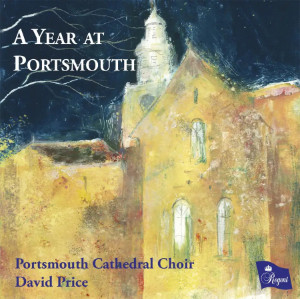
A Year at Portsmouth
Sachin Gunga (organ)
Portsmouth Cathedral Choir/David Price
rec. 2024, Portsmouth Cathedral, UK
Regent REGCD592 [79]
It was fifty years ago that I was last in Portsmouth Cathedral. There was no service on, the organ was not playing but the door was open, so I had a good look around. Afterwards, I walked the few hundred yards to the Coal Exchange (now Spice Island) pub on Broad Street. The view across the harbour from The Point was outstanding. The United Kingdom had many Royal Navy vessels in those days, and I watched a frigate arrive into port. Somehow, I never got back. I have explored the area on Google Maps and there seem to have been lots of changes there.
Portsmouth Anglican Cathedral, dedicated to St Thomas of Canterbury, stands at the heart of Old Portsmouth as a dignified landmark formed by centuries of maritime history. Its origins lie in a 12th‑century chapel, expanded and adapted as Portsmouth grew into a major naval city. The building blends medieval remnants with later Georgian and contemporary additions; the West End was completed in 1991.
There is a long tradition of music at the Cathedral. The present choir comprises twenty-four boy and twenty-two girl choristers, alongside a team of lay clerks and choral scholars. The choir is directed by the Organist and Master of the Choristers, David Price, a well-regarded recitalist and composer. He is assisted by the sub-organist, Sachin Gunga, who also serves as the School Organist at Portsmouth Grammar School.
At the time of my visit, I was a nominal Presbyterian, from a tradition that paid little attention to the rhythm of the church’s liturgical seasons, apart from Christmas and Easter. There was certainly no observance of the Saints, not even of the church’s own patron, St Andrew.
In the CD booklet, Canon of Honour at Portsmouth Angela Tilby reminds the listener that the Christian Year “provides a rich syllabus of the Christian faith […] to follow the seasons in music from Advent to Pentecost is to enjoy an aural feast that is grounded in faith and wonder”.
A Year at Portsmouth ranges across the liturgical calendar, beginning with, as noted, Advent through to St Cecilia’s Day on 22 November, honouring the patron saint of music. In keeping with Portsmouth’s identity as the Cathedral of the Sea, it embraces not only the principal Christian feasts but also traditions rooted in the city’s maritime life, including the annual Seafarers’ Service, Remembrance Sunday, the Royal Marines Band Memorial Service, and the commemoration of D‑Day.
The anthems included on this disc range across the centuries. The earliest is Handel’s ‘How Beautiful are the Feet’ from Messiah with a beautiful treble solo by Daniel Sands. Evelyn Cowhig gives a stunning account of Mozart’s famous setting of Laudate Dominum. The 19th century is represented with two rarities: the simple but near-perfect Hail, Star of the Sea (Ave Maris Stella) by Edvard Grieg which is sung during Advent, and the straightforward Lord’s Prayer by Nikolai Rimsky-Korsakov. Our own Charles Villiers Stanford celebrates the Ascension with his masterful Coelos ascendit hodie.
Moving on in time, I was particularly struck by Gustav Holst’s setting of Clifford Bax’s poem, Turn Back, O man. This anthem is often used at the Royal Marines Memorial Service held in the Cathedral. The burden of the text is that Humanity must abandon its foolish ways and awaken from dark dreams to unite as one, fully realising a Fair Earth.
The rest of the programme features music from the late 20th and early 21st centuriy by a variety of greater or less-well-known composers.
I was impressed with Philip Moore’s spectacular Advent anthem All wisdom cometh from the Lord, which opens the disc, with splendid words from the Old Testament book of Ecclesiastes and Psalm 119. Moore also provides the only organ solo in this concert: Fanfare de Maris, written to celebrate the addition of the bright chamade trumpets to the cathedral’s Nicholson organ.
Christmas is observed with the late Richard Lloyd’s bouncy I saw three ships. Lloyd, former organist of Hereford and Durham Cathedrals, also contributes a dignified setting of Thomas Campion’s View me, Lord, a work of thine. Gregorian chant permeates Brian Moles’s devotional response to the Magnificat, sung here to commemorate the Annunciation. Undine Smith Moore’s We Shall Walk Through the Valley projects a quiet, resolute hope, its African American Spiritual roots shaped into a contemplative choral utterance. Listeners used to Charles Wesley’s incomparable words Love Divine, all loves excelling being sung to Hyfrydol or Blaenwern will be delighted by Howard Goodall’s fresh and eloquent treatment.
The British composer conductor George Arthur Richford contributes a moving response to Paul Verlaine’s poem Les sanglots longs / Des violons / De l’automne (The long sobs of violins of autumn), which was used during the Second World War as radio code to contact the French Resistance in the days leading up to the Normandy Invasion of 1944. The present piece, coloured by slightly astringent harmonies, was composed for the 80th Anniversary of D-Day commemorations.
Michaelmas marks autumn’s arrival, celebrating St Michael with harvest traditions, shifting light, and a reflective turn toward the year’s end. Paul Trepte’s The Gateway of Heaven muses on the biblical story of Jacob’s ladder, with the angels ascending and descending. It is a reticent number; baritone Alex Wallace adds to the work’s contemplative, upward‑yearning character.
One of the great seafaring biblical texts is taken from Psalm 107: They that go down to the sea in ships. British composer, singer and choral director Grayston Ives has provided a stirring setting, although at times it becomes a little muddy in the ‘middle eight’.
John Rutter’s The Lord is my light, and my salvation is a musical reading of Psalm 27 for tenor, clarinettist and choir. I am not sure it is an ideal choice for All Saints’ Day. That said, there are moments when Rutter’s trademark luminous warmth shines through.
I found Philip Stopford’s In My Father’s House a little hard going, yet like in so many anthems there are moments of pure delight. It may feel weighty in places, but its tender climaxes and well‑shaped phrases offer the listener true reward.
Mark Blatchly’s anthem For the Fallen sets the well-loved words by Lawrence Binyon. It is an early piece written when he was an undergraduate at Christ Church, Oxford. It was premiered by St Paul’s Cathedral Choir at the Royal Albert Hall Festival of Remembrance, 1980. The listener cannot fail to hear echoes of Edward Elgar. The Last Post, played on the trumpet, is cleverly introduced into the final verse.
The disc closes with Matthew Coleridge’s A Song for St Cecilia, commissioned by Portsmouth Cathedral in 2022. Joseph Addison’s poem asks the Muse’s help to “Enliven our earthly airs” with the thought of God. Sung at the Evensong celebrating the Patroness of Music, this short anthem brings the recital to an exciting, thoughtful conclusion.
The booklet provides a brief introduction to the cathedral itself, the welcoming notes from Angela Tilby and Anthony Cane, Dean of Portsmouth. I would have liked dates for all the tracks: I have provided those where convenient. The texts are given along with brief sentences about each piece. Résumés of the choir and musical staff are included. A web address linking to the “History of the Organ” is given. This incorporates the full specification.
In sum, A Year at Portsmouth is a richly rewarding release that beautifully blends timeless sacred classics with compelling modern works. Guided by David Price’s expert direction, the Portsmouth Cathedral Choir captures the quiet solemnity of the liturgical seasons and the unique maritime identity of their historic home. It stands as a fitting, heartfelt celebration of faith, history, and choral excellence
John France
Buying this recording via the link below generates revenue for MWI, which helps the site remain free
Contents
Philip Moore (b.1943)
All wisdom cometh from the Lord
Edvard Grieg (1843-1907)
Hail, Star of the Sea (Ave Maris Stella) (1898)
Traditional – arr. Richard Lloyd (1933-2021)
I Saw Three Ships
Richard Lloyd
View Me, Lord
Brian Moles (b.1979)
Magnificat (The Fourth Service)
Nikolai Rimsky-Korsakov (1844-1908)
Our Father (The Lord’s Prayer)
Undine Smith Moore (1904-1989)
We Shall Walk Through the Valley
Howard Goodall (b.1958)
Love Divine
Charles Villiers Stanford (1852-1924)
Coelos ascendit hodie (pub.1905)
Wolfgang Amadeus Mozart (1756-1791)
Laudate Dominum, K. 339 (1780)
George Arthur Richford (b. 1985)
Chanson de Normandie (2024)
George Frideric Handel (1685-1759)
How Beautiful Are the Feet (Messiah) (1741)
Philip Moore
Fanfare de Maris (Organ Solo)
Paul Trepte (b.1954)
The Gateway of Heaven
Gustav Holst (1874-1934)
Turn Back, O Man (1916)
Grayston Ives (b.1948)
They That Go Down to the Sea in Ships
John Rutter (b.1945)
The Lord is my Light and my Salvation.
Philip Stopford (b.1977)
In My Father’s House
Mark Blatchly (b.1960)
For the Fallen (1982)
Matthew Coleridge (b.1980)
A Song for St Cecilia (2022)













