
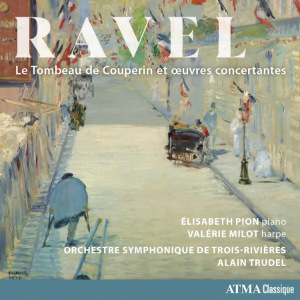
Maurice Ravel (1875-1936)
Le Tombeau de Couperin, M. 68a
Pavane pour une infante défunte, M. 19a
Introduction et Allegro, M. 46
Piano Concerto in G major, M. 83
Élisabeth Pion (piano)
Valérie Milot (harp)
Orchestre symphonique de Trois-Rivières/Alain Trudel
rec. 2024/25, Salle de concert Oscar-Peterson, Montréal, Canada
Atma Classique ACD22941 [64]
2025 marked the 150th anniversary of Ravel’s birth, and there were quite a few releases to celebrate the occasion. These have continued into 2026, and beyond this new recording, there is another waiting in my to-be-reviewed queue.
Le Tombeau de Couperin is interesting because it includes the two movements not orchestrated by Ravel, the Fugue and Toccata; the orchestrations were done by British composer Kenneth Hesketh in 2013. Ravel considered them to be “too pianistic” to be orchestrated, but Hesketh has done a good job with them – they certainly don’t stand out as being by someone other than Ravel. The Introduction et Allegro is performed here with a full complement of strings, which tends to obscure the delicate writing for harp and winds.
The Orchestre symphonique de Trois-Rivières is based in the eponymous city, in the province of Quebec. Given the city has a population of less than 150,000, it is doing very well to support a professional orchestra. However, releasing a recording of music recorded many times by the greatest orchestras and soloists is courageous, as Sir Humphrey would have said. This isn’t just a souvenir disc, it is a fully commercial release on a respected label, and is thus asking for comparison with those greats. My comparison for Le Tombeau and Pavane was the Boston Symphony with Claudio Abbado (Deutsche Grammophon). This is where I must be unkind, or at least critical: while the orchestra plays perfectly well, it lacks the finesse of the Bostoners (hardly surprising), and the interpretations are mostly fairly mundane, missing the subtleties of colour and detail brought out by Abbado. By way of example, the phrasing of the beautiful horn part that opens the Pavane is very plain, no real shaping or variation. I should say that Trudel’s Prélude and Rigaudon from Le Tombeau are well done.
Élisabeth Pion is a young Canadian pianist, who has performed at Wigmore Hall, won some competition prizes in her homeland and recorded previously for Atma Classique, so she clearly is talented. Unfortunately, this recording does not really show that. My comparison was the great Martha Argerich recording (again DG), with Abbado, this time in Berlin, and the comparison wasn’t flattering. The slow movement must be one of the most beautiful pieces of music written in the 20th century, and sounds deceptively simple, in the way that Mozart can sound simple and so clearly is not. Pion sleepwalks through it without finding any sensuousness or poetry, and at one point it descends into cocktail bar background music. The riotous start to the final movement lacks the snap and élan of Argerich/Abbado; it sounds a little like she is mainly making sure all the notes are there.
The recording quality is good, and the notes provide some good background to the works, though one has to wonder why the English version is all in italics, making it harder to read (the French isn’t).
There is nothing really wrong with this recording, and for the players and supporters of the orchestra, it should be seen as recognition of their achievement in an era where much bigger name orchestras have gone to the wall. That perhaps sounds a little patronising, and certainly isn’t intended to be, but unfortunately, it simply isn’t competitive when compared with the best.
David Barker
Buying this recording via the link below generates revenue for MWI, which helps the site remain free














For anybody interested in the six-movement version of the orchestral Le Tombeau de Couperin, the Sakari Oramo – Royal Stockholm Philharmonic Orchestra recording on a BIS SACD (https://www.prestomusic.com/classical/products/9309151–ravel-la-valse-m-72-other-works) programs the exact same Kenneth Hesketh orchestrations of the Fugue and Toccata movements along with other assorted Ravel orchestral works. It has generally been well-received by most reviewers, including here at Musicweb International (https://www.musicweb-international.com/classrev/2022/May/Ravel-Valse-BIS2438.htm).
I maintain that Zoltan Kocsis’s orchestration of the other two Tombeau movements is more convincing, even though he used instruments in the Toccata that Ravel did not use in the other movements, the final effect is very imaginative.