
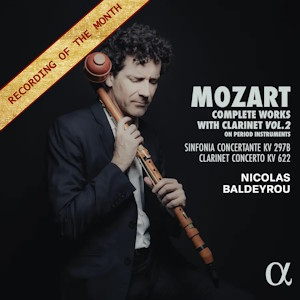
Wolfgang Amadeus Mozart (1756-1791)
Complete Works With Clarinet Volume 2
Sinfonia Concertante in E flat, K.297b
Clarinet Concerto in A major, K.622
Nicholas Baldeyrou (clarinet)
Gabriel Pidoux (oboe), David Guerrier (horn), David Douçot (bassoon)
Kölner Akademie/Michael Alexander Willens
rec. 2025, Emmanuelskirche, Wuppertal, Germany
Alpha Classics 1243 [59]
I enjoyed volume one of this series by Nicholas Baldeyrou so much that I made it one of my recordings of 2025. It is too soon to say whether this disc will be following it in 2026, but early signs are certainly good: it is as expertly put together and as beautifully played as its predecessor.
Let us leave aside the point that the wind Sinfonia Concertante might not even be by Mozart. When you hear it played as delightfully as it is played here, that detail will not bother you. You can tell that it is a treat long before the soloists enter. The wheezy tone of the strings in the opening tutti sounds almost like a hurdy-gurdy man warming up his machine for an afternoon’s entertainment. It really suits the “getting ready” tone that such a concerto exposition should have, and I found it really beguiling.
The orchestra provides an exceptionally strong foundation layer for the concerto as it unfolds. However, Michael Alexander Willens is sensible enough to make the Kölner Akademie co-partners rather than scene-stealers, because there is no doubt that the quartet of soloists are really where the action is.
The CD booklet lists the names of the soloists all individually. As in Volume 1, this showcases the idea that this is not a prefabricated ensemble. Instead, it is a collection of players who have come together to form a unit and, in doing so, have sublimated their egos while retaining their individuality. Baldeyrou’s clarinet is no more than a primus inter pares here, albeit a lovely one, with juicy longer notes and gurgling runs that sound utterly lovely. The distinctive rasp of David Guerrier’s natural horn is also a unique actor in this troupe, as is the uncommonly romantic low oboe sound of Gabriel Pidoux, ardent in its lower register but soaring in its upper phrases. David Douçot’s bassoon is more of a supporting player until the variations of the finale, but his support is never lovelier than in the quasi-operatic slow movement where the higher soloists sound like they are serenading one another in a blissful love song where anything is possible.
The finale with its set of variations is a total delight. Every soloist gets a moment in the limelight, yet they all maintains that gorgeously euphonious blend that characterises the rest of the work. All four of them seem to conspire winkingly with Willens in the final variation. They join the orchestra in a climactic whirl towards the finish line, giving the strong impression that everyone involved in making the recording was having an absolutely wonderful time. This reviewer, who was only involved in listening to it, had a wonderful time, too.
The booklet note makes the somewhat surprising point that this is the first recording of the Sinfonia Concertante where all four of the soloists were playing historically authentic copies of the Parisian instruments of the period. The desire to recapture the sonic authenticity of Mozart’s sound world is one of the things that has made Baldeyrou’s series so special so far. It is no surprise, then, that in the Clarinet Concerto he plays a copy of a basset clarinet of the period, the more effectively to capture the sense of wistful beauty of Mozart’s final concerto.
Right from his first entry, Baldeyrou’s chosen instrument makes a huge difference, and not just in the added notes in the lower range. It has an extra quality of breathiness to it, making it sound more than ever like a human voice in its delicate vulnerability. That beautifully suits the concerto’s autumnal tone, and Baldeyrou adds to it with a few discrete ornamentations in the repeated or cadenza-like phrases. Complementing this, the orchestral tone is gentle and transparent, as though Willen wants you to hear the spaces in between the phrases as well as the notes themselves.
The slow movement is beautiful without being sentimental. The tempo is broad but does not wallow. In the central section, Baldeyrou adopts a gorgeously conversational tone, as though he is extemporising conversationally rather than trying to make you weep. There is a gorgeous sense of melancholy to the famous main melody, though, with the long-breathed notes sounding even more lovely, even slightly fragile, because of the airiness of the instrument’s tone. There is no fragility to the finale, however. It bounces and wheels its way along with winning energy and a terrific kick, offset by Baldeyrou’s energetic ornamentations which are fun without being intrusive.
In short, this is another winner: sensitively played and beautifully recorded, too. Speed on volume 3!
Simon Thompson
Buying this recording via the link below generates revenue for MWI, which helps the site remain free













