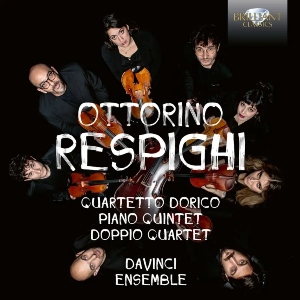
Ottorino Respighi (1879-1936)
Quartetto Dorico (1924)
Piano Quintet in F minor (1902)
Quartetto Doppio in D minor (1900)
DaVinci Ensemble
rec. 2024, BartokStudio, Bernareggio, Italy
Reviewed as lossless download
Brilliant Classics 97379 [60]
I think it’s safe to say that chamber music is not the genre that comes to mind when thinking of Respighi’s music. Anyone coming to these three works expecting the colour and vibrancy of the Roman Trilogy or the Ancient Airs and Dances will find them rather dry.
I think it was a mistake to put the Quartetto Dorico first on the disc. There’s no doubt that it is the most substantial and well-written work of the three, but its very restrained and ascetic atmosphere, together with the unbroken twenty-four minute span may cause those new to it to switch off. Of its relatively small presence in the catalogue, the most significant recordings are those by the Brodsky Quartet (Challenge Classics) and the New Hellenic Quartet (BIS – review). In his review of the BIS recording, my colleague Glyn Pursglove described the work as “both lush and austere”, which I think is a perfect description, though I’d say the work is more the latter than the former. The earlier recordings take just over 21 minutes, while the DaVinci Ensemble takes over 23. It makes a little bit of difference, but more importantly, the playing of the Brodsky, and also the much less well-known New Hellenic, wins out in smoothness over the DaVinci, who are good, but not as good as the others.
The Piano Quintet was written after Respighi’s return from studies with Rimsky-Korsakov, but it shows little sign of that, rather a lot of time listening to Brahms. The work is unbalanced, with a grand and dramatic ten-minute opening movement, followed by a slow movement less than two and a finale under five. The slow movement feels like it was left unfinished, but I should make it clear that there is no historical or musicological suggestion indicating that is the case; it’s just my impression. The Vivacissimo final movement is quite a delectable offering with a lovely slow mid-section, bookended by driving rhythms, but again it feels like it is over too soon. I have another recording – there aren’t many – by the Ambache ensemble on Chandos, which takes each movement more slowly, and that is not for the better. This is the DaVinci’s best performance of the three.
This is the second outing for the Quartetto Doppio in little more than a year. The first, a premiere recording as far as I can tell, impressed me greatly (review), and this new version reinforces that opinion. In the earlier review, I praised the work’s diverse moods and the skilful way that Respighi took us from one to the next. Each movement has its own charms, but the Hungarian dance that closes the work is wonderfully entertaining. Again, I felt that the DaVincis were not as smooth as their competitor, the Dutch ensemble Roctet, which is a permanent string octet, and thus much more used to playing in that format than the DaVinci ensemble which adds and subtracts players as necessary.
My main criticism of the DaVinci Ensemble’s playing was a lack of smoothness; there was a raw wiry “quality” to the strings, especially at high volumes, which was not appealing. I did wonder if some of this could be attributed to a rather dry acoustic. The booklet notes provide a little bit of historical context, but mainly concentrate on the thematic structure of each work.
This provides a good, fairly inexpensive, sampling of Respighi’s chamber music, but those coming to it for the first time should not expect Roman fireworks.
David Barker
Buying this recording via the link below generates revenue for MWI, which helps the site remain free