
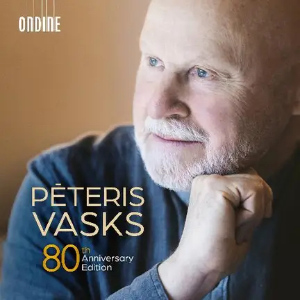
Pēteris Vasks (b. 1946)
80th Anniversary Edition
rec. 2002-2007
Latin text and English translation included
Ondine ODE1482-2T [3 CDs: 208]
The veteran Latvian composer Pēteris Vasks is eighty this year, and, in celebration, Ondine have put together three of their recordings of his work into one package. They have made at least ten discs of his music, so presumably they thought that these three were the best, or perhaps the most popular, or perhaps they had some other reason to choose them. Anyway, they have a somewhat miscellaneous character: we have the second and third symphonies, but not the first, the Symphony for Strings known as Voices. Similarly, they have included the first violin concerto, Distant Light, possibly the composer’s most celebrated work, but not its successor, In Evening Light. Again, we have the first cello concerto but not the second. All these missing works have been recorded, but not by Ondine, so they can’t be criticized for not including them, but it does make the collection look haphazard. The third disc is not orchestral, but a group of choral works.
Vasks, like his rather older contemporaries the Estonian Arvo Pärt, the Georgian Giya Kancheli and the Ukrainian Valentyn Silvestrov, grew up under the Soviet system when all these countries were part of the Soviet Union. They all had difficulties with the state authorities but, with the end of the Soviet Union, were able to forge their own paths, though there are some similarities across their music because of the circumstances of their upbringing. Although they all engaged with Western modernism, they largely prefer a less dissonant idiom and their music often has a spiritual dimension.
The first disc here has the second symphony and Distant Light. The second symphony is in four sections with a coda, which play continuously for about forty minutes. There is a minatory start and the opening section is reminiscent of Shostakovich in its idiom. A sudden pause leads to a much quieter passage, introduced by cor anglais and flute, which nevertheless builds to a climax. Another section is mysterious and quiet and permeated with the sounds of woodblocks, which sound like trotting horses. There is then a kind of scherzo, going at a tremendous rate. The final coda brings back the minatory mood of the opening before moving to a serene conclusion.
Distant Light is in eight sections which again play continuously. The solo violin is accompanied by a small string orchestra. It begins very quietly at a high pitch on the solo violin which leads to a long, winding lyrical line with a shimmering accompaniment. There is then the first of three cadenzas which become progressively more virtuosic. The next section begins in the low bass with the violin also in its low register. There follows a faster section, then the second cadenza and then a burst of energy in a dance. An anguished passage has some dissonant noises and the final cadenza before the conclusion returns to the mood of the opening. The idiom is not very different from that of the Estonian Arvo Pärt and I was also reminded of John Tavener’s violin concerto Lalishri. The violin writing is occasionally reminiscent of Brahms, whose concerto perhaps Vasks looked at before writing his own; it is, of course, none the worse for that. It seems to me clearly a masterpiece, with a balance maintained between the serene atmosphere and more challenging material.
This disc dates from 2002. John Storgårds conducts the symphony but leaves the podium to take up the violin for Distant Light, for which Juha Kangas conducts. It was well received by MWI (review) and this is the only recording, so far, of the second symphony. Distant Light has been recorded several times.
The second disc has the third symphony and the first cello concerto. The symphony is about the same length as its predecessor. It opens with a long, somewhat mournful melody over a pounding bass. That sounds rather like the opening of Brahms’s first symphony, and, indeed, there is a similar stern and sombre feeling about this work. However, this passage breaks off and quite different material comes in. Throughout the work there is a pattern of new material, which comes in quietly, gradually builds to a climax and is followed by a silence before the work resumes with something else. This is not at all like Brahms but is reminiscent of Bruckner. Vasks here likes composing in blocks. I should add that the musical material is all memorable and attractive and the work is compelling.
The first cello concerto is in five clearly distinct movements, each of which is named. It also has a programmatic aspect, invoking the suffering of the Latvian people under the Soviet regime. The opening Cantus I evokes a world of ideal beauty and is predominantly lyrical. Toccata I is fierce and rapid, with explosive energy. The central Monologhi features expansive meditation by the cello, interrupted by outbursts from the orchestra; it is, in fact, more an argument than a monologue. You may think of the central movement of Beethoven’s fourth piano concerto as a comparison. There are also two cadenzas for the soloist. Toccata II is even fiercer than its predecessor, has another cadenza and ends with a huge crash. The final Cantus II is serene. This is an excellent and most moving work, and I am surprised that this is still its only recording so far. This disc dates from 2006.
The third disc is of religious music and dates from 2007. Vasks’s father was a Baptist minister. He encouraged his son to make a setting of the Lord’s prayer, Pater noster, but the composer did not feel able to do so for many years. The Soviet authorities forbade sacred music. By the time Vasks was able to make this setting his father had died. The setting is in both Latvian and Latin; it is sung in Latin here. Vasks explains that he had no exposure to Latin as a child but came to love the language later. He sets the prayer complete with the final clause which is generally used by Protestants but omitted by Catholics.
Dona nobis pacem is for mixed choir and string orchestra. It does not, as one might expect, set the whole of the Agnus Dei, from which that phrase comes, but only those three words, repeated again and again in waves of sound which build up and then break off suddenly at the climax. Despite the brevity of the words, this is quite a substantial setting.
The Mass omits the Credo but has an extended setting of the Sanctus and Benedictus. All these liturgical settings are in a lush romantic idiom with very full writing for accompanying strings. In them, Vasks deliberately eschewed the more experimental idiom he adopted for his non-religious choral works. All three works are expertly delivered by the Latvian Radio Choir.
The performances and recordings are all good. The booklet is interesting and contains the Latin texts and English translations of the religious works. (It uses the new translation, which for some reason gives ‘sin of the world’ for the Latin peccata mundi, which means ‘sins of the world’.) There are several other recordings of Distant Light and one other of the third symphony. You will have to look elsewhere for the first symphony, subtitled Voices, and the second violin and cello concertos, but if you are a Vasks enthusiast and missed out on these issues when they first appeared, this is a good opportunity to pick them up.
Stephen Barber
Buying this recording via the link below generates revenue for MWI, which helps the site remain free

Contents
Symphony No. 2 (1998)
Violin concerto No. 1 Distant Light (1997)
John Storgårds (violin in distant Light, Tempere Philharmonic Orchestra/John Storgårds (symphony), Juha Kanga (Distant Light)
rec. 2002 at Tampere Hall, Finland (symphony 2), Folk Art Centre, Kaustinen, Finland (Distant Light)
Symphony No. 3 (2005)
Cello Concerto No. 1 (1994)
Marko Ylönen (cello), Tempere Philharmonic Orchestra/John Storgårds
rec. 2006 at Tampere Hall, Finland
Pater Noster (1991)
Dona nobis pacem (1996)
Missa (2000/2005)
Latvian Radio Choir, Sinfonietta Riga/Sigvards Klava
rec. 2007 at St. John’s Church, Riga, Latvia













