
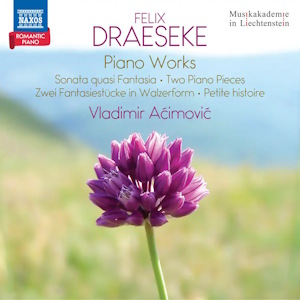
Felix Draeseke (1835-1913)
Piano Works
Vladimir Aćimović (piano)
rec. 2024, Hagen-Haus, Nendeln, Liechtenstein
Naxos 8.574675 [67]
I am loving the Romantic Piano series on Naxos, which brings lesser-known names to the forefront with really committed performances by excellent young pianists. Where possible, Naxos have opted to build each recital around a Sonata or Suite by the composer in question. That is so even on the forthcoming disc of piano works by Bedřich Smetana (Naxos 8.574718), whose Czech dances are far more familiar than his G minor piano sonata. In the disc under review, there is an absolute corker of a Sonata in the shape of Felix Draeseke’s Sonata quasi Fantasia alongside works he wrote around the Sonata’s five-year composition period.
In his notes to Hyperion’s recording of Draeseke’s and Solomon Jadassohn’s piano concertos (review), Ken Hamilton describes the composers as “two of the more interesting also-rans of Romantic music”. Draeseke was a passionate advocate of the Wagner school, though Wagner was characteristically unimpressed with the little he knew of Draeseke’s music. His early works suffered because of this. He was described as “the especially dangerous beast” after an 1861 concert including his orchestral music; listening to the music here, that conclusion is hard to fathom. Hamilton goes on to recommend this Sonata if one is tempted to doubt Liszt’s opinion: “since Schumann’s F sharp minor sonata I know of no such significant work of this genre”. My humble opinion may be worth less than Liszt’s but I wholeheartedly agree with Hamilton.
The Sonata was originally conceived in one movement but reached its final three-movement state in 1867. The fantasia in the title becomes clear in the improvisatory opening that introduces the two main themes – one strident and chordal, the other tender – that Liszt could have written. One can hear his shadow in some of the sonata’s harmonies, though Draeseke does not mimic the style of Liszt’s sonata. The bulk of the movement is a funeral march, interrupted by a passionate exploration of the second theme. The short intermezzo is a swift waltz; it has elements of Saint-Saëns’s frothy waltz-writing, but its constant harmonic twists make it Draeseke’s own. The ebullient finale reprises themes from the opening movement, interwoven between episodes of brilliant virtuosity and idiomatic writing that explores every reach of the keyboard.
The intermezzo in the sonata paves the way for the two fantasy pieces in waltz form, essentially dazzling concert waltzes. They are more light-hearted than the sonata, though Draeseke’s penchant for side-stepping harmonies, a constant surprise, sits alongside their playful nature. Ignaz Moscheles was one of Draeseke’s tutors. If he found Chopin’s turns of harmony awkward under his fingers, one can only think what he made of his pupil’s writing.
Draeseke, stung by the criticism his orchestral music received, made a conscious decision to alter his style as the 1860s progressed. His Petite histoire begins to show this, even if there is no dramatic shift in his writing. The first piece, Rêve de bonheur, is a flowing song without words with a gentle triplet accompaniment. The second, an Intermezzo, is an impish, delightful and finger-twisting scherzo. The set closes with Incertitude, the uncertainty highlighted by a syncopated, chromatic accompaniment to its slowly unfolding theme. (The Petite histoire also appeared on Zlata Chochieva’s excellent double CD Im freien, Naïve V7959. She writes that Draeseke’smusic“deserves to be heard in all the major concert halls”.)
The most Chopin-like piece on this disc is the Valse-Nocturne which brings together elements of Chopin’s nocturnes, the slower waltzes and even, in its middle section, his mazurkas. Draeseke’s gentle chromaticism is no more than can be heard in some of the later mazurkas, and thematically they have similar styles. The Valse-Scherzo returns to the fast waltz format of the sonata’s intermezzo or the fantasy pieces. It looks forward to the dazzling waltzes of French writing, and owes something to Chopin’s final scherzo or the scherzo from his third sonata.
In homage to Liszt and early 19th century traditions, Draeseke wrote a fantasy on operatic themes, choosing Boieldieu’s once very popular La Dame blanche for his inspiration. The fantasy may follow the usual pattern of such works but it is imaginatively written. It captures the drama and provides magnificently assured and virtuosic figuration even for a simple theme like the first-act trio Grand Dieu! que viens-je donc d’entendre? Much of the improvisatory opening is based on the overture, though the atmosphere is enhanced by Draeseke’s evocative keyboard writing. I would stand this alongside many of Liszt’s réminiscences and grand fantasies. Like everything on this well-planned disc, the work is well worth exploring if it is appealing to discover a major but forgotten figure from the second half of the 19th century.
Serbian pianist Vladimir Aćimović is an excellent advocate for this music, probably the most valuable release so far in this excellent series. With eleven Romantic Piano discs in the bag, I am eager to hear what Naxos have up their sleeves for us in future releases.
Rob Challinor
Buying this recording via the link below generates revenue for MWI, which helps the site remain free
Contents
Sonata quasi Fantasiain C sharp minor, Op.6 (1862-1867)Grande Fantaisie sur La Dame blanche, Opéra de Boieldieu,Op.8 (1866)Zwei Fantasiestücke in Walzerform, Op.3 (1862)Petite histoire,Op.9 (1868)
Two Piano Pieces (1867?)
– No.1. Valse-Nocturne in E major
– No.2. Valse-Scherzo in C sharp minor
















This is a wonderful review, Rob– I just wanted to agree with you and say that this is also my favorite so far of the Naxos Romantic Piano series. I’d never heard of Draeseke before, and entered this album a little bit skeptical, but it really is very fun, dramatic, and Lisztean. Not that we need more Liszt-style piano music, really, since Liszt himself took care of that in hard-to-fathom quantities. But still, it has a lot going for it.
An extra little anecdote that made me laugh: Draeseke wrote (over a period of, apparently, 35 years) a cycle called “Christus” consisting of “a Prelude and Three Oratorios” and making use of leitmotifs. So, trying very hard to be Wagner II.
It has actually been recorded on Bayer Records (conducted by Udo-R. Follert) according to Google. Go figure!