
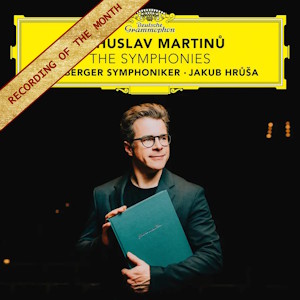
Bohuslav Martinů (1890-1959)
Symphonies 1-6
Bamberger Symphoniker/Jakub Hrůša
rec. 2023-25, Joseph-Keilberth-Saal, Konzerthalle, Bamberg
Reviewed as lossless download
Deutsche Grammophon 4867810 [176]
Recordings of any of the Martinů symphonies do not come along very often; as far as I can tell, this is the first one since 2017. That is disappointing because all six are very fine works which should be regarded among the best of the 20th century. They are the product of Martinů’s maturity: he was fifty-two when he wrote the First as a commission for Serge Koussevitsky, and living in the USA.
According to Michael Herman’s National Discography for these works, this is just the eighth full set, and the first on a “major” label. The previous seven were Neumann/Supraphon (from the vinyl era – review), Järvi/BIS (review), Thomson/Chandos (review), Fagen/Naxos, Válek/Supraphon, Bělohlávek/Onyx (review) and Meister/Capriccio (review). Each of these has received praise and criticism, so the market has been waiting for one that gains (more or less) unanimous approval. This new release may just be the one: I have seen several reviews, all of which have been very positive (at the very least), and I am not going to change that.
If you are an aficionado of these symphonies, then this release will have come across your radar a while ago, and you probably haven’t been waiting with bated breath for a MWI review before purchasing. Hopefully, you have been as impressed as I have been.
For those reading this who are not really familiar with the works, it is somewhat difficult to describe them, or at least relate them to those of other composers contemporary with Martinů. They are certainly not angst-ridden like Shostakovich or spiky and dissonant like Prokofiev, and while they have the lyricism of Vaughan Williams, they have little musical resemblance to RVW’s. There is a definite cinematic quality to them, though he never wrote for Hollywood. Given that five of the six were written during or immediately after WW2, they are relatively genial, even the Third, which is certainly the most dramatic, and apparently when Martinů was feeling particularly homesick. All, except the Sixth, which is subtitled “Fantaisies symphoniques”, have a role for piano as an orchestral instrument. Normally, in a review of not entirely familiar repertoire, I would write something along the lines of “To see if you will like this, try the … movement of the …”, but here the writing is so consistent across the twenty-one movements that I can’t really pick one. There are so many moments of great beauty, drama, passion and humour liberally scattered throughout that you can take your pick. I will say the Fourth is the most popular of the six.
I know these works best from Jiri Bělohlávek’s Onyx cycle with the BBC Symphony, and it was Bělohlávek with whom Jakub Hrůša studied conducting at the Academy of Arts in Prague. He clearly taught him well, as Hrůša, at forty-five, has a conducting career of more than two decades behind him, with appointments at major orchestras such as the Czech Philharmonic, the Royal Opera House Covent Garden, the Philharmonia and the Orchestra dell’Accademia Nazionale di Santa Cecilia. He has been Principal Conductor in Bamberg since 2015, and will be so until the end of the 2028/29 season. They obviously like him there, and on the evidence of this recording, it is easy to see why. He has made numerous recordings of music by Czech composers, mainly on Supraphon, and this is his first with Deutsche Grammophon.
There is no point, even if I felt able to, in analysing each symphony or making a detailed comparison of the performance of teacher and student. Essentially, my conclusion for each work is the same: Hrůša is better. In general, he adopts slightly quicker tempos than his mentor, the exception being the Fifth, where he is marginally slower. The difference is most significant in the slow movements, where Hrůša achieves a better sense of forward progress without sacrificing any beauty or passion. However, it’s not the pacing that makes the big difference, but rather the vibrancy of the playing on the new recording, and the orchestral colours brought out by Hrůša. The music absolutely glows, and the rhythmic vitality, and I’m especially thinking of the martial-like march in the second movement of the Fourth, is spectacular. I suspect some of this is down to the superb recording quality, and the fact that Bělohlávek’s recordings were made live in London’s Barbican Hall, not regarded as the most sonically forgiving venue. I also listened to some samples from Neeme Järvi’s BIS set, also with the Bamberger Symphoniker, and it has some of the characteristics observed in Hrůša’s, but the playing is not as assured, nor is the almost forty-year sound quality as good.
It may well be another decade before we have another Martinů symphony cycle to savour, but I don’t think it matters, because Hrůša and the Bambergers have given us one for the ages.
David Barker
Buying this recording via the link below generates revenue for MWI, which helps the site remain free













