
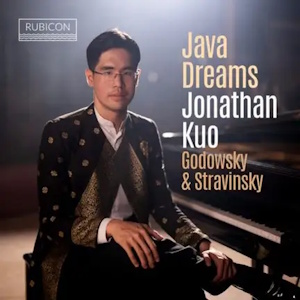
Java Dreams
Leopold Godowsky (1870-1938)
Java Suite (1924-5)
Igor Stravinsky (1882-1971)
Three Movements from Petrushka (1911, arr. for piano by the composer 1921)
Jonathan Kuo (Piano)rec. 2025, Teldex Studio, Berlin
Reviewed as a digital download
Rubicon Classics RLP1135 [65]
In the Southwest of Indonesia lies Java, the most populous island in the world, assuming we discount huge landmasses like “Afro-Eurasia” and “the Americas.” Its volcanic soil has been particularly good at nourishing tropical flora, including coffee, which was grown on the island and exported by Dutch merchants in the 17th century to such an extent that ‘a cup of java’ became a generic nickname for coffee, particularly in the US.
Javanese culture is likewise rich, with a whole succession of ancient kingdoms establishing their base on the island. Their shadow puppetry (wayang kulit) is somewhat well-known in the West, and then, of course, there is Gamelan.
Deriving from a Javanese word that means “to strike” (as in, a percussion instrument with a mallet), Gamelan is an indigenous form of art music played by ensembles on metallophones, xylophones, idiophones, gongs – a smorgasbord of pitched percussion. If you search ‘Gamelan’ on Wikipedia, you will be treated to an extensive list of these instruments, and I highly recommend giving it a skim. There is something delightful about knowing that what I would call a ‘gong’ actually has forty-odd subtypes, each with its own history and meaning.
A Javanese myth tells of the invention of Gamelan by the god Sang Hyang Guru: he would use a simple gong to summon the other deities, and he created this more complex musical system to deliver more elaborate messages to them. A more rationalist account says that it was developed in the courts of the 8th-9th centuries AD, but I find the myth particularly interesting for what it tells us about the perception of Gamelan as communicative and expressive music, a genre which, not unlike Western Classical, is understood as being, in some way, a language unto itself. In fact, it is a celestial language.
Of course, fans of 20th-century Western Classical already know about Gamelan. Ever since the 1889 Paris Exposition, in which the Javanese Gamelan was performed, composers have found it an inspiration. Debussy was particularly taken with it, writing that Javanese music “is able to express every shade of meaning,” as was Ravel, and, 60 years later, Benjamin Britten. Colin McPhee and Lou Harrison made it an integral part of their musical vocabulary; Steve Reich has cited it as an influence. I have a soft spot for Gamelan-inspired classical music, and have spent several happy hours watching YouTube performances of the authentic Gamelan in Java or Bali.
Then there is also Leopold Godowsky, born in modern-day Lithuania to Jewish parents, a piano-and-violin prodigy who lived in Vienna and then Berlin, became an American citizen, studied with Camille Saint-Saëns, and toured extensively throughout the world, including Southeast Asia. As Godowsky remarked in his preface to the Java Suite, “Who is at heart not a globe trotter?”
I had previously enjoyed Godowsky’s transcriptions and paraphrases on themes by other composers: his Passacaglia with 44 Variations on Schubert’s Unfinished Symphony and the 53 Chopin Étude transcriptions (also as recorded by Emanuele Delucchi). I would describe Godowsky’s music as hyper-virtuosic, and it is no surprise that he is best known through recordings by Konstantin Scherbakov and Marc-André Hamelin, pianists who specialize in Liszt, Busoni, and other technically challenging piano composers. It takes a special pianist to keep up with Godowsky’s demands.
I was mostly unfamiliar with his original works, but here is his Java Suite, composed across 1924-1925 after travels to Java, Bali, and elsewhere in Indonesia. It is in 12 parts and runs for nearly 50 minutes. Godowsky called the individual movements “phonoramas”, or “musical travelogues, tonal journeys for the pianoforte” and wrote descriptions to accompany each one. If you are curious, you can read the complete text on IMSLP here. The CD booklet does not include these.
Leaving aside excerpts, the Java Suite has already received several complete recordings. The world premiere was made by Esther Budiardjo in a 2000 album for Propiano (review), it appeared in Volume 8 of the Complete Godowsky series on Marco Polo played by Scherbakov (review), and I believe it was released twice last year by pianists capitalizing on the work’s centennial: Tobias Borsboom for TRPTK and Julian Chen as part of the Royal Academy of Music Bicentenary series. Looking at the timings shows us that Borsboom is generally on the slower side and Kuo, in this present recording, is often the fastest. To my ears, Budiardjo and Kuo have the clearest differentiation of line, with contrasting foregrounds and backgrounds. It’s possible that what I’m hearing is really the acoustic of the recording environment, but I will state that I needed that extra differentiation to follow this music. Scherbakov’s recording washed over me somewhat in comparison. Still, I should stress that the differences are minor; by its very nature, the music here admits considerable rhythmic flexibility and would work well at different tempi. I do perhaps prefer Kuo’s speed, though; I think he keeps the music vital and exciting. I have read other reviews elsewhere that describe Kuo as being ‘unflashy’ and somewhat introverted in this music. I can’t say I hear that, necessarily. I hear him as very exciting and energetic.
The structure of Java Suite overall can be understood as four parts consisting of “opening movement – slow movement – scherzando/dance”, almost like a modified concerto form.
The opening movement, simply titled Gamelan, begins with a quiet introduction before working itself up into a thrilling climax – see if you aren’t won over by 1:00-2:00 in Kuo’s playing. The second movement takes its cue from the Javanese shadow puppets mentioned above. It is full of rippling aquatic effects and is overall more contemplative. Next, we visit a country fair, and Godowsky gives us plenty of playful sparkle.
The fourth movement evokes Chattering Monkeys, and, sure enough, it’s staccatissimo and humorous. The slow movement here is inspired by the “Shrine of the Many Buddhas” when seen in the moonlight. And we close out this second part with a view of Bromo Volcano at daybreak – a triumphant movement that reminded me a little of Rachmaninoff. I only mention that because it is one of the few parts of the suite that feels a bit more Western than Javanese. It’s fun to have the contrast.
The third part of the suite opens with Three Dances. Godowsky’s notes imply, I think, that they are not based on any three particular dances, but rather on different facets of the dancing he observed while in Java: a sort of melancholy slow dance first, something statelier and more undulating next, and then an ornate, rapid conclusion. I couldn’t help but think about elements of a baroque dance suite – perhaps a Sarabande, Prelude, and Gigue in that order. At any rate, this is followed by a strikingly Ravel-like ballad depicting the botanic gardens, and our final movement, In the Streets of Old Batavia, is an absolute showstopper of speed and technique depicting the vast crowds in the city. It’s in a sort of ternary form, where the A section absolutely packs in the notes-per-second, with a cooler, contrasting B section.
Next is In the Kraton, which refers to the old palaces of the capital cities of Java. Godowsky designates this piece for evening, and it largely works the way the first movement of the suite does – it is a vivid evocation of Gamelan music transcribed for piano. I am, of course, in no position to comment on the accuracy of it from a Javanese perspective, but Godowsky certainly gives the impression of trying very earnestly to capture the feeling of hearing Gamelan. Our slow movement depicts the ruins of the Water Castle, and the finale, perhaps my favorite extract from the suite, depicts ‘the pomp, bombast, and gorgeousness of a royal procession’ (as Godowsky writes). It opens with a sort of march that transforms into something more introspective, before pulling out all the stops, so to speak.
If you’ve ever wondered how Debussy’s Pagodes might sound if the composer had been born with an extra pair of hands, the answer is Godowsky’s Java Suite.
Kuo rounds out his disc with the famous Trois Mouvements de Petrouchka, arranged by Stravinsky for Arthur Rubinstein around the same time that Godowsky was writing his suite. These are not transcriptions per se; they are piano pieces that draw on material from the ballet. Many pianists have tackled them, including Rubinstein, Trifonov, Rana, Kissin, Pollini, Béroff, Wang… it’s a competitive field, and Kuo’s may not be my absolute favorite account, but he undoubtedly acquits himself well: plenty of sparkle, clear rhythms, and excitement. Plus, it’s good programming – not ‘more of the same,’ but a genuine contrast with the Java Suite.
Kuo’s taken on a substantial challenge for his debut album, and I am delighted to say that he pulls it off. This is repertory that ought to be better known, and I would nominate Kuo’s recording for those curious about getting to know it.
Aidan Gray
Buying this recording via the link below generates revenue for MWI, which helps the site remain free














