
Frédéric Chopin (1810-1849)
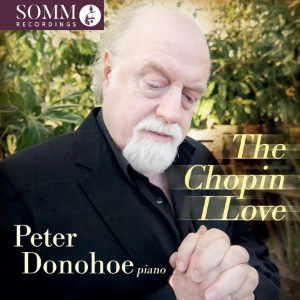
The Chopin I Love
24 Préludes, Op. 28 (1839)
Prélude, Op. 45 (1841)
Barcarolle, Op. 60 (1845-46)
Polonaise-Fantaisie, Op. 61 (1846)
2 Nocturnes, Op. 62 (1845-46)
3 Écossaises, Op. 72 No.3 (ca 1826-30)
Peter Donohoe (piano)
rec. 2025, St George’s Headstone, Pinner View, Harrow, London
Somm Recordings SOMMCD0726 [78]
Peter Donohoe hardly needs much of an introduction here, though the PR notes for this release remind us that he was joint winner of the 1982 International Tchaikovsky Competition which, coming up for half a century ago, now seems absurdly distant in time even to us old-stagers. Donohoe has previously recorded Chopin with SOMM including both the 2nd and 3rd Sonatas (2023) and Waltzes (2024), and so The Chopin I Love joins a collectable series of highly regarded releases. This is a title that Donohoe freely admits to borrowing from an LP by Arthur Rubinstein, which was one of the most formative recordings of his youth.
The most substantial collection in this programme are the Preludes, Op. 28, which Chopin seems not to have really intended for performance as a cycle although the set covers each of the 24 keys. These range from charming lyrical pieces that some of us will know from those dreaded graded piano exams, to works whose technical demands place them amongst Chopin’s most virtuosic works, with the opus as a whole considered by Donohoe to be “one of the great landmarks, not only of piano music but of all Western classical music.” Comparison with Arthur Rubinstein has to be made though, beyond much improved sound quality, this serves to show Donohoe to be very much his own man. Rubinstein’s playing has its own expressive power, and while both players phrase and breathe amidst Chopin’s harmonies and lines with personal touches of weight and rubato, their distinctive characters result in a respectful conversation with the composer rather than promoting quirky individualist interpretations. Donohoe doesn’t push the boundaries of that long line of performance tradition of which Rubinstein is an important part, but he imparts his own colours and sense of drama into each piece and the set as a whole, clearly relishing the miniature worlds created by something like the Prelude No. 18 in F Minor, holding nothing back in the climax to that wonderful “Raindrop” prelude, or fully exploring the darkness and tragedy in the Prelude No. 20 in C Minor.
Excellence of musicianship and bountiful expressive characterisation continues in the remaining works in this programme, with Donohoe picking out the Polonaise-Fantaisie, Op. 61 as “one of the most beautiful but enigmatic works in the piano repertoire”, and the Barcarolle “the piece that sums up – perhaps most satisfyingly in all of his works – the whole being of Chopin and his contribution to music”. With regard to this work, I had a listen to Leon McCawley’s recording (review), also on the SOMM label and also recorded in 2025 in St George’s Headstone, presumably on the same instrument. This is a fine and often entertainingly festive performance and both are very similar in timings, but with the present version I get more out Donohoe’s more eloquent touch and feel for the rich contrasts in sonority demanded by Chopin’s various episodes, alongside his greater clarity of narrative direction.
As ever with Chopin, we will all have our own favourites but, ounce for ounce, Peter Donohoe delivers pretty much all of the pianism and musical depth I could ask for in the works recorded here. For sure, wider contrasts and more explosive playing can be found with the likes of Evgeny Kissin (review), but that younger person’s view is not always what you want.
Dominy Clements
Buying this recording via the link below generates revenue for MWI, which helps the site remain free













