
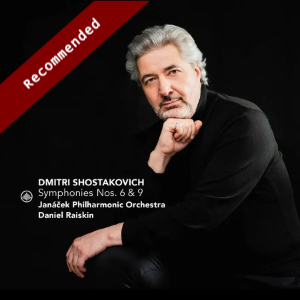
Dmitri Shostakovich (1906-1975)
Symphony No.6 in B minor Op.54 (1939)
Symphony No.9 in E flat major Op.90 (1945)
Janáček Philharmonic Orchestra/Daniel Raiskin
rec. 2025, Vesmír Concert Hall, Ostrava, Czechia
Challenge Classics CC720043 [58]
I first encountered Daniel Raiskin’s name when he was the viola soloist in a fine performance of Arthur Benjamin’s Romantic Fantasy alongside one of my very favourite violinists Benjamin Schmid (review). Jump ahead several years: he conducted a stunningly fine performance of Shostakovich’s brutally demanding Symphony No.4; Dan Morgan was suitably in awe in his review. Running contrary to the popular trend to record complete cycles with breathless speed – yes, Andris Nelsons, I’m looking at you – one searches in vain for more Raiskin’s Shostakovich… until now. Has it been worth the wait? The very simple answer, happily, is a resounding yes.
The catalogue is awash with fine performances by virtuoso orchestras of all fifteen of these great symphonies. It is very hard to expect much of a ripple from a new recording by an allegedly not top-tier orchestra and a conductor with a solid if not stellar career. But the playing here proves beyond doubt that “top-tier” and “stellar” are merely labels, of value to marketing departments and agents, and have no correlation with, or guarantee of, artistic excellence.
The pack of Shostakovich’s symphonies has been endlessly shuffled to create a wide variety of couplings. It strikes me that the 6th and 9th symphonies make a particularly intelligent combination. Mariss Jansons in Oslo did it for EMI; there seems to be an old EMI/Melodiya LP with Temirkanov and Svetlanov sharing podium duties; and then there was Bernstein in Vienna on DG, which proved that the biggest names do not always guarantee the best performances. Logic would suggest there must be more, but none spring to mind.
I would suggest that it is a good coupling because there is a valid argument for saying these are two of the composer’s most subversive symphonies. He wrote both after well-received big symphonies that created an expectation – certainly in their Kremlin-based audiences – of works equally towing party line. Yet, if anything, Symphony No.6 could almost be seen as “an Artist’s reply to unjust criticism”; and Symphony No.9seems to embody more a circus march rather than the expected victory parade for the Soviet army.
Naturally, the debate about just how subversive Shostakovich’s scores were rattles on. They can be played straight; for me, this is where Bernstein in Vienna gets it wrong. Wiener Philharmoniker really do not do grotesque or sly – but not to do so surely misses much of the point. Raiskin, as in his performance of Symphony No.4, is very good indeed at pointing the sorrow and bitterness beneath the grease-paint smiles, yet without resorting to extremes of tempo or musical point-making. He is helped by the excellent Ostrava-based Janáček Philharmonic Orchestra, who in turn is backed by very fine, rich and detailed engineering by the Challenge Classics production team.
The orchestra will be familiar to collectors via diverse releases on cpo, Centaur and Naxos. amongst others, as well as some genuinely fine Smetana, Nielsen and Dvořák on Brilliant Classics under a previous principal conductor Theodore Kuchar. The liner notes include a full orchestral list. As their names tell us, it is that rare thing these days – an ensemble which seemingly comprises players predominantly from the same country as the orchestra. So, while the sound might not fully embrace that Bohemian warmth and vibrancy of fifty years ago, there is a distinctive timbre, a bite to the winds and brass, a richness in the strings, that suits this music so well.
The tonal weight is particularly appropriate in the extraordinary grieving Largo that opens Symphony No.6.This is nineteen minutes of bleak, unblinking despair. Shostakovich often wrote slow introductions to first movements but normally they heave themselves out of this slough of despond – not here. By timings alone Raiskin, as he often does, is really fairly average. The older school of Soviet conductors tend to be quicker, Kondrashin remarkably so, and Jansons is also relatively faster. More recent conductors find some greater breadth. But it is the brooding intensity that Raiskin does particularly well.
After the formally conformist Symphony No.5, the Sixth has about as unconventional structure as any of Shostakovich’s symphonic works (except the experimental early works and the later song cycles). The issue for the performers is how to bind coherently the long opening slow movement to the quick and quicker-still pair that follow. This is where Raiskin succeeds.
The central Allegro starts off skittish and flighty, with the woodwind swirling almost aimlessly. The Ostrava orchestra really show off their collective and individual virtuosity here. The tension ramps up quickly with the movement becoming one of Shostakovich’s trademark nightmare scherzi. In my recent review of the LSO’s complete cycle under Gianandrea Noseda, I referred to “Noseda’s cultured, almost playful approach” to this movement. Listening again, I admire the actual technical execution but find the darker shadows of the music wholly absent. Raiskin is very good indeed at allowing the music to morph from light to dark. Again, the fine Challenge Classics engineering allows the percussion and heavy brass to bludgeon their way through the lighter string and woodwind textures.
Raiskin and Noseda adopt identical timings for the closing Presto.It starts with seeming bright-eyed playfulness but Raiskin’s control of the gradual build in tension is equal to the very best. In my Noseda review, I noted “Neeme Järvi with the SNO on Chandos”. I saw recently that Chandos are collecting all of Järvi’s Shostakovich recordings for a boxed release. It is unclear if it will be remastered but it will be a welcome restoration to the catalogue of a fine series of performances. Järvi’s Presto is borderline manic. The SNO play an absolute storm but at such a fast tempo that it means the music starts fairly crazed and never lets. Raiskin’s tempo, not much slower, allows the tension to crank up. To be honest, Järvi’s take is very exciting and impressive if unrelentingly hectic. Either, it must be said, is preferable to Bernstein’s.
The denial of expectation is also the striking feature of Symphony No.9. Instead of the epic square-jawed victory parade, we get an elusive and quirky work that – when it does finally reach a march towards the end – is accompanied by grotesque orchestral raspberries and gawky crudeness. I found Noseda to be objective and clear-headed but oddly emotionally underengaged. My comparison there was the Jansons recording I mentioned earlier, which always struck as one of the highlights of his somewhat variable cycle.
Once more, Raiskin finds an ideal balance between clarity, expressive range and orchestral virtuosity. On this form, the Janáček Philharmonic Orchestra are the equal of any of the ensembles I have compared them with. Raiskin does not require extremes of tempo or expression to make his points. Instead, he carefully highlights the musical material, with textures perfectly balanced and individual lines etched with ideal clarity. This allows the ambivalence that seems to be at the heart of so much of this music to register; it is carefree and jaunty or scowling beneath the smile.
The Moderato second movement is played with beautiful sparseness of tone by the solo clarinet, and the hushed low-string pizzicati are suitably stealthy. The two brief climaxes do little to dispel the odd sense of meandering weariness that pervades the music. The spinning-top Presto is one of Shostakovich’s most virtuosic creations, again in a brilliant performance. This is not the nightmare Stalin portrait of the 10th Symphony’s scherzo but there is a delirious mania in the brief 2:48 that lead straight into the imposing Largo. The principal bassoon leads the lament with some beautifully poised but poignant playing; the hushed intensity of the accompaniment is perfectly judged. “Enough of that”, the bassoon seems to say as it leads the orchestra attacca into the closing Allegretto. Throughout Shostakovich’s works, this unprepossessing tempo indication applies to some of his most personal utterances. The woodwind seem to be meandering around before a march rhythm starts for the first time to insinuate itself onto proceedings. Slowly tempo and tension ratchet up before – with just over a minute and half to go – the “parade of the clowns” finally arrives. Then, even that is displaced by a near-hysterical whirling final few pages. With all the benefit of historical hindsight, this is a curiously unsettling conclusion to an elusive, even baffling work.
The biographical note says that Raiskin is taking on the role of Chief Conductor and Artistic Director of the orchestra from the beginning of the 2026/2027 season. During his tenure, they will be moving into a new concert hall in Ostrava. If the calibre of this disc is anything to go by, then this is a musical collaboration to watch out for.
This very intelligently coupled programme is as fine as any that I have heard of these two works in some years. Do we need more Shostakovich symphony recordings? Probably not. But when the performances are as good as these, the joy is in discovering great music all over again. It might be some fifteen years since Raiskin’s last Shostakovich recording, and it is hard not to conclude that is has been worth the wait.
Nick Barnard
Buying this recording via the link below generates revenue for MWI, which helps the site remain free













