
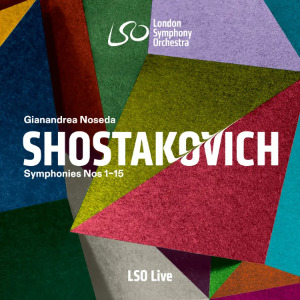
Dmitri Shostakovich (1906-1975)
Symphonies 1-15
Festive Overture
Vitalij Kowaljow (bass), Elena Stikhina (soprano)
London Philharmonic Choir
London Symphony Orchestra & Chorus/Gianandrea Noseda
rec.2016-25, Barbican Hall, London, UK
LSO Live LSO0907 SACD [10 discs: 707]
Back in the 1970s, if you wanted a one-stop-shop for Dmitri Shostakovich’s Symphonies, the choice was pretty limited. Until Decca came along a few years later with Bernard Haitink conducting the LPO and latterly the Concertgebouw, pretty much the only choice was the big EMI/Melodiya box (with the composer staring bleakly from the lid). The set featured various Soviet conductors, artists and orchestras, but was built around Kiril Kondrashin’s compelling performances with the Moscow Philharmonic Orchestra. I mention it simply because this was my guide and teacher to Shostakovich’s music in terms of the works themselves as well as the spirit and sound of them. To this day, my “inner-ear-orchestra” plays Shostakovich in this forbidding manner.
Fast forward to the 50th anniversary of the composer’s death in 2025. The options available to collectors are too numerous to mention. Just about any combination of nationality of orchestra and conductor is available, at a variety of price points. Quite often cycles have been released over a number of years; once complete, a boxed option becomes available. 2025 saw two notable additions to this release format: Andris Nelsons in Boston on DG, and this set by Gianandrea Noseda and the LSO on the orchestra’s own label. Both sets derive from live performances given over a number of years. Noseda’s cycle is essentially a repackaging of original releases, whereas on first release the Nelsons box included previously unreleased versions of the six concerti and a concert performance of the stunning Lady Macbeth of Mtsensk.
Bundling of performances usually comes with a price benefit for purchasers. I checked a couple of the usual marketplaces. In January 2026, the Noseda box is around £35 in the UK; individual discs sell for £6-10. The Nelsons 19-disc set is £64; individual releases (some as two disc) retail at £8-10 per disc if not more. The critical reception of the Nelsons cycle has been generally very positive. I was far less compelled by the interpretations, fine though the actual playing was.
The Noseda set, recorded between September 2016 and April 2025, has been warmly received; you can see a list of reviews of the individual releases at the end of the review.
Most recently, my colleague John Quinn reviewed No.13. He wrote that Symphonies 2, 3, 12, 13 and 14 will only be released on disc as part of this set, otherwise downloads will have to suffice. That strikes me as a bit of a slap for collectors who have been building a CD collection of these performances. Do they bite the bullet and buy the box or make do with downloads?
Given the extensive and detailed insights in the eight reviews I listed, I do not intend to make any great analysis of each performance. Instead, certain aspects become apparent from concentrated listening to the entire cycle. Top of the list here is consistency – in every department. Noseda is an intelligent and sensible interpreter. Listeners new to this cycle will find sane, non-controversial, respectful traversals of the scores. Detail is well observed and the overall control of these often sprawling scores is very fine. Likewise, the playing of the LSO, whether solo parts or as a collective, is genuinely excellent.
At the time of Shostakovich’s death, his symphonies – except for two of three – were little known to orchestras in the West. Now they are nearly all standard repertoire. Frankly it shows: even the extreme demands of, say, Symphony No.4 seem to hold few terrors, especially for an ensemble of the LSO’s calibre. Perhaps most surprisingly, I was pleasantly impressed by the quality of the engineering. Reviews of just about any LSO Live disc seem to reference the less than ideal sound at the venue. For sure, it is not glamorous; the lower end of the orchestra is not supported in the way that some venues – concert and recording – do. But conversely the relative neutrality of the sound allows the detail of these complex and colourful scores to register. Again, over a period of immersive listening the ear soon adjusts. and accepts it for what is.
The team of producer Nicholas Parker and engineers Jonathan Stokes and Neil Hutchinson have done, to my ear, a very good job at handling the overall sound. This set is offered in standard stereo and in two-channel and 5.1 SACD sound. I listened to the two-channel SACD; it is not glamorous or consciously hi-fi as some productions but rather effortlessly clean and precise. Not that SACD is unusual in a Shostakovich symphony cycle. I can think of at least three others off-hand: Mark Wigglesworth with various orchestras on BIS, Dmitri Kitajenko with the Gürzenich-Orchester Köln on Capriccio, and Oleg Caetani with the Orchestra Sinfonica di Milano Giuseppe Verdi on Arts. The latter, another live’ cycle, has more performing flaws and audience noise/applause than this one. A fourth cycle, by John Storgårds with the BBC Philharmonic on Chandos is still in progress.
A consistent “but” is coming – hence the reference to the Melodiya LPs I noted. Noseda and the LSO seem to be under little pressure, not just technically but, more important, emotionally. Listen to just about any of those old Soviet recordings. It sounds as if the players’ lives depend on what they are doing. Attacks are ferocious, playing can teeter between collapse and the crude. Here, dynamics are observed but somehow everything sits just inside the envelope of comfort and control. Not once does anything feel at risk.
Now of course there is a wide range of style and emotion across the entire cycle, so there are works which respond better than others to this fairly objective and controlled approach. I reckon Symphony No.1 must be one of the most remarkable graduation works ever written (alongside Rachmaninov’s first symphony perhaps); it emerges as more slyly playful than I would usually think. There was even a moment when Prokofiev’s Classical Symphony sprang to mind quite unbidden. But even in this work Shostakovich found depths and bleak introspection which here are distilled into beauty and reflection. Those are perfectly valid interpretative choices, and very well executed here. I just feel the dark side is better still.
The emotionally ambiguous and elusive Symphony No.15(coupled here with Symphony No.1) also fares well in Noseda’s hands. The engineering reveals the pointillist clarity of the scoring to great effect – not least at the very end as the music tickety-tocks off into oblivion. The LSO’s principal trombone Helen Vollam does not push the expressive extreme that Viktor Batashov of the Moscow RSO did for Maxim Shostakovich back in 1972. I am sure many will prefer the exceptional control and beauty of tone of this new version. Still, for a message behind the notes surely the earlier version speaks a deeper truth. Maxim after all did conduct the work’s premiere and his recording remains a classic, even if unavailable. His own remake with the LSO for Collins Classics was not as compelling.
Disc 2 interestingly/effectively juxtaposes two choral symphonies: the bright-eyed idealism of No.2 To October against the jaundiced cynicism and desolation of No.13 Babi Yar. In isolation and on their own terms it is another pair of fine performances. The atmospheric opening of No.2 is well-handled musically and well recorded. The LSO chorus work hard in the second movement to invoke revolutionary zeal but no-one is ever going to mistake them for a Russian-speaking choir. To me, that is more a question of the collective vocal tone a British group will produce, compared to any ensemble trained in Eastern Europe. The choral movement is heralded by the famous factory whistle. It sounds here as if it is the orchestral alternative; given the choice, I prefer a proper whistle.
Symphonies No.2, No.3 and probably No.12 are often side-lined or pigeon-holed as the least consequential/important of the cycle. To my mind, if you are going to consider this as a complete body of work – which is the purpose if you are buying the set – then these works are important way-markers precisely because they show Shostakovich’s remarkable development as a composer and creator of great art in a short period of time. I am not sure we would have had the masterpiece that is Babi Yar without the experimental enthusiasm of To October.
In No.13, the men of the LSO chorus are joined by their LPO colleagues. It is another good performance, and the fine Ukrainian bass Vitalij Kowaljow is impressive. Yet even superficial comparison points to a particular favourite of mine. Rudolf Barshai with the WDR Sinfonieorchester on Brilliant gives one of the great performances. It is a highlight of an impressive set, helped in no small part by the choral contribution of a Russian choir. The Choral Academy Moscow are simply better in terms of choral weight and tone, and more idiomatic than their London counterparts. Barshai’s reading is also more sardonic, darker. He finds more behind the notes than Noseda in his faithful but ultimately literal interpretation. Even a superficial hunt online can find this 1990s cycle complete for under £20; it must remain just about the best-bargain complete cycle still.
Disc 3 couples two more propaganda works: No.3 The First of May and No.12 The Year 1917. Received wisdom will say again that the earlier work is just the folly of idealistic youth whereas No.12 is the weakest/worst of the cycle. To my ear, one maximises their impact by playing with complete commitment if not abandon. Back in the LP days, the standout version was Ogan Durjan with the Leipzig Gewandhaus on Phillips (pretty much his only contribution on record!). That still measures up very well: the urgency and edge make the piece work as much as an example of musical agitprop as anything else. Noseda and LSO’s well-mannered and cultured approach reinforces the sense of hollowness that the work can present. I had the same complaint about Storgårds’s performance that I reviewed here.
Pretty much the first all digital/CD cycle was by the great Gennady Rohzdestvensky with the USSR Ministry of Culture Symphony Orchestra on the late-lamented Olympia label. The engineering, often by Severin Pazhukhin, was borderline crude, but it epitomised the last hurrah of Soviet-style performing and recording aesthetics. As such, it remains a valuable and indeed admirable historical record of a very specific interpretative style. The difference between Rohzdestevensky’s cycle and this new set is like comparing a blasted heathland to a manicured garden.
Disc 4 offers just Symphony No.4: an artistic ‘sliding-doors’ moment if ever there was one. The youthful lauded composer, darling of the politburo and poster-boy for the Soviet regime writes two of his greatest, most personal scores – this symphony and Lady Macbeth of Mtsensk. The “Muddle instead of Music” scandal erupts. Even though Shostakovich continues to work on the symphony, completing it in April 1936, the proposed December premiere is cancelled, and the work quietly lands in a drawer for the best part of 30 years. Arguably, in all of Shostakovich’s output this is musically the most daring and most individual. It is also the most explicitly Mahlerian symphony he wrote, although I have no idea how possible it was in the Soviet Union in the mid-1930s to access Mahler scores, let alone hear anything played live.
No.4 is the last of the symphonies that is not pored over for subtexts and double meanings. What you hear is what you get – a genius composer in supremely confident mood. Not that it is without flaws. For such a huge score of vaulting ambition not to collapse under the sheer weight of that vision requires great skill from players and a sure-handed interpreter. In many ways, this new version succeeds precisely because of the qualities of precision and clear-headedness that elsewhere can make the scores feel emotionally hampered. Noseda is very good at controlling the long musical paragraphs and binding together passages that can seem unrelated from one bar to the next. The LSO, naturally, play superbly, and the engineering copes well with Shostakovich’s extravagant orchestration.
Kitajenko in Cologne often favours epic interpretations and broad tempi (his 1st movement is 30:36 compared to Noseda’s 27:02) but I do like the way he maintains tension and power; the closing mighty climax some six minutes out from the end is simply awe-inspiring. Perhaps this is a moment when the lean sound of the Barbican Centre works slightly against the sheer weight of orchestral sound. On the other hand,the music does not descend in the wall of loud mush than many more resonantly recorded versions do. So, overall this is a fine version.
From Symphony No.5on, interpreters and critics will spend much time and effort deciding if they prefer to analyse Shostakovich as the collaborator or the subversive dissident. This is his best-known symphony, so perhaps it was no surprise that it was chosen to launch this cycle in September 2016. The coupling on disc 5 is the immediately baffling Symphony No.6. Noseda reverts to a rather plain, accurate but ultimately uninvolving No.5. Inner tension is low, with the focus on clean ensemble and control. After the daring and experimentalism of No.4, this sounds like a very safe and sane work, which is perhaps what the composer intended. The sheer control of these fine players makes the pensive close to the first movement genuinely beautiful. The second movement is good natured rather than earthy, the third lyrical and flowing rather than heartbroken. Noseda is a good two minutes quicker than Haitink, although Rostropovich in Washington and Kondrashin are both quicker, which suggests a historical precedent for such an approach. Again the clarity of the engineering is a real bonus. The gentle woodwind solos can register beautifully over the gentlest of string tremolandi. To my ear, this movement is the highlight of this performance.
The finale is a good example of Noseda’s control over tempo, and the ‘gear-shifts’ between the various sections are handled very well indeed. Once again, though, the result feels just a little smoothed out and routine. The closing pages, with the relentless repeated string notes, are played at a mid-ground tempo which favours neither Bernstein’s CBS/NYPO upbeat version (Kitajenko does the same) nor Rostropovich’s grit-your-teeth-and-keep-smiling approach. Rostropovich was one of the first to question the motivation behind this superficially festive ending. Rohzdestvensky chooses a fairly steady tempo but the style of playing and engineering hammers the listener into submission; “you will be happy or else…” Safe and sane once more seems to be Noseda’s watchword.
I referred to No.6 as baffling simply in the following sense: after the conformity of No.5, Soviet critics and the powers that be were confused quite what to make of it. There is a 17-minute Largo followed by a pair of fast movement that total much less than that. Conform this work most certainly does not. Once again, Kitajenko adopts a much broader tempo, radically different from Kondrashin’s, 19:10 compared to 13:30. Vasily Petrenko in his well-regarded RLPO cycle takes an epic 19:37, almost identical to Nelsons in Boston. Vladimir Jurowski’s part of Pentatone’s mixed conductor cycle with the Russian National Orchestra breaks the 20-minute barrier. Personally I find either extreme can work but that depends on the engagement of the conductor and the narrative they tell.
As earlier with Noseda, I find I am admiring the actual beauty of the playing and the superb control exhibited without being drawn in by a sense of storytelling. The two quicker movements, played with the expected technical brilliance, are playful, even capricious, but do not seek the darker depths that other performances mine. I am not sure anyone achieves the helter-skelter of Neeme Järvi with the (as was) SNO. His partial cycle on Chandos remains one of his finest achievements on that label. The Scottish players do remarkably well to keep up. At this tempo, there is a sense of mania bordering on hysteria that certainly gives a quite different character to the work as a whole. Noseda’s cultured, almost playful approach does not seek to achieve this, which clearly is perfectly legitimate and might well appeal to some listeners.
Discs 6-8 cover the so-called War Symphonies Nos.7-9; disc 8 also includes No.10. The genesis and world-wide reception of No.7 Leningrad is well known. This was the only release from this series that I had heard previously, not in the context of a review. It is interesting to note that the core values of this cycle are so clearly in place here. Noseda chooses a good solid no-nonsense tempo for the opening Allegretto; that results in a timing just shy of 27 minutes. The usual suspects do the usual things. Kondrashin is faster at 26:25 and Kitajenko slower at 27:10. Järvi is quite a bit quicker at 25:34 in his SNO version that many still place near the top of the pile as a preferred version. The outlier in every sense is Bernstein’s remarkable set on DG with the Chicago SO, which lumbers in at 31:41. By any reasonable measure that should fall apart under the weight of its own seriousness. But whether it is the force of Bernstein’s personality or the superhuman playing of the Chicago orchestra, this is as compelling a version of this music as you will ever hear. Noseda is not alone in sounding emotionally lightweight after that.
LSO’s playing is excellent, the engineering again very fine, almost too wide in the dynamic range: you will be cranking the volume up for the beginning of the infamous repeated march and diving to turn it back down at the cathartic climax. The calm after the storm is very beautifully played here, although the close of the movement is so quiet the volume needs further adjustment. The following intermezzo-like Moderato (poco allegretto) plays to Noseda’s strengths at the start. It is absolutely serenely delicate, with meltingly beautiful wind solos. But as it develops into some kind of stamping dance, once again there is a distinct sense that any sense of risk or danger is tightly controlled if not eliminated. Likewise the Adagio third movement has a strongly contrasting central section with a blazing trumpet solo over a sharply dotted string figuration. This is a moment when old-school Soviet brass playing was surely in the composer’s inner ear. Rohzdestvensky, Kondrashin and Svetlanov all showcase this ferocious sound. Chicago SO for Bernstein might not quite have the laser intensity of the Soviets but this is still an epic passage in this account.
The closing movement Allegro non troppo is another fine example of Noseda’s skilful pacing of long musical paragraphs with individual solos within the orchestra played with great finesse. This is once again aided by the engineering that keeps the textures clear and the balances believable. The closing pages, the heroic ending, expand impressively, much more effectively than Haitink’s LPO version on Decca recorded in 1979 in the famed Kingsway Hall. This was the first all-digital recording of the work but surprisingly sonically underwhelming and musically lacking intensity. I reviewd the Noseda performance and was distinctly unimpressed. To be fair, when I hear it here as a part of the full cycle, the consistency of approach and quality of playing register far more, even if it would not get to the top of a list of preferred versions.
After the populist propaganda of Leningrad comes No.8, sometimes spuriously called Stalingrad:by 1943, the war was turning in favour of the Soviet who broke the siege at Stalingrad. But any expectations that this might be a celebratory work proved profoundly misguided. Instead, it is probably Shostakovich’s bleakest orchestral score. As the liner notes say, after its 1944 premiere it was dropped from the repertoire. It was specifically singled out for its “unhealthy individualism” and pessimism in the notorious 1948 anti-formalism conference.
To my ear, this is the most demanding of all of the Shostakovich symphonies to bring off. The sheer scale and the generally bleak mood mean that it is hard for interpreters to navigate a convincing arc across the whole structure. This is not the first time this work has appeared as an LSO Live recording. Rostropovich recorded this, No.5 and No.11 in the early 2000s. I have not heard that version but contemporary reviews were very positive. The BBC Radio 3 CD reviewer went as far as to say: “The performance is one of the finest I have ever heard of anything.” – which is quite something. I do know the No.11 from back then, a uniquely brooding and weighty version of that symphony, possibly not my personal favourite but undeniably powerful.
No.8 was one of Haitink’s first where he swapped the LPO for the Concertgebouw, also in early digital sound. This has always struck me as one of the most impressive of his cycle. The sound remains very fine but the weight of the orchestral sound caught in the Concertgebouw Hall aligns very well with Haitink’s conception. For Noseda, the LSO play as well as ever but perhaps this is one time the slightly bass-light recording militates against the music. Except for a few seconds difference in the opening long Adagio, Noseda is notably slower than Haitink in every movement but somehow the earlier recording feels weightier. The LSO also recorded this work twice with André Previn. The earlier EMI version from 1973, the first commercially released recording from the West, stands the test of time rather well – a vintage EMI Christophers Bishop and Parker production.
For the two adjacent faster movements, Noseda chooses quite heavy tramping tempi. This is a sensible uncontroversial choice. I have a sneaking feeling that the sheer finesse of the playing debrutalises what is surely meant to be brutal music, but of course this is a matter of subjective taste. It is not that the Concertgebouw were sonically brutal either, just implacable. The second of the faster movements, III. Allegro non troppo,encapsulates for me the reason I find these performances as a whole admirable but not compelling. A perfectly sane mid-range tempo somehow ends up sounding like a superbly executed orchestral exercise (nimble trombones take a bow) rather than having any cumulative nightmare narrative. Of course that is my subjective interpretation but I don’t believe music like this in this kind of work is ‘just’ absolute. But I must stress once again that I am sure many will rightly applaud the clarity and sheer accuracy of the playing here.
The great cathartic climax around the 2/3 mark in the closing Allegretto is also perfectly played but without somehow achieving an overwhelming sense of collapse. Kitajenko’s Gürzenich-Orchester Köln is very good here, as is the Berlin PO with Kirill Petrenko in his set of Symphonies No.8-10 from a couple of years ago; it has been praised on this site and elsewhere. In part, this is due to the more supportive Philharmonie acoustic. But as ever go to the older Soviet-influenced/dated recordings for something borderline apocalyptic. The closing handful of minutes of Noseda’s performance are genuinely lovely but lack a sense of “aftermath”. Other performances manage to make the closing C major chord oddly bleak but here it is beautiful.
Symphony No.9 is well-known for not fulfilling its expected role as post-war epic triumphal celebration. Instead, this was the shortest of the instrumental symphonies with a sly capricious and indeed subversive character. The lighter textures and leaner writing perhaps suit Noseda and the engineering better than other works in the cycle but I still feel the essential spirit of the music-making is missing. Mariss Jansons recorded a multi-orchestra cycle for EMI that is not my personal favourite but his No.9 is a genuine tour de force by the Philadelphia orchestra. The central Presto is gleeful and terrifying, a genuine showcase for that superb orchestra. Petrenko’s Berliners are not far behind, it has to be said. For a gaudy grotesque closing ‘triumphal march’, again it is the older Soviet-influenced recordings that seem to encapsulate the sense of curdled celebration. Rohzdestvensky made a series of live performances of some of the symphonies with the USSR Ministry of Culture SO alongside his studio versions. The sound is about as crude as you can imagine, and the actual playing sometimes hangs on by the skin of its teeth. Yet I find it hard to believe that this is not the authentic sound and spirit of Shostakovich.
Alongside Symphony No.5, No.10 is probably the most often performed and best known of the cycle. Its recordings are too numerous to count, and even conductors little associated with the composer offer interpretations; Karajan is the most obvious example. It is no surprise by now to find Noseda’s version a very well played performance. As with No.5, of all of the Shostakovich symphonies, this is formally the most traditional: four movements with a pair of fast/slow central panels and a big exciting finale. But with this composer there seem always to be subtexts. The most obvious here is his hammering home of the D.S.C.H. motif to thumb his nose at the recently deceased Stalin. Perhaps because control of form is Noseda’s strength, this version is consistently impressive. All the virtues shown elsewhere align to create a convincing and indeed exciting performance. No, the Allegro second movement is not as blazingly thrilling a roller coaster as it can be, but this is a pretty much bullet-proof movement. Play the right notes at the right tempo and it works – as here. Noseda manages the numerous tempo transitions from brooding introductions to full-fledged allegros very well, and the LSO ensemble is reliably faultless. This is as close as Shostakovich gets to a festive/happy ending in a symphony, the early propaganda works excepted.
Disc 9 is devoted to the first of the two ‘Revolution’ symphonies, No.11 The Year 1905. As a pair, these are often dismissed as party-hack works with programmatic and musical material more akin to Shostakovich’s film scores rather than his symphonies. It is interesting that the larger-scale, more epically conceived work is about the failed Revolution. Quite typically, Noseda’s well-played performance tends to the middle ground of timings and expressive intent. Kondrashin blazed his way through in an exciting if hardly nuanced 54 minutes, while the trenchant Rostropovich with his take on the LSO Live is an astonishing slow 72 minutes. Noseda’s is a much more “typical” 63 minutes.
Direct comparisons between the two LSO incarnations are probably most telling. For Rostropovich, the players dig into their instruments with his glacial speeds in the ominous and oppressive opening movement. Icy strings, ghostly fanfares and maudlin folk-songs – it is utterly compelling. Noseda’s is a thing of control, beauty and finesse, but should it be? In fairness, Rostropovich’s is so unique a version that probably for repeated listening the judicious Noseda might be preferable. Personally, I would take either Kondrashin or Rostropovich in preference.
The ending of the work is telling, too, the Allegro non troppo movement subtitled Tocsin. A grimly triumphant resolution is reached with pounding drums and clashing bells. These are oddly inaudible for Noseda but perfectly present for Rostropovich, who also allows them (and the tam-tam) to ring on long after the orchestra has finished. The latter effect is always a cause for debate: Kondrashin and Rozhdestvensky don’t but Slakovsky and Vasily Petrenko do. Caetani has the biggest, deepest bells of all, which he allows to ring on even though they are instantly engulfed in enthusiastic applause. Personally I like hearing them ring on but I have no idea if the composer ever expressed a preference. The effect in a dramatic performance is one of shock and exhaustion. Noseda’s LSO are too in control for that thought to ever occur.
Disc 10, the last, is devoted to Symphony No.14, a song-cycle about Death in all but name. The other symphonies feature a full orchestra. This is a work for two vocal soloists, a soprano and a bass, and a string orchestra plus a large percussion section. The eleven movements/song settings do have motivic and musical links that allow a symphonic structure. They can be considered in five groupings (1; 2-4; 5-7; 8-9; 10-11) to suggest that form. The two soloists here are Russian Elena Stikhina and Ukrainian Vitalij Kowaljow. Many willconsider ideal their combination of wholly authentic pronunciation but vocal techniques free of any old-school ‘wobble’.
The whole performance shows just how fine this cycle of performances can be when the creative stars align. The playing is superb, the engineering lean but with the disparate elements of voices, strings and percussion perfectly balanced – and not even the hint of an audience being present. Noseda’s total timing of 46:33 places him very close to the original 1969 performances by Barshai with Moscow Chamber Orchestra. In this instance, the weightier versions by Kitajenko and Bernstein seem less persuasive. Barshai’s ‘remake’ in Cologne is again very good: another impressive performance in that set with a weightier total string sound than here. Vasily Petrenko’s Liverpool version is also impressive, one of the few modern versions that seem to use a smaller chamber orchestra body of strings as the score suggests.
The Moscow premiere took place a week or so after the first performance in Leningrad, with the original artists, soprano Galina Vishnevskaya and bass Mark Reshetin. It can be easily found on YouTube, and it is searingly powerful. The recording renders the Moscow strings rather acidic but you get authentic Soviet grit, and the soloists are simply superb. Noseda’s new performance rather smoothes off those edges but the work still emerges as one of the composer’s most powerful and personal. Reading around the piece reminded me of its dedication to Benjamin Britten. He conducted the UK premiere at Aldeburgh just a year after its Soviet debut, with the same soloists. Was it because I had this thought in my mind that this performance occasionally made me think passingly of Britten’s Les Illuminations? Is that yet another sly Shostakovichian reference?
This set is nicely presented. Each disc is in the standard cardboard sleeve, and the box is sturdy. More unusually for a bargain repackaging, there is 190-page booklet in three languages. It includes the original very good liner notes by various authors, along with full texts, biographies and orchestral lists. As I frequently mentioned above, the engineering and production are consistently very good, once one accepts the basic acoustic characteristics of the Barbican Hall. At the end of this journey through Shostakovich’s symphonies, the thought is reinforced that they are a truly remarkable document. This cycle is a consistently faithful and superbly played set. At its best – for me in Nos.1, 4, 6, 10 and 14 – there is much to enjoy. The rest will impress through the genius of the composer, although I personally prefer a more red-blooded old-school approach. Those who find that musically and technically too coarse will see Noseda as a safe pair of hands. But should Shostakovich be safe?
Nick Barnard
Buying this recording via the link below generates revenue for MWI, which helps the site remain free

Recording dates
Sept. 2016 (No.5)
April 2018 (No.8)
June 2018 (No.10)
November 2018 (No.4)
March 2019 (No.1),
October 2019 (No.6)
December 2019 (No.7)
January/February 2020 (No.9)
February 2022 (Nos.14-15)
November 2022 (No.11)
April 2023 (No.13)
June 2024 (No.3)
April 2025 (Nos.2, 12, Overture)
Reviews of individual releases
Symphonies Nos.1&5
Symphony No.4
Symphonies Nos.6&15
Symphony No.7
Symphony No.8
Symphonies Nos.9&10
Symphony No.11
Symphony No.13













