
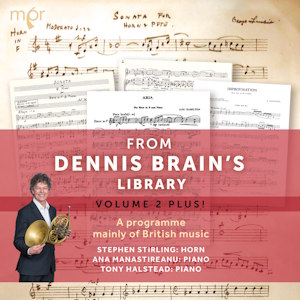
From Dennis Brain’s Library Volume 2 Plus!
A programme mainly of British music
Stephen Stirling (horn)
Anna Manastireanu, Tony Halstead (piano)
rec. 2024, Pamoja Hall, Sevenoaks School, Kent
MPR 120 [77]
After the success of the CD: Volume 1 From Dennis Brain’s Library, reviewed by John Durrant, for MusicWeb International in 2022, this further attractive CD selection includes well-chosen and rare pieces, some likely first performances, not known to have been previously performed by Brain.
The “Plus” in the CD’s title requires explanation. Not all the works on this CD are taken from Brain’s library, now largely preserved at the Royal College of Music, London. These “extras” appear to this reviewer to be carefully selected here as sympathetic to the way of playing that Brain used for recital work with a piano, either for horn and piano recitals with Denis Matthews and others, or his Wind Ensemble. Pieces not in Brain’s Library include the first on the CD: William Maurice Miles’s Sonata for Horn and Piano (1929), Lionel Ovenden’s Meditation, Thomas Pitfield’s A Folkish Tune, and Humphrey Proctor-Gregg’s Duettino. They are all very listenable and ought to have further airings in future. There are pieces very challenging to the horn player (for example by Linstead, Desportes, Miles) and others accessible to both student and seasoned professional alike (Ovenden, Meditation, Carse Two Easy Pieces, Pitfield A Folkish Tune, and Proctor-Gregg’s Duettino). The players are all outstanding musicians and one could not hope for better to present this programme. A big credit must go to the producer, Mike Purton and the recording engineer, Ben Connellan. The twenty-two-page sleeve notes booklet is meticulously crafted by John Humphries, and Tony Halstead, giving the reader all they need to know about the history of the pieces and the composers who wrote them. Tony Halstead writes all the sleeve notes for the pieces which he plays the piano parts. John Humphries, of the British Horn Society, supplies notes for the other pieces.
Stephen Stirling’s horn sound, being focused, clearly articulated and bright in tone, is very suited to perform these works. At the Royal Northern College of Music, his horn professor was Ifor James, one of Aubrey Brain’s most famous students. Dennis Brain had few students but his father taught an enormous number of whom many later distinguished themselves as professionals. In this way, the Brain horn sound has continued to influence horn players not just in the UK but all over the world. Brain’s many commercial as well as published radio performances have also influenced modern horn players by example and the impact on today’s horn players worldwide of his recorded legacy should not be underestimated.
Now to the materials recorded on this CD. William Maurice Miles’s Sonata for Horn and Piano (1929) has a pleasing tune in the first movement: Allegro in the key of G minor. The second movement: Andante, has a delightful melody for the horn and piano from the start and dramatic forte passages for both players. In the final movement, Allegro, a rocking rhythm starts a dialogue between the instruments with repeating themes and some through-composed passages. The theme at the start returns before a splendid conclusion.
Iain Hamilton’s Aria for Horn and Piano (1952) was in Brain’s library and now preserved at the RCM (library shelf mark D3593Hnpf). The copy Brain owned was the 1952 Schott & Co edition. This piece has a dissonant element in the piano part of the first movement which Tony Halstead, in his sleeve notes, mentions in contrast to the lyrical horn part. He also mentions that he had first performed it in 1967. The second movement is lighter in mood and more conventionally tuneful.
Humphrey Proctor-Gregg’s Duettino for Horn and Piano contains a beautiful introduction, elegantly phrased by the pianist, Tony Halstead. This is a very short and pleasant piece that one can easily imagine Brain playing as an alternative encore.
George Frederick Linstead’s: Sonata for Horn and Piano has no date. It was in Brain’s library – He listed it among works suggested for broadcasting in a letter to the BBC in 1951 – but the author has not been able to confirm that it is among Brain’s music scores at the Royal College of Music. Of all the works on this CD, this sonata looks the most demanding as it is virtuosic in many passages and very long in the first and third movements. The second movement is not, however, the fourteen minutes, nineteen seconds printed in the sleeve notes. It is rather shorter – four minutes and nineteen seconds. It begins with a quick dissonant phrase on the piano (ably played by Ana Manastireanu), dropped into the silence and followed soon by the horn playing softly and reflectively before the echo has died away. The style of the music is reminiscent of Hindemith, as correctly observed by John Humphries in the sleeve notes. He considers the piece is likely of 1930s date. The first movement, Moderato, is at times dreamy, contemplative, loud and stern. A repetitive phrase on the horn with vibrato features and also a lovely passage of flutter tonguing for the horn player. The second movement, Cadenza Melancolica is moody, sometimes quiet, ponderous, chattering and forthright. Third movement, Allegro is shorter than the first, being eleven minutes, fifty-three seconds. It is lighter in mood than the previous movements. It starts with the piano and horn simultaneously. At intervals, it is contemplative and quiet and sometimes loud and agitated. One can easily imagine Brain playing this with perhaps Noel Mewton-Wood, had they lived long enough. The pianist has as much to do as the horn player and is clearly a strenuous piece for either player. Together, they keep each other on their toes. The piano dreamily works its way to the dramatic conclusion where it is joined by the horn.
Adam Carse’s Two Easy Pieces for Horn and Piano (1939), was also in Brain’s former library (RCM, shelf mark D3578). The edition is Augener, published in London, 1939. Tony Halstead, who is the pianist, in his sleeve notes, describes this piece as “mellifluous, elegantly understated”. It’s interesting to hear a piece which Brain probably played as a student of his father at the Royal Academy when he was just eighteen. The first piece is pleasantly tuneful in a register that does not pose any great demands on the player. The second piece might be described as progressively more difficult than the first. The piano part is played with deft aplomb by Tony Halstead.
Thomas Pitfield’s A Folkish Tune for Horn and Piano begins with the horn, followed soon by the piano, sensitively played by Tony Halstead. It’s very short and pleasant music that one can easily imagine Brain choosing as an alternative to his favoured “Le Basque” for encores. It post-dates Brain’s lifetime and was premiered by Tony Halstead with David Lloyd, piano, together with other pieces under title “Tunes from my Notebooks” at Manchester in 1964.
Yvonne Desportes’ Improvisation for Horn and Piano was part of Brain’s library (RCM, shelf mark D3583). It is the Paris Alphonse Leduc & Co edition, 1953. John Humphries, in his sleeve notes, describes it as challenging and it certainly seems to be though not to the outstanding players in this recording. The pianist is Ana Manastireanu.
Lionel H. Ovenden’s Meditation for Horn and Piano is tuneful music, romantic and gentle on the ears. It is not among the works in Brain’s music library but one can readily imagine Brain playing it. The piano part was admirably played by Tony Halstead.
Philip B. Catellinet’s: Caprice Encore for Horn and Piano, was also part of Brain’s library (RCM shelf mark D3579), Hinrichsen London edition of 1953. The music begins with a fanfare for the horn player followed by the piano. An energetic and cheerful piece played on piano with enthusiasm and the usual consummate musicianship by Tony Halstead. There are plenty of staccato passages for the horn, a dreamy middle section and returns to the chattering staccato of the beginning. Surely, Brain would have played this at some point in his career, had it not been cut short so soon.
The reviewer looks forward to Volume 3 and would suggest that the following be considered; Brain’s music library contained all the following and it appears that he played none of them in public:
– Sverre Jordan – Concerto Romantico per corno in F
– Leslie Bassett – Sonata, horn and piano
– Domenico Ceccarossi – Ten Caprices for Horn
– Hermann Blume – Concerto for horn and orchestra
– Philipp Grosch – Reduced for horn and piano
– Robert Clérisse – Chant sans paroles, horn and piano
Stephen J. Gamble
Availability: MPRContents
William Maurice Miles (1883-1958)
Sonata for Horn and Piano (1929)
Iain Hamilton (1922-2000)
Aria for Horn and Piano (1952) [3:29]
Humphrey Proctor-Gregg (1895-1980)
Duettino for Horn and Piano [2:08]
George Frederick Linstead (1908-1974)
Sonata for Horn and Piano [29:92]
Adam von Ahn Carse (1878-1958)
Two Easy Pieces for Horn and Piano (1939) [1:57]
Thomas Pitfield (1903-1999)
A Folkish Tune for Horn and Piano [1:03]
Yvonne Desportes (1907-1993)
Improvisation for Horn and Piano [6:47]
Lionel Hutchison Ovenden (1893-1976)
Meditation for Horn and Piano [5:22]
Philip B. Catelinet (1910-1995)
Caprice ‘Encore’ for Horn and Piano [4:19]














In this extremely detailed and enthusiastic review, the ‘header’ information curiously includes a question mark over the recording date of this recital. I write ‘curiously’ because my CD of ‘From Dennis Brain’s Library Volume 2 Plus!’ comes with a 24-page booklet whose back page (a photo of the three performers) includes all the recording’s technical details, including the recording dates: 17-19 December 2024. The information is also printed on the CD box’s back inlay.
Thanks for that information; I have duly made the correction in the header (although we don’t now give precise recording dates beyond the year except for live performances).