
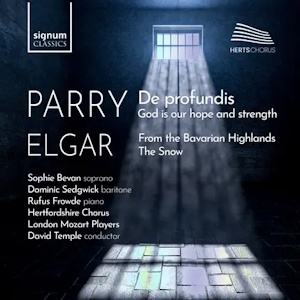
Sir Hubert Parry (1848-1918)
De profundis (1891)
God is our hope and strength (1913)
Sir Edward Elgar (1857-1934)
The Snow, Op 26, No 1 (1894)
Scenes from the Bavarian Highlands, Op 27 (1894)
Sophie Bevan (soprano); Dominic Sedgwick (baritone)
Richard Smith, Rebecca Turner (violins); Rufus Frowde (piano
Hertfordshire Chorus
London Mozart Players / David Temple
rec. 2025, St Jude-on-the-Hill, Hampstead Garden Suburb, London
Texts included
Signum Classics SIGCD1005 [66]
David Temple is one of the UK’s foremost choral directors. He runs two large choirs, the Crouch End Festival Chorus and the Hertfordshire Chorus. With his Crouch End choir, he has already made some significant contributions to the revival on disc of choral music by Parry. He acted as chorus master for the 2019 Chandos recording of the 1888 oratorio Judith (review) and three years later he performed a similar function when Scenes from Shelley’s ‘Prometheus Unbound’ (1880) was recorded (review). Now, Temple himself is on the rostrum for the premiere recordings of two more long-neglected Parry scores.
I should point out an important feature of these Parry recordings. All the performance materials are available to download – for free – from the website of an American organisation, English Heritage Music Series (EHMS), which is associated with the University of Minnesota. This estimable organisation restores to general circulation works from the period known as the English Muscal renaissance which are no longer in print and which are out of copyright. On their website I found all manner of pieces by the likes of Bantock, Bridge, Coleridge-Taylor, Ireland, Moeran, Stanford and, of course, Parry. In assessing these recordings of two works by Parry which were completely unknown to me, I found it invaluable to download the vocal scores.
Parry was commissioned to write a choral/orchestral work for the 1891 Three Choirs Festival, which was held that year in Hereford. The composer himself conducted the first performance of De profundis at a Thursday morning concert which, I presume, was given in the cathedral. The piece was effusively praised by the critic of the Musical Times but the late Anthony Boden and Paul Hedley pointed out in their definitive The Three Choirs Festival. A History (2017) that the concert attracted “a disappointingly small audience”. Parry took for his text the Latin words of Psalm 130, ‘Out of the depths’. He scored it for solo soprano, orchestra and, very ambitiously, for an SATB chorus which often divides into three separate choirs. The work, which here plays for 24:10, is continuous, though the recording is helpfully divided into four very logical tracks.
The work has a broad, impressive orchestral introduction. When the singing begins, the chorus is divided into three choirs; Parry lays out the music very effectively for the choirs. The solo soprano makes her first appearance at 5:30 (‘Fiant aures tuae’). This tranquil episode makes a fine contrast with what has gone before. The soloist’s music, and the accompaniment, is elegant and expressive. Sophie Bevan’s voice is ideally suited to the music and she sings it very well. I like very much the rich accompaniment for strings, woodwind and horns. Ms Bevan’s solo takes us up to the end of the first track. The chorus returns at ‘Sustinuit anima meo’ (tr 2). Here, the marking is Allegro energico; the energetic aspect of the music is emphasised by the martial dotted rhythms in the orchestra. This time, the chorus is divided into two six-part choirs and once again Parry’s part writing is very accomplished – and interesting. This section of the work is impressive and sonorous; the performance is highly committed. There follows another section for solo soprano (‘A custodia matutina’, tr 3). Here, the music, which is marked Allegretto, is graceful and once again Sophie Bevan’s contribution is distinguished. The final track (‘Apud Dominum misericordia’) begins with a short three-choir introduction after which Parry launches into an extended six-part fugue (‘Et ipso redemit Israel’). For me this is a little bit disappointing. I say that not because the writing is poor – it is very accomplished and clearly indebted to Bach – but because to me the fugal writing doesn’t compare with what Parry had achieved in the closing section of Blest Pair of Sirens in 1887. In Blest Pair, the fugue (‘To live with him’) is technically superb but, more than that, it’s emotionally inspiring; Parry doesn’t match the emotional side of things in this episode in De profundis. Eventually (tr 4, 3:37) the soprano soloist joins in, the choral writing expands into twelve parts once more and Parry builds his composition to a majestic conclusion.
In his authoritative booklet essay, Parry’s biographer, Jeremy Dibble lists a handful of performances which followed the Hereford premiere but so far as I know De profundis was never revived at the Three Choirs Festival; perhaps part of the trouble was that Parry produced further works for Three Choirs which eclipsed De profundis. Even though Vaughan Willaims, no less, admired it and pushed for it to be performed, De profundis lay in neglect until, at VW’s prompting, Sir Adrian Boult conducted a broadcast performance in 1949 but it appears that the score then sank without trace until David Temple and the Hertfordshire Chorus revived it in 2022. I suppose I can understand the neglect, which was suffered by most of Parry’s choral/orchestral works; they simply fell out of fashion. It’s a pity, though, because there’s much fine music in the score, as this excellent, committed performance makes clear.
In some ways, I find the neglect of the anthem God is our hope and strength (Psalm 46) even harder to comprehend; the music is strong and the length of the piece -12:55 in this performance – should make it ideal for inclusion in mixed choral programmes. Incidentally, on the EHMS website, the duration is given as “8 minutes (approx)”; that’s significantly shorter than David Temple’s performance but I thought his reading seemed ideally paced.
The piece was commissioned in 1913 for the prestigious Festival of the Sons of the Clergy, an important annual service in St Paul’s Cathedral. It’s scored for bass solo, double SATB choir and orchestra. The setting is in English. The opening marking is Slow; we hear a majestic orchestral introduction. The choir enters quite quietly (‘God is our hope and strength’) but soon the music launches into a vigorous Allegro. In the pages that follow the writing is exciting and imposing; indeed, I’d describe it as vintage Parry. There are moments of contrast, though; I’m thinking of a quiet meno mosso section (‘But God hath shewed his voice’), which is most effective. Shortly thereafter I was impressed with a broad melody, distributed around the voice parts, at ‘The Lord of Hosts is with us’; this is also vintage Parry. We have to wait quite a while for the appearance of the bass soloist at ‘O, come hither and behold the works of the Lord’ (8:16). In this solo passage the music for both the singer and the orchestra becomes increasingly dramatic; Dominic Sedgwick makes a good job of this episode. Thereafter, the chorus is in the ascendancy again. There’s some good – and not over-extended – contrapuntal writing, where the music is strong and purposeful. The very end of the piece is a short but imposing peroration. Temple, his choir and his orchestra give a really persuasive account of this piece; other choirs should hasten to investigate it, especially since they can access free performing materials.
Alice Elgar played a key role in the creation of the works by Elgar which feature on this disc. She wrote the words for the two choral songs, Op 26, of which The Snow is one. Originally conceived for female voices, two violins and piano, Elgar later scored them for a small orchestra. In this performance we hear an arrangement for SATB choir by John Pointer but with the original instrumental accompaniment. This little piece is shrewdly positioned on the programme because it lowers the temperature (pun intended) after the majestic conclusion to the Parry work. I sang this little part song a few times a good few years ago and I was delighted to be reminded of it in this excellent performance. It’s a charming and expressive piece.
Alice also furnished the texts for Scenes from the Bavarian Highlands. At this time in their married life the Elgars took holidays in Germany on several occasions; the present work was composed during one such holiday. Alice adapted six texts, in English translations, from southern German Volkslieder which, as Jeremy Dibble puts it, “suited the local Bavarian dances known as Schnadahüpfler”. Elgar conceived the songs for SATB choir and piano; he later rescored them for small orchestra and, later still, turned three of them into purely orchestral pieces as Three Bavarian Dances. I’ve sung these songs several times and I have to say that they’re not my favourite Elgar; unlike The Snow, which is a miniature delight, I find Scenes from the Bavarian Highlands is too redolent of the Victorian parlour for my taste. I don’t think the words help; I feel they are very much of their time. In general, the slower-paced songs are more interesting. The second song, ‘False Love’ is charming and its cause is helped by an interesting piano part. In the fifth song, ‘On the Alm’, Elgar’s writing for the tenors and basses takes us, I think, closer to the Alps than anywhere else in the set of six. On the other hand, ‘The Dance’ trips along in a way that is a little too self-consciously merry for my taste and I’m no more taken with the energetic last song, ‘The Marksmen’ with its cries of ‘Huzza, the hit’. But I must stress that these are entirely subjective reactions and should not in any way be construed as implicit criticism of the present performance. The Hertfordshire Chorus enter right into the spirit of each piece; they offer singing which is, animated, clear and excellently articulated. They receive splendid, crisp support from pianist Rufus Frowde.
Though the Elgar pieces are well done, the chief interest in this release has to lie in the two Parry works, which here receive their first performances. Both are works of genuine stature and I hope the excellent performances that David Temple leads will further their cause; they deserve to be better known.
The recorded sound is excellent; that should come as no surprise since the producer is Tim Oldham and the engineer is Mike Hatch. Jeremy Dibble’s booklet essay gives a very good introduction to all the music; that’s especially important for the largely unknown Parry pieces.
I congratulate David Temple and the Hertfordshire Chorus on their enterprise in bringing the Parry pieces before the public. They may well contemplate reviving more neglected Parry, subject, of course, to funding. That would be welcome, but might I put in a plea for them to turn their attention to a Parry piece which has received a previous recording. Ode on the Nativity is surely Parry’s masterpiece in the choral/orchestral genre. The recording by Sir David Willcocks is a fine one (review). However, it must be well over forty years old now – the recording date is not specified, but I first heard it in the early 1980s – and a new, modern recording is long overdue. On the strength of the performances on this disc, I think Temple and his choir would make an excellent job of it and Sophie Bevan would be an ideal soloist.
John Quinn
Buying this recording via the link below generates revenue for MWI, which helps the site remain free














It’s splendid that “De Profundis” is available on disc at last. However, the following statement “De profundis lay in neglect until, at VW’s prompting, Sir Adrian Boult conducted a broadcast performance in 1949 but it appears that the score then sank without trace until David Temple and the Hertfordshire Chorus revived it in 2022” may not be entirely true. I have heard an off-air recording of a broadcast by Sir Adrian Boult set down on 30 April 1960 in the Sheffield City Hall (seemingly a studio recording without audience) and broadcast on 23 July 1960. The forces involved were the Sheffield Philharmonic Chorus and the BBC Northern Orchestra and the soprano was Joyce Barker. The sound is not bad (and of course, better-sounding tapes may exist in someone’s collection) though obviously not comparable to a modern stereo recording. However, given that any performance by Boult, and all the more so one of a work he did not record commercially, is a historical document, it would be nice if Somm, CRQ, Pristine or any other company offering historical issues would make it available.