
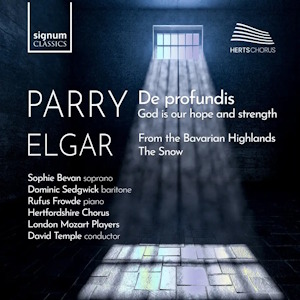
Sir Hubert Parry (1848-1918)
De profundis (1891)
God is our hope and strength (1913)
Sir Edward Elgar (1857-1934)
The snow, Op.26, No.1 (1894)
From the Bavarian highlands, Op.27 (1894)
Sophie Bevan (soprano), Dominic Sedgwick (baritone)
Rufus Frowde (piano), Richard Smith (violin), Rebecca Turner (violin)
Hertfordshire Chorus
London Mozart Players/David Temple
rec. 2025, St Jude-on-the-Hill, Hampstead Garden Suburb, London
Texts included
Signum Classics SIGCD1005 [66]
For many years, if not decades, Parry and the music he composed fell easy prey to critics. There were several reasons. At best, he himself was seen as little more than the teacher who nurtured, alongside Stanford, many of the composers who would come to represent “The English Musical Renaissance”. As a composer in his own right, the lazy comment went, he wrote music of little real individuality that did little except support and promote the musical and political institutions of the Victorian age.
There is some truth in such comments but, as recent recordings and scholarship have revealed, Parry was a much more complex character than such dismissal warrants – as indeed was his music. To this day, the wider public will know him best via the hymn Jerusalem and the Coronation Anthem I was Glad but little else. Recent years have seen a significant amount of his orchestral and choral work appear on recordings. I doubt, however, that there has been an equivalent increase in concert performances unless enthusiasts such as the conductor of this collection, David Temple, are involved.
Labels such as Chandos and Hyperion have steadily released recordings of the large-scale choral works Parry wrote to feed the voracious Victorian Choir Festival market. Yet it is curious that until now nobody has recorded De profundis, a work which no less a figure than Vaughan Williams described as Parry’s “finest work”. Part of the reason is intimated by the rest of Vaughan Williams’s quote: “I wrote to Atkins of Worcester about it. He says it is beyond them.” Beyond them simply means very demanding choral writing. Within the 24-minute time frame, Parry writes for 12-part chorus, demonstrating his mastery of contrapuntal and choral writing: sometimes for three four-part choirs, sometimes two six-part. The work was Parry’s first for the famous Three Choirs Festival. It is easy to imagine that he sought to use such an important musical stage to showcase his considerable compositional skill.
Led by David Temple, the Hertfordshire Chorus with the London Mozart Players give a well-prepared and skilled performance. Temple and Parry scholar Jeremy Dibble contribute informative and enthusiastic notes, extolling the merits of this work. Yet it does seem to represent exactly the kind of institutionally acceptable work that later composers such as Elgar (whose own Three Choirs festival compositional debut came the year before with the orchestral Froissart Overture) and Vaughan Williams would instinctively surpass.
The dozen or so lines of the De profundis are set in a manner familiar to any of the great oratorio composers, and text is in the original Latin; the booklet contains full texts and translations as appropriate. The word painting is attractive, the distribution of the text between various choral groupings and the soprano soloist Sophie Bevan is intelligently handled, and of course the sheer craft in the writing of such complex polyphony is genuinely impressive. Yet again somehow – and this is a response I have had to much of Parry’s choral music – it fails to convince me as musical theatre. To make the direct comparison with Elgar’s The Light of Life, an 1896 Three Choirs premiere: the later work is uneven and flawed but when the flame of inspiration burns high in that score, it trumps emotionally anything that the polished De profundis achieves or possibly even seeks to achieve.
Interestingly, I had much the same reaction to Temple’s recent recording of The Kingdom on Signum: I would happily trade the craft of that work for the grab-you-by-the-throat drama of Gerontius. As a passing thought, it is interesting to note that Parry’s only opera, the 1880 Guinevere,remained unpublished and unperformed in his lifetime – unlike those of his RCM colleague Stanford. Perhaps he realised that he was not a natural dramatist.
All this is not to diminish the calibre of this performance or recording. As mentioned, the Hertfordshire Chorus sing with energy and accuracy. They have a distinctly ‘British’ sound, not as youthful or bright-toned as many choirs from other countries. The London Mozart Players seemed to have reinvented themselves as a high-quality freelance symphony orchestra. They play this music with skill and suitable sonority. Likewise, soloist Sophie Bevan has the right kind of dramatic soprano voice. The reliable production team of Tim Oldham and Mike Hatch ensure the actual sound is good. One curio: they have used a digital organ for the work although the St. Jude on the Hill website makes no mention that their Father Willis organ is out of commission.
Jeremy Dibble describes the accompanying God is our hope and strength thus: “A classic example of Parry’s robust choral architecture, comparable with the eight-part sonorities of Blest Pair [of Sirens] and the processional drama of I was Glad.” It dates from some twenty two years after the earlier work. Parry wrote it for St. Paul’s Cathedral’s 259th Anniversary of the Festival of the Sons of the Clergy. Dibble places it alongside the Coronation Te Deum of 1911 and the Ode on the Nativity as an important part of the late Indian Summer of Parry’s choral music – which the genuinely great Songs of Farewell crown. This psalm setting opens with a warmly nobilmente melody which suggests that Parry has not let any of the global musical developments of the previous two decades impinge much, if at all, on his own compositional world. But again, by his own frame of reference, this is an impressive and enjoyable work; “big-boned” is Dibble’s wholly apposite description. It is hard not to feel the post-Edwardian certainties of 1913 would be soon swept away in the mud of the Western Front.
The solo role is taken by a baritone; Dominic Sedgwick sings with excellent diction and authority. This piece is on a consciously smaller scale than the other work – just under 13 minutes, and ‘only’ a double chorus deployed. Yet this is a very good example of this type of choral work: celebratory, uplifting, easily attractive for the listener and rewarding (I imagine) to sing. Again it does tick various compositional boxes rather than trying to break any stylistic bonds but it fully achieves its goals and as such is certainly worth hearing. I suspect that its fall from familiarity was simply a combination of the date of its composition with the scale of the work and the demands on singers and orchestra – which may have meant that the average Choral Society would look elsewhere to fill their concert schedules.
The second half of the disc is given over to Elgar’s two familiar works for choir with piano accompaniment which Rufus Frowde plays neatly and sensitively. The Snow adds two obbligato violin parts, very well played here by Richard Smith and Rebecca Turner. The work was originally written for upper voices only but is sung here in an arrangement for the full mixed choir. My personal preference is for the original. This song and the full set of From the Bavarian Highlands are beautiful works which receive another sympathetic and enjoyable performance. Even so, I am not completely convinced they are a good coupling. Perhaps it was driven more by circumstance of rehearsed repertoire and budget than completely coherent programme planning.
The intent behind the Elgar scores is completely different from Parry’s two works in scale, expressive goals and function. They have texts supplied by the composer’s wife Alice. I reviewed both works and gave the Recommended status to the performances by the Chor des Bayerischen Rundfunks under Howard Arman. (See that review for a more detailed discussion of these delightful light-spirited musical postcards.) The earlier collection includes both Op.26 partsongs; certainly there is space on this disc to include Fly, singing bird.
Returning to the earlier recording cements in my mind that – while this new disc is good and the choir sing well – I have a personal preference for the extra vocal polish and tonal allure of choirs such as the Chor des Bayerischen Rundfunks. Interpretatively it is nip and tuck. Both conductors are sensitive to the musical idiom and the subtleties of choral performance. But just take one instance: On the Alm, the penultimate setting. The male voices sing the main text in closely harmonised writing while the female voices echo off the mountains from afar. The German choir attain a perfect blending of the men which seems to emulate the sound of European ‘harmonist’ groups while the women float with light effortlessness. The effect is disarmingly beautiful. The British choir, at the same tempo, sing absolutely perfectly well: good tuning and ensemble with perfectly decent phrasing. But to my ear the difference is between the good and the revelatory.
Curiously, moments like this also point to a difference between the two composers. Parry might be able to write in twelve parts with a technical address others (probably including Vaughan Williams) could only dream of. Yet, apart from a handful of instances across his long and distinguished career, the ability to create moments of heart-stopping expressive beauty out of simplicity or even banality (the texts for the Bavarian songs are hardly great art) eluded him. Fourteen years ago I reviewed a Chandos collection of Parry’s rare orchestral and choral works, including the aforementioned Te Deum. My comments then parallel what I feel about this new disc. It is interesting and certainly worth hearing, and congratulations to all for producing performances of such quality. But I end this review with exactly the same words I wrote in 2012: an interesting but not obligatory purchase.
Nick Barnard
Other review: John Quinn
Buying this recording via the link below generates revenue for MWI, which helps the site remain free













