
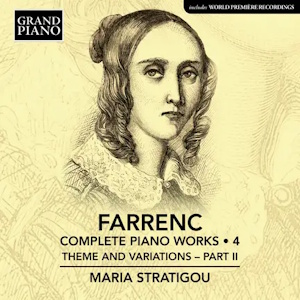
Louise Farrenc (1804-1875)
Complete Piano Works • 4. Theme and Variations – Part II
Variations sur une Galopade Favorite Op.12 (c.1833)
Les Italiennes. Trois Cavatines Favorites de Bellini et Carafa, variées pour le piano Op.14 (1835)
Variations Brilliantes sur la Cavatine d’Anna Bolena de Donizetti “Nel veder la tua costanza” Op.15 (c.1835)
Les Allemandes. Deux mélodies favorites variées Op.16 (1835)
Maria Stratigou (piano)
rec. 2024, Royal Northern College of Music, Manchester, UK
Grand Piano GP965 [61]
In the fourth volume of Louise Farrenc’s complete piano works, Maria Stratigou brings us the second of three discs with the many sets of variations, a staple of Farrenc’s early writing. Opp.2-10 and some variations without opus numbers appeared in volume two (review). The rest will follow in volume six.
The variations Op.12 are based on a Hungarian galopade, a popular dance with a skipping motion, though the theme does not really reflect that. The interest is mostly in the various figurations that Farrenc brings to each variation. There are elegant semiquavers in the first, triplets in the second, scales and – in the obligatory slow variation – scalic passages in sixths and thirds. Harmonically it is all very straightforward and mostly stays in G major. Only the finale ventures briefly into G minor and E flat major before returning hurriedly to the home key.
Les Italiennes Op.14 are three variation sets on Italian operas by Vincenzo Bellini and Michel Carafa de Colobrano (1787-1872). The latter is represented by his 1818 opera Berenice in Siria. The theme of the first set is Dell’aura tua profetica from Bellini’s Norma, which Liszt used to great effect in Réminiscences de Norma. It has a more gentile treatment here, although the variations are by no means easy. Bellini’s la Straniera seems to have fired Farrenc’s passions a little more; there is more drama in the writing and a longer, grander introduction. There is also contrapuntal writing and a minuet finale that happily modulates to B major for a lyrical episode.
Carafa’s aria Aure felici di pace in grembo is ripe for variation in its utter simplicity. Farrenc adorns it with a wealth of keyboard devices that include octave leaps, fast triplets, seemingly as obligatory as a slow variation, and a scherzo finale. In a nod to its operatic inspiration, there is a vocal cadenza coming out of the fourth variation, an effective funeral march. Maria Stratigou travels from Italy to Germany for Les Allemandes, two short variations. The first is based on an Austrian song, Chanson autrichienne, the second on Joseph Weigl’s air. I find these pieces modest and unassuming. They pleasantly trot along with the kind of figuration that sounds effective but is within the reach of the talented amateur, especially in the first of the two. Farrenc wrote Les Allemandes in June 1835 and dedicated them to her then nine -year-old daughter Victorine.
That just leaves the largest variation set in this recital, the Brilliant variationsafter Donizetti’s Anne Boleyn. Farrence completed them a few months before her Op.16. The theme is Lord Percy’s well-known tenor aria Nel veder la tua costanza. We hear it after the customary dramatic introduction that includes Percy’s Vivi tu, te ne scongiuro as a little appetiser. The opera had been premiered in Paris just four years earlier. It evidently made an impression, because Farrenc brings out the big guns here, dramatically and technically. She gives it more substance than many of her variations so far. It stands amongst the best of the many, many opera variations that were appearing in Parisian salons of the time.
Maria Stratigou once again demonstrates her gift for bringing this music to life. The second variation album gives her a little more to get her teeth into, even if this is mostly lighter music, bread and butter in the repertoire of the salon virtuoso. Everything I said in previous reviews could effectively be repeated here. That includes the fact that this is a programme to dip into rather than swallow whole. All in all, it is an excellent addition to an exciting project. Volume 5 –melodies, fugues and waltzes – is already on forthcoming release lists. The present recital has whetted my appetite for the variations of volume six.
Rob Challinor
Buying this recording via the link below generates revenue for MWI, which helps the site remain free













