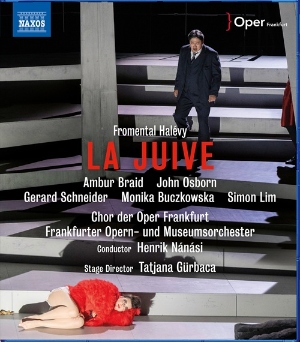
Fromental Halévy (1799-1862)
La Juive (1835)
Rachel: Ambur Braid (soprano)
Éléazar: John Osborn (tenor)
Léopold: Gerard Schneider (tenor)
Eudoxie: Monika Buczkowska (soprano)
Cardinal Brogni: Simon Lim (bass)
Ruggiero: Sebastian Geyer (baritone)
Albert: Danylo Matviienko (bass-baritone)
Chor und Extrachor der Oper Frankfurt, Frankfurter Opern und Museumsorchester / Henrik Nánási
Tatjana Gürbaca (stage director)
Sung in French
rec. live, 11/14 July 2024, Oper Frankfurt, Frankfurt am Main, Germany
Naxos DVD 2.110781 [199]
La Juive has long been an opera known more by reputation than by performance. A great success in the nineteenth century, it later dropped out of favour. It did not help when the Nazis banned it for its theme of love between a Christian man and a Jewish woman. Rachel is the title character, and her aria Rachel, quand du Seigneur is the best-known number. (Readers of Proust will remember Rachel, Saint-Loup’s great love, whom the narrator nicknamed Rachel when from the Lord after this aria.)
Fromental Halévy was widely admired; that included Berlioz, Wagner and Mahler. He wrote some thirty operas, of which La Juive was the first and most successful. The libretto was by Eugène Scribe, who wrote libretti for most of the leading composers of the day. He prided himself on providing well-made plays. David Conway wrote of Scribe’s historical opera libretti: ‘They exist in a parallel universe, in which colourful historical or geographical milieux display a handful of stereotypes who, as a consequence of some secret manoeuvrings in their own pasts and coincidences in the present, are forced to face some implausible crisis of choice or conscience, preferably accompanied by a simultaneous natural disaster or violent death (or both).’ (David Conway, Jewry in Music: Entry to the Profession from the Enlightenment to Richard Wagner, Cambridge: Cambridge University Press, 2012, p.217).
La Juive exemplifies all these characteristics. It is set in Constance in 1414. The Jewish goldsmith Éléazar is saved from a lynching by the intervention of Cardinal Brogni, who had previously been responsible for the death of Éléazar’s sons. Prince Léopold, disguised as Samuel, is in love with Rachel, brought up as Éléazar’s daughter. He reveals toher his true identity as a Christian. (At the time, sexual relations between Christians and Jews were supposedly punishable by death.) Léopold is in fact married – to Princess Eudoxie – and that rather undercuts his position. The Princess comes to order for her husband a jewel from Éléazar. Rachel takes a job as a lady’s maid at Eudoxie’s palace.
Éléazar comes to deliver the jewel and recognises Léopold as the supposed Samuel. Rachel says that Léopold seduced her. She, Éléazar and Léopold are all put in prison on the orders of Cardinal Brogni. Eudoxie persuades Rachel to withdraw her allegation. Cardinal Brogni is willing to spare Léopold but wants Éléazar and Rachel to convert to Christianity. Éléazar refuses, and tells Brogni that the Cardinal’s infant daughter did not die in a fire, as was thought, but survived, and he knows where she is. (Brogni must have married and had his child before losing his family and becoming a priest.) The way to save Rachel is to disclose that she is in fact Brogni’s lost daughter and a Christian, something she does not know. But Éléazar does not do so. It is at this point that he sings the aria Rachel, quand du Seigneur. In the last act, Éléazar and Rachel are to be thrown into a cauldron of boiling water. Rachel refuses to convert and goes to the gallows. Éléazar’s tells Brogni his daughter is alive, shows her to him in the cauldron and goes to his own death.
This production does nothing to evoke the year 1414. The specified settings would be Éléazar’s house, a garden, a Gothic interior and so on. Instead, there is one all-purpose vaguely abstract set which remains unchanged. Most of the cast wear the everyday clothes of the present day, and that makes the production look like a rehearsal. Éléazar wears a three-piece suit until the prison scene, where he is dressed like a clown in a harlequin outfit with a silly hat. When Rachel takes the position as lady’s maid to Eudoxie, she changes her clothes – not into the kind of uniform one might expect, but like a tart, complete with prominent breasts and fishnet tights. Brogni usually also wears a business suit, rather than a cardinal’s robes and red hat. He is shown handing out consecrated wafers from a plate. That suggests that the director does not know much about the Christian faith. Nor is it normal for the Host in a monstrance to precede an execution, as it does here.
Some of the stage directions are not followed. For example, Léopold is supposed to hide when Eudoxie comes to order the jewel, but here does not do so, so her failure to recognise him is incomprehensible. When Eudoxie sings of the longing for her husband, he is there. At first, he takes no notice of her, then becomes coercively controlling. They are also given two school-age children – not in the score – who wander around aimlessly in school uniform. The boy has a model tank to play with, the girl a picture book too young for her age. In Brogni’s scene with Éléazar in prison, there is far too much physical byplay between the two men, so all dignity is lost. I could go on but that will do on the staging.
Much of the singing is really good, and it is always at least acceptable. The standout singers are John Osborn as Éléazar and Monika Buczkowska as Eudoxie. Osborn is always a pleasure to listen to, with a beautiful line and a very expressive voice. He gets the big aria Rachel, quand du Seigneur, and he makes a great scene of it, as he should. Eudoxie is also a delight to listen to, with beautiful voice and sensitive delivery. She dutifully does all the silly things the director has asked for but does not let this detract from her portrayal. Ambur Braid as Rachel is not so lucky. Her unsuitable costume in the later scenes really spoils what would be a very good performance of the title role. Gerard Schneider is adequate in the thankless role of Léopold. Simon Lim is straight but rather wooden as Brogni, again not helped by the direction. The chorus and orchestra are excellent and the conductor, Henrik Nánási (whom I had not previously heard of) does a fine job with the score.
The sound and picture are clear and good. The English subtitles rather minimal – I cannot speak for the others. Had this been an audio-only recording, I would have strongly recommended it. Indeed, I wish Naxos would also issue this on CD. As it is, it depends on what you think of the staging. This seems to be the only DVD currently available, but Naxos has also issued this on CD. The other audio recordings are all quite old, the previous most recent complete recording being from Philips, 1988-89 (review).
I have to point out that the title is a misnomer: as the daughter of a Christian father and, presumably, Christian mother, Rachel is not in fact Jewish.
Stephen Barber
Previous review (Blu-ray): Dominic Hartley
Buying this recording via the link below generates revenue for MWI, which helps the site remain free

Production staff
Klaus Grünberg (set and lighting designer)
Anne Kuhn (associate set designer)
Silke Willrett (costume designer)
Carl-Christian Andresen (associate costume designer)
Nadja Krüger (video)
Tilman Michael (chorus master)
Maximilian Enderle (dramaturge)
Technical details
Subtitles: French, English, German, Japanese, Korean
Picture format: NTSC 16.9
Sound format: Dolby Digital Stereo 2.0 and Dolby DigitalSurround 5.1
Region code: 0 (worldwide)