
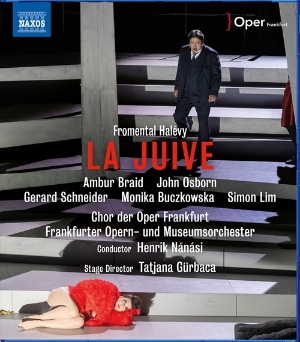
Fromental Halévy (1799-1862)
La Juive (1835)
Rachel – Ambur Braid (soprano)
Éléazar – John Osborn (tenor)
Léopold – Gerard Schneider (tenor)
Eudoxie – Monika Buczkowska (soprano)
Cardinal Brogni – Simon Lim (bass)
Chor und Extrachor der Oper Frankfurt
Frankfurter Opern und Museumsorchester/Henrik Nánási
Tatjana Gürbaca (stage director)
rec. live, 11/14 July 2024, Oper Frankfurt, Frankfurt am Main, Germany
Sung in French
Naxos NBD0190V Blu-ray [199]
Here is a rare opportunity. La Juive has never wanted for admirers, Wagner among them, who professed himself carried away by it. It has mostly wanted though, for the best part of a century, the means to be staged. Until now there has been one staging captured on DVD or Blu-ray: the 1999 Vienna account under Vjekoslav Šutej, with Neil Shicoff’s celebrated Éléazar, issued by DG. One. For a work that, between its Paris premiere in 1835 and the fall of the Weimar Republic, was among the most performed operas in Europe. So, the arrival of this Frankfurt production is not merely another release to be weighed against a crowded field. It is, give or take, the field doubling in size.
Why the long silence? The reasons divide into the historical and the practical, and they reinforce one another. Halévy was Jewish; his librettist Scribe gave him a drama in which Jewish characters are hunted to their deaths by the Christian majority; and the Third Reich did the odiously predictable thing and swept the work from German stages. It has never entirely recovered the ground. There have been periodic rescue attempts in Vienna, Zurich and elsewhere which have kept it visible rather than secure. But the case for grand opera is hard to make these days in any event. The scale defeats most houses: five acts, a vast chorus, a significant running time, and a tenor role of such sustained demands that casting it is a problem before rehearsals even begin. Only a company with deep resources and real programming nerve can mount the thing at all. Frankfurt, which in recent seasons has made a speciality of marrying vocal seriousness to scenic ambition, is exactly such a company.
And the drama it is mounting is, for all its French dress, essentially Jacobean. The machinery is the machinery of revenge tragedy: a buried secret, a concealed identity, a father’s long-nursed hatred, and a final reversal in which vengeance and self-destruction prove to be the same act. Éléazar the goldsmith has raised Rachel as his daughter and as a Jew; she is in truth the child of his enemy, Cardinal Brogni, snatched as an infant from a fire. Éléazar knows this. He withholds it through five acts, and only at the foot of the scaffold, with Rachel already gone, his own death a moment away, does he tell Brogni what the Cardinal has just done. It is the kind of plot that ends with the stage strewn with bodies and the survivor wishing he were not one. Webster would have recognised every element of it.
Musically, this is as fine an account as you could hope to find anywhere. John Osborn’s Éléazar is the centre of it. Osborn sings with an evenness and an authority that never once sounds like survival. He recorded a Gilbert Duprez homage album on Delos some years ago (Duprez created Éléazar in 1835, as well as Rossini’s Arnold) but the disc contains nothing from La Juive. What Osborn left off the record he now delivers whole on the stage, and the wait was worth it. Ambur Braid’s Rachel matches him: a soprano of real weight with a thrilling darkness in her lower register, an actress who makes the girl’s terror and conviction land with equal force. Around them, Henrik Nánási draws playing of glowing colour from the Frankfurt orchestra. Halévy’s orchestration is far subtler than his reputation as a mere purveyor of spectacle would suggest, and the framing of the great arias is tended with proper care. And then the chorus, which a grand opera lives or dies by, is superb here, weighty without coarseness, and, crucially, handled by the production as a body of individuals rather than a scenic mass.
The staging generally is problematic, however. The director, Tatjana Gürbaca, was the last pupil of Ruth Berghaus. Berghaus’s stagings, however austere or strange, possessed a hard legibility: every image earned its place, and the spectator always knew what was being argued, even when disagreeing with it. Gürbaca, working with the designer Klaus Grünberg, has plainly thought long and hard about La Juive. The production teems with ideas about persecution, identity, the crowd’s appetite for a victim, but the thinking has not resolved with Berghausian clarity. Grünberg’s single set, a pale tapering structure of stairs and galleries read variously as tower, rampart and ruin, is more obstacle than statement. Silke Willrett’s costumes, ransacking every period from the medieval to the present, work hard to drag the parable into the now and succeed mainly in cluttering it: Eudoxie as fashion-plate, Léopold as gilded muscleman, Rachel forced into the dress of a streetwalker. There are strong things: the character direction is detailed and alert, and the final coup, Rachel’s body falling from the flies, genuinely shocks. But too often the eye is invited to decode rather than to watch, and an evening that wanted concentration gets accumulation instead. At the Frankfurt premiere the production team were booed amid otherwise unanimous cheers, and while booing is no kind of criticism, one can understand the frustration it came from.
Having said that, anyone who has waited for a new La Juive on disc shouldn’t hesitate on account of the staging. Watch it for Osborn, for Braid, for a chorus and orchestra on fine form, and let the production make its case, or fail to, as it will. The opportunity, to return to where we began, is rare. Seize it.
Dominic Hartley
Other cast
Ruggiero – Sebastian Geyer (baritone)
Albert – Danylo Matviienko (bass-baritone)
Production staff
Klaus Grünberg (set and lighting designer)
Anne Kuhn (associate set designer)
Silke Willrett (costume designer)
Carl-Christian Andresen (associate costume designer)
Nadja Krüger (video)
Tilman Michael (chorus master)
Maximilian Enderle (dramaturgy)
Technical details
Picture format: 1080i High Definition
Subtitles: French, English, German, Japanese, Korean
Sound format: PCM Stereo / DTS-HD Master Audio 5.1
Region code: 0 (worldwide)
No. of discs: 1 (BD 50)
Buying this recording via a link below generates revenue for MWI, which helps the site remain free














