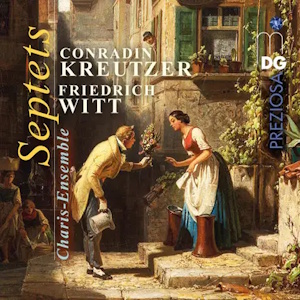
Conradin Kreutzer (1780–1849)
Septet Op. 62
Friedrich Witt (1770 – 1836)
Septet
Charis Ensemble (Diethelm Adorf (clarinet), Stephan Rüdiger (bassoon), David Bryant (horn), Rainer Sonne and Brigitte Rocholl-Gerlinghaus (violin), Christina Lohss (viola), Anette Adorf-Brenner (violoncello), Norbert Brenner (double bass))
rec. 1986, Schloss Nordkirchen, Oranienburg, Germany
MDG 102 2397-2 [62]
You would expect a recording made in 1986 to be a re-release, but the story here is a little more nuanced. There is no mention of a previous catalogue number or of any remastering, and with no online evidence for an earlier edition I presumed that this is this programme’s first appearance which, on CD, is indeed the case. The CD booklet reveals that MDG ‘Preziosa’ is a now quite substantial MDG sub-label for a series that in at least some cases only came out on vinyl records. These recordings are of sessions that hold special memories for Werner Dabringhaus in the early years of MDG, a few anecdotes from which are recollected here. These include having to record at night to avoid the crunching footsteps of visitors to the Nordkirchen palace on a freshly gravelled path outside of the recording venue. The philosophy of exploring works unknown to mainstream concert programmes was a strong feature of MDG from the outset, and these two septets are fine representatives of this noble aim.
Beethoven’s Septet in E-flat major, Op. 20 was a big hit in the early 1800s, and there can be little doubt that Conradin Kreutzer and Friedrich Witt were riding the wave of this popularity with the works recorded here. Beethoven’s septet is well-crafted ‘easy listening’ in comparison with his more revolutionary masterpieces, and this character of charming and witty entertainment is of course one of its main values as a concert success.
Neither Kreutzer nor Witt are remembered much today. Kreutzer was a respected Kapellmeister in Stuttgart and Donaueschingen and there are a handful of recordings of his chamber and operatic works around, and both he and Friedrich Witt have had attention from the ever-enterprising CPO label. Witt has his footnote in musical history as the composer of the so-called Jena Symphony, which was for a time wrongly attributed to Beethoven and therefore representative of a similarity in both composers’ styles at this time. Texts around this recording make the claim that “these two pieces are in no way inferior to the work of their renowned colleague”, and I tend to agree with this statement. Kreutzer’s Septet has a nicely lyrical character, especially in the gorgeous Adagio second movement, and Witt’s music has a way of exploring the colours of this rich instrumental combination with imaginative contrasts and sonorities. Yes, both works remain within the kind of classical tropes that descend from Haydn and others, but neither these nor Beethoven’s septet are intended to stir the soul or expand the boundaries of our existential experience.
With the entire range of this ensemble, from its rich double bass foundations up to a mellow and expressive clarinet, beautifully captured in this fine recording, it is easy to hear how such an instrumental setting would prove both novel and charming to listeners in its day. Nothing about the music-making here sounds at all dated, and only the puffy sleeves on the ladies dresses in the Charis Ensemble’s photo are a giveaway of that special 1980s era. If you are a fan of Beethoven’s septet and want a bit more of that sumptuous resonance, then this will fill the bill nicely.
Dominy Clements
Buying this recording via the link below generates revenue for MWI, which helps the site remain free