
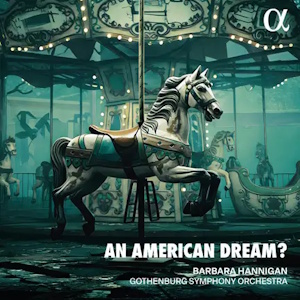
An American Dream?
George Gershwin (1898-1937)
Porgy and Bess: A Symphonic Picture (1942, arr. Robert Russell Bennett)
Aaron Copland (1900-1990)
Dance Symphony (1929)
Richard Rodgers (1902-1979)
The Carousel Waltz (1945, arr. Don Walker)
Barbara Hannigan (b. 1971)/Bill Elliott (b. 1951)
At The Fair – Orchestral Suite with Soprano
Gothenburg Symphony Orchestra/Barbara Hannigan (soprano)
rec. 2025, Gothenburg Concert Hall, Gothenburg, Sweden
English texts and French translations included
Alpha Classics 1222 [71]
There’s an unashamedly polemic background to this album which the determinedly Canadian Barbara Hannigan has curated and also directed from the podium. In the booklet she writes thus: “Growing up as a northern neighbour to the United States, I have been fascinated (and also intimidated) by aspects of the USA which seem built on an entirely different foundation than my country, Canada”. Later, she says: “I grew up in awe of America. I am still in awe, but not in the same way”. Take note of the question mark in the title of this album. It’s deliberately there; she clearly feels that in her lifetime the USA has changed and not for the better. Viewing North America from the outside, I find it hard to disagree. The music which Barbara Hannigan has selected reflects, in her view, a different USA than the one she sees today. Incidentally, I can assure readers that it was a genuine coincidence, though perhaps a fitting one, that I finished my listening to this album and sat down to write this review on the very day that the present occupant of the White House turned eighty.
We have an unexpected benefactor to thank for the existence of Porgy and Bess: A Symphonic Picture: the conductor Fritz Reiner. In her notes, Hannigan explains that Reiner was dissatisfied with orchestral suites, such as Catfish Row, which had been assembled from George Gershwin’s great American opera, Porgy and Bess. Reiner, she says, did much more than commission Robert Russell Bennett to put this Symphonic Picture together and do the arrangements; Reiner himself apparently selected all the excerpts to be featured and decided in what order they should appear in the score. He also decided upon the instrumentation. Thus, for example, it must have been Reiner’s idea that the Symphonic Picture should not open with the dazzling, exciting opening orchestral music from the opera; instead, that occurs in the third of the Symphonic Picture’s seven sections. (These sections play continuously and the whole score runs for about 28 minutes.)
So, instead of the usual bustling opening to the opera we hear first ‘Catfish Row’; here, Hannigan and the orchestra produce a languid atmosphere and I admire the way the various solo lines, such as the terrific trumpet and saxophone solos, are given time and space in which to breathe. When we get to the Opening Music from Act I, the music is projected with great vitality and urgency until the brakes go on, at which point we’re treated to a gorgeous instrumental rendition of ‘Summertime’. Later on, the banjo is rightly put in the spotlight during ‘I got plenty o’nuttin’’; Porgy’s cheerful optimism (at this point in the opera) comes across well, even if there’s no singing. ‘Bess, you is my woman now’ is very touching; I love the warmth of the Gothenburg strings at this point. The Picnic Scene features, of course. ‘Oh, I can’t sit down’; the performance catches the toe-tapping, celebratory mood. Then the saxophones swing seamlessly into ‘There’s a boat that’s leaving soon for New York’. Perhaps the most obvious example of Reiner’s re-ordering of the music away from its place in Gershwin’s full score comes in the seventh and final section where Sportin’ Life’s cynical but entertaining ‘It ain’t necessarily so’ is followed immediately by ‘Oh Lord, I’m on my way’. But it doesn’t matter that some – indeed most – numbers are “out of sequence”; just sit back and enjoy a succession of great tunes from the opera, presented in vital, colourful and faithful arrangements. And you can also sit back and enjoy a scintillating performance by the Gothenburg Symphony, galvanised by Barabara Hannigan’s conducting.
It’s a long way from Catfish Row to the world of Aaron Copland’s Dance Symphony, and even further if you go back to the symphony’s origin. The music originated in Copland’s 1922 ballet Grogh. The macabre scenario for the ballet was inspired by Copland seeing the film Nosferatu when he was in Paris studying with Nadia Boulanger. The story of the ballet, about a wicked sorcerer, who causes corpses to be brought back to life in order to dance for his perverted pleasure, wasn’t exactly a crowd-pleaser and Hannigan reminds us that it was never performed or staged in its entirety. Seven years later, Copland reshaped the music into a continuous three-movement work which he entitled Dance Symphony. The score is succinct – it plays for some 28 minutes – and whilst it may not have the immediate appeal of, say the three great American ballets which Copland wrote in the late 1930s and early 1940s, it’s a very interesting piece which ought to be heard more often. Barbara Hannigan gives us a bit of detail about the action of the ballet as represented in the symphony – and Barbara Heymann adds more detail in her notes for Leonard Slatkin’s 1995 RCA recording of the symphony. To be honest, though, I think it’s perhaps better not to think about the original scenario and just focus on the symphony as an abstract work.
Hannigan, who tells us that the work has “really got under my skin”, confirms that by leading a fine performance. Following a sinister-sounding slow introduction, the Molto allegro section of the first movement has genuine bite; here, I think the influence of Stravinsky is prominent. The second movement (Andante moderato) is primarily shadowy in nature and you can feel the tension in this performance. Hannigan and her orchestra really drive home the movement’s potent climax. The last movement is spiky and forceful in nature; the present performance is really punchy.
Hannigan then takes us to music which is infinitely lighter in nature but no less accomplished: The Carousel Waltz by Richard Rodgers. Hannigan states in her notes that what we hear on her disc is the overture to the film of the show; that was made in 1956, I believe. I wonder if the overture for the film version differed somewhat from the music with which the stage show began. Back in 2024 I reviewed the outstanding recording of the complete score, conducted by John Wilson. On that recording, the overture plays for 6:52, whereas Hannigan’s performance, which, I hasten to say, doesn’t drag, plays for 9:14. Without access to a score I can’t be sure that there weren’t changes for the film. It matters not; the music as presented by Hannigan is richly enjoyable – what a great tune the main waltz is! – and she and the Gothenburgers deliver it with verve and panache. As we shall see, there’s a shrewd link between this number and the closing item on Barbara Hannigan’s programme.
I remember that back in 2017 I reviewed an album entitled Crazy Girl Crazy, recorded in 2016; this was my first experience of Barbara Hannigan as a conductor. She tells us in the booklet for this present CD that the 2016 album included her first collaboration – on the music of George Gershwin – with the American composer and arranger, Bill Elliott. Aparently, they’ve worked a lot together since and now they present the latest fruit of their collaborations in the form of a three-movement Orchestral Suite with Soprano entitled At The Fair. Here, Hannigan features simultaneously as singer and conductor in the two outer sections; the central movement is purely orchestral.
Until I looked up my review of that earlier album, I had completely forgotten that Hannigan and Elliott ingeniously designed their Gershwin suite, entitled Girl Crazy to complement – of all things – Berg’s Lulu Suite. I summarised the reasoning in my review; I thought the concept was interesting and worked well. Here, there’s a similar idea. The first section of At The Fair is an arrangement of Billy Barnes’ song ‘Have I stayed too long at the fair?’ As Hannigan explains, in the Barnes song “someone looks back, with melancholy, on a life, as the carousel slows down”. The linkage with Richard Rogers’ music is clear for all to see. It’s a very melancholy song indeed, especially as voiced by Hannigan. Performed as it is here, with ample rubato and many pauses, it must be very difficult to sing and conduct at the same time but Hannigan more than holds everything together; indeed, she and the orchestra seem to move as one. The same challenges surely apply – and are surmounted – in the third part of At The Fair. Here, Hannigan conducts and sings Jule Styne’s song ‘Don’t rain on my parade’ from Funny Girl; this song, like ‘Have I stayed too long at the fair?’, was made famous by Barbra Streisand, an artist for whom Hannigan expresses great admiration. Again, this number must be really tricky to conduct and sing, especially given the way Hannigan so conspicuously commits to the song. In between the two sung numbers comes an orchestral section, ‘An American Dream’. Don’t think it’s been plonked in there by accident; the Jule Styne song concerns a parade and in this central movement, we’re right in the midst of a parade. As Hannigan explains, she and Elliott “conjured a town holiday, where all the various local groups, bands, and sports teams got together, playing their own favourite popular and patriotic tunes, actually not listening so much to the others around them”. The result is a chaotic (by design), colourful collage of snippets from recognisable tunes. Surprisingly, Hannigan doesn’t reference Charles Ives but, as I listened, his name immediately came to mind. In the track list no fewer than ten tunes are listed; they make but fleeting appearances because the whole thing lasts a mere 2:26. It’s ingenious and fun.
Whether or not you sympathise with Barbara Hannigan’s view of the USA and regret for the way it has changed in recent years – I do – nevertheless you can still enjoy a stimulating and highly entertaining programme of American music from a kinder, dare I say less complicated age. Hannigan tells us that she has been working with the Gothenburg Symphony Orchestra for longer than with any other orchestra; their collaboration goes back more than 10 years and since the 2019/20 season she has been their Principal Guest Conductor. There’s an evident rapport between conductor and orchestra; these performances are full of life and energy.
Alpha’s recorded sound is crisp and excellent.,
John Quinn
Buying this recording via the link below generates revenue for MWI, which helps the site remain free













