
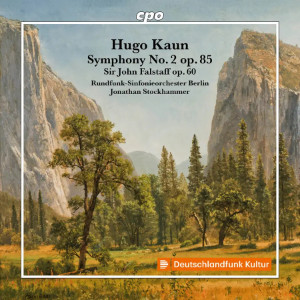
Hugo Kaun (1863-1932)
Sir John Falstaff: A Humoresque for Full Orchestra Op.60 (1904)
Symphony No.2 in C minor Op.85 (1908)
Radio Symphony Orchestra Berlin/Jonathan Stockhammer
rec. 2004, Haus des Rundfunks, Berlin, Germany
cpo 555714-2 [59]
Rob Barnett’s MWI review found the release, I think it is safe to say, moderately impressive. In the opening Humoresque, Hugo Kaun portrays Falstaff, the Shakespearean character, and events surrounding him. I have never been particularly taken by so-called humorous orchestral music. It can be amusing the first couple of times you hear it, but after that… I agree with Rob that the piece is loquacious, to the same degree that can strike one in Strauss’s Macbeth. The situation is not helped by the absence of a distinctive melody. So, the overall effect is one of a pleasant quarter-of-an-hour that does not impress itself on one’s memory.
The symphony is a rather different proposition. On first hearing it, I felt that orchestrally it is a typical product of the late-Romantic German school, where luxurious orchestration is tempered by a conservative choice of instruments. At one point, I considered that the piece might be by a German Elgar, but an Elgar without the familiar inimitable melodic inspiration.
Kaun had his musical education at the Berlin Hochschule für Musik and Prussian Academy of Arts. In 1886 he left Germany for the USA, where he gained a strong reputation for his teaching and conducting activities. He returned in 1902, and gradually established himself in the German-speaking lands. He became quite well-known as a composer; his music, influenced by Wagner, was often performed. After WW1, the increase of much more radical musical styles in Berlin left him behind, and his compositions gradually became neglected.
The melodic inspiration I mentioned earlier is clearly not the only criterion by which we judge a work. Some sort of structure is needed: the composer cannot just create a tune and then repeat it umpteen times. That problem caught composers who tried to base their compositions entirely on folk song.
The thirteen-minute first movement Etwas bewegt, ernst begins in the style of Brahms’s C minor symphony. Audible timpani soon change into a slightly lighter mood that wants to revert to seriousness as Kaun adds the march rhythms. The central section suggests that he has been taking an interest in impressionistic music. The booklet notes claim that, had Hollywood been around at the time, the music would bring its output to mind. Now, pleasant though the passages are, film music does not spring to my mind at all, although I suppose very brief brass interjections might do so, were they prolonged. I agree with the booklet notes: “The melodies, again charged with many leading tones, are on a first hearing still difficult to grasp and to recall”. I have listened to the symphony several times, but I do not come away humming its tunes.
The notes suggest that the fourteen-minute slow movement Adagio. Sehr inning, mit großem ausdruck contains traces of the slow movement of Bruckner’s 7th symphony and Parsifal, with textures that approach “choral saturation and great effectiveness”. Well, on style I would agree, but not on memorability, despite the composer’s instruction to play very heartfelt, with great expression.
The most immediately effective movement, I think, is the nine-and-a-half-minute Finale. Marschmäßig. A mildly memorable march forms the central section, with a slow build up of march-like fragments tossed between the different sections of the orchestra. About two minutes in, the march tune takes form and continues in style, occasionally interrupted by brass or woodwind chorales. About two minutes before the end, Kaun employs the organ to support the rest of the orchestra, and the march is brought to an effective end “in C major euphoria”.
The excellent Berlin Radio Symphony Orchestra play the programme very well. They are ably conducted by Jonathan Stockhammer, an American based in Germany. The recording is full and very well balanced. The booklet notes are somewhat long-winded, but have all the necessary detail about Kaun, his music and the performers.
Jim Westhead
Previous review: Rob Barnett
Buying this recording via the link below generates revenue for MWI, which helps the site remain free













