
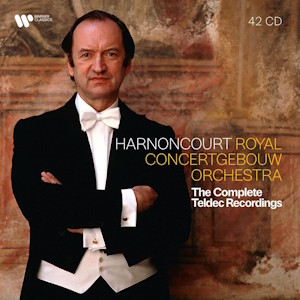
Nikolaus Harnoncourt (conductor)
The Complete Teldec Recordings
Royal Concertgebouw Orchestra
rec. 1980-2001
Warner Classics 2685417620 [42 CDs]
After reviewing Warner Classics’s box of Nikolaus Harnoncourt’s complete recordings with the Chamber Orchestra of Europe, I was delighted to hear his entire output with the Concertgebouw Orchestra, a partnership that yielded spellbinding music making. Harnoncourt persuaded this large orchestra, established in 1888, to adopt his historically-informed approach and play in a manner radically different from how it sounded with its then-principal conductor Bernard Haitink. The chemistry between Harnoncourt and the Concertgebouw demonstrates that commonalities are not actually a basis for relationships: shared interests may bring people together in the first instance, but other factors, such as values and mutual respect, keep people together. The Concertgebouw’s usual repertoire overlapped with Harnoncourt’s only partially, but they found common ground and built a very impressive discography that represents some of this orchestra’s finest achievements. Differences enrich relationships when they do not cause conflict, so Harnoncourt’s knowledge enabled Concertgebouw members to perform music that many internationally-renowned ensembles neglected.
Harnoncourt was one of the most innovative conductors of his generation, who challenged how musicians and audiences thought about music. As a co-founder of the Concentus Musicus Wien in 1953, he was a pioneer in using the instruments, techniques, and aesthetics of the respective eras in which works were composed. By combining scholarship with passion, he inspired performers and listeners to enjoy long-neglected works and re-examine familiar masterpieces. Many ideas about performing the compositions that he undertook with the Concertgebouw (e.g., light textures, brisk tempos, clear phrasing, attention to historical sources) were controversial when he began advocating them. In other words, Harnoncourt did not continue the performing traditions that his colleagues inherited, but transformed performance practices to suit his vision.
The first twenty discs are devoted mostly to symphonies by Wolfgang Amadeus Mozart, as well as the three operas he composed in collaboration with Lorenzo Da Ponte. Recorded while Christopher Hogwood was completing his cycle of all Mozart’s then-known orchestral works on period instruments, Harnoncourt used a modern symphony orchestra, albeit with awareness of how the music was played during the composer’s lifetime. Pronounced rhythms, transparent textures, dramatic phrasing, energetic tempi, and dynamic contrasts characterise how Harnoncourt performed the symphonies. A very welcome observation of all the repeats that Mozart indicated in the scores reveals the structure of these works in full and enhances their emotional impact. In my review of Harnoncourt’s recordings with the Chamber Orchestra of Europe, I suggested that his interpretations of Mozart’s symphonies with that ensemble were similar to these. The chief difference lies in the Concertgebouw’s extra degree of refinement. I suspect that Harnoncourt might have chosen this orchestra to ease listeners into what was then a new way of experiencing these works. When these discs were released in the early 1980s, many critics saw them as insightful and invigorating while others complained about what they deemed arbitrary alterations of accents, rests, and phrasing. In my opinion, these rank among the finest accounts of these symphonies with modern orchestras. Legendary conductors (e.g., Bruno Walter, Josef Krips, and Karl Böhm) performed abbreviated versions of these works in which most of the repeats were removed and the number of instruments for each part was increased. Against this background, Harnoncourt sounds bold and original: the performances are satisfying on repeated listening, and his interpretive decisions are defensible based on the scores. These recordings challenged listening habits by defying expectations that developed from prolonged exposure to a performance tradition.
From an orchestral standpoint, the recordings of Le nozze di Figaro, Don Giovanni, and Così fan tutte offer lustrous texture and optimal accompaniment during arias and ensembles. There is sufficient transparency for the voices to come through clearly and enough heft and variety to do justice to Mozart’s complex scoring. Figaro benefits from dramatically alert conducting that combines precision and rhythmic vitality with the Concertgebouw’s rich sonority. These virtues are, unfortunately, compromised by occasionally mannered phrasing, emphatic accents, and self-conscious interpretive gestures, such as slow tempi and elongated pauses. Given his penchant for textual accuracy, Harnoncourt surprisingly opted for a synthesis of the ‘Prague’ and ‘Vienna’ versions of Don Giovanni, which Mozart himself never performed. I would have preferred one of Mozart’s texts with the music from the other included in an appendix. Merits include gravitas and crisply articulated recitatives and ensembles combined with the Concertgebouw’s opulence in a gripping, coherent, and vibrant reading. Among the singers, Edita Gruberová stressed Donna Anna’s grief and inner conflict, especially in ‘Non mi dir’ with elaborate runs, trills, and floating pianissimi. Roberta Alexander brought a warm lyrical tone to Donna Elvira and portrayed the character as wounded, proud, and obsessed with Don Giovanni because her affection is genuine. In the title role, Thomas Hampson resembled Dietrich Fischer-Dieskau in Ferenc Fricsay’s 1958 recording in that both baritones had the right voice type, but captured only aspects of the character. Both rightly depicted the Don as a man who pursues what he wants and uses his social position to control others, but they missed his charm and seductiveness. Così is, thankfully, given complete in a lucid performance that balances period-informed articulation with the orchestra’s lush timbre. Textures are transparent and ensemble writing sharply etched, while the drama unfolds with poise. Though less theatrical than some rivals, it rewards attentive listening with subtle psychological shading. This recording is a qualified recommendation because the singing cast, while never less than adequate, does not rise to the level heard elsewhere.
Of particular interest to collectors are the recordings of Mozart’s rarely performed incidental music for the play Thamos, König in Ägypten, K. 345/336a, and Antonio Salieri’s Prima la musica e poi le parole, which is juxtaposed with Mozart’s Der Schauspieldirektor, K. 486. The latter is a partial reconstruction of the contest between Italian opera buffa and German Singspiel on 7 February 1786 in the Orangerie of Schloss Schönbrunn in the presence of Kaiser Joseph II. In Thamos, Harnoncourt brought out the ceremonial, ritualistic theatrical qualities. The main competition for this recording is the one by John Eliot Gardiner, which is on period instruments and also contains Mozart’s original, discarded versions of the first and final choruses. Prima la musica reveals Salieri’s keen theatrical pacing, wit, and exquisite vocal writing. Harnoncourt’s recording features crisp orchestral playing with sharp rhythms and a strong cast, including Thomas Hampson, Robert Holl, Julia Hamari, and Roberta Alexander. I enjoyed this performance so much that I wish the score had been recorded in full. Comic situations in this reading of Der Schauspieldirektor carry dramatic weight, but, as with other recordings, the musical numbers are given in isolation from the dialogue that was intended to join them. Without a story, the arias and ensembles are disembodied, which might explain why this work is performed infrequently.
Harnoncourt’s recordings of Franz Joseph Haydn’s twelve ‘London’ symphonies, plus Symphony No. 68 in B-flat major, stand out among other cycles, including those by Antal Doráti, Eugen Jochum, and Colin Davis, by tempering this world-class orchestra’s elegance with these works’ inherent rustic charm. Harnoncourt imparted Haydn’s ingenuity, boldness, and expressive depth through sharply articulated rhythms, transparent textures, and dynamic shading. As with his interpretations of Mozart’s symphonies, Harnoncourt brought out the vitality and individual character of each symphony. I would describe No. 93 as witty and contrasted sharply with a weighty slow introduction. In No. 94, Harnoncourt creates drama, rhythmic bite, and, especially in the finale, exhilaration. Dark C-minor energy permeates No. 95, whereas No. 96 gains stature through a beautifully shaped slow movement. Brisk tempi and buoyancy make No. 97 vibrant, while gallantry characterises No. 98. The Concertgebouw’s luminous wind and string sections give No. 99 a degree of richness and No. 100, abetted by percussion, a vivid martial character. Astonishing rhythmic incisiveness, especially the ticking accompaniment in the second movement, make No. 101 burn with tension. My favourite in the set is No. 102, which has incredible grandeur, thrust, and structural coherence. The imposing introduction to No. 103 opens a magnificent reading that sustains tremendous momentum throughout. The final symphony in the collection, No. 104, has architectural integrity and rhythmic power.
The cycle of Franz Schubert’s symphonies counts among the finest on disc and was, along with the set conducted by Claudio Abbado with the Chamber Orchestra of Europe (1988), one of the first to be based on the original manuscripts rather than the edition revised by Johannes Brahms. Crisply articulated rhythms and accents, judicious dynamics, nuance, and lithe tempo shifts from brisk to spacious underline Schubert’s poignancy. Harnoncourt elicited sparkling, lyrical playing from the Concertgebouw and preserved Schubert’s stark dynamic contrasts, often moderated with crescendos and diminuendos in the Brahms edition. For accounts of Brahms’s versions, Karl Böhm’s cycle with the Berlin Philharmonic and recordings of individual symphonies conducted by Bruno Walter and Otto Klemperer remain references.
Harnoncourt’s disc of nine waltzes by Johann Strauss II and Josef Strauss animates these mostly well-known works unsentimentally with a degree of freshness that even the best New Year’s concerts from the Musikverein rarely capture. In contrast to treasurable performances by Willi Boskovsky and others, Harnoncourt treats these dances as organic orchestral miniatures (almost like tone poems) with stories to tell. Anyone who labours under the view that the Strauss family produced exclusively light-hearted entertainment should discover the range of feelings this diverse and highly original music expresses.
The recording of Die Fledermaus, however, is mostly joyless, but the eschewal of routine, including legato smoothness, reinforces the seriousness underlying this apparently light-hearted operetta. One fatal flaw is the replacement of the original dialogue between the characters with a narration, which distorts character development and the plot. One consequence of eliminating the spoken text concerns the relationship between Eisenstein (Werner Hollweg) and his wife, Rosalinde (Edita Gruberová): their conversation during the first act, as it stands in the libretto, reveals a lack of warmth and love. They remain together out of social convention and legal obligation, which keeps them both in misery from which each seeks to escape through affairs. The first voice in the operetta is that of Alfred (Josef Protschka), Rosalinde’s lover; at Prinz Orlofsky’s (Marjana Lipovšek) party in the second act, Eisenstein is eagerly seeking a lover, but ends up with Rosalinde in disguise. Harnoncourt treats this work a social commentary with real depth that uses waltzes and vivacious melodies to present issues, such as love, fidelity, trust, revenge, and justice, in a palatable way so that audiences will be entertained if they are not paying attention to the spoken and sung texts, but also provoked to think about their own situations when they follow the story. In spite of its exploration of the ‘dark side’ to this comedy and the welcome inclusion of the complete ballet music, this recording does not compete with classics, such as Clemens Krauss (1950) and Herbert von Karajan (1955 and 1960) because ponderousness and earnestness, which would have been clear enough if the dialogue had been included, render Harnoncourt’s account mundane.
Anton Bruckner’s Third and Fourth Symphonies, given in their 1877 and 1878/80 versions respectively, are rife with melodic invention. Bruckner was contemporary to Johann Strauss in Vienna, and they shared a gift for crafting memorable motifs despite their distinctive musical styles. Harnoncourt uncovered the almost Schubertian orchestration in Bruckner’s Third Symphony, which the composer dedicated to Richard Wagner, as well as the cohesion between the numerous themes. The Fourth, taken swiftly in all four movements, gains in beauty and propulsion what it sacrifices in monumentality. In Harnoncourt’s hands, the finale ‘Bewegt, doch nicht zu schnell’, which often seems interminable, has a gentle, cathartic effect. Interestingly, Harnoncourt’s tempo choices and the overall texture he derived from the Concertgebouw approximate those achieved by Bruno Walter, who overlapped chronologically with Bruckner more than almost anyone else who recorded this symphony. Although no information is provided, it sounds as though Harnoncourt scaled back the orchestra to the proportions specified in the scores and divided the violin desks, so the forces may be those the composer envisioned. After hearing Harnoncourt and revisiting Walter’s account of the Fourth, I wonder if conductors born from the mid-1880s onward, such as Wilhelm Furtwängler and Hans Knappertsbusch, created the turgid, coagulated ambience associated with these symphonies.
Rudolf Buchbinder was at the keyboard for flowing, lyrical performances of the two piano concertos by Johannes Brahms in which feelings of tragedy and struggle emerge without seeming indulgent. By minimizing vibrato, Harnoncourt illuminated orchestral detail, including the inner voices, bassoon lines, brass interjections, rhythmic counterpoint, and harmonic tensions that seem to inhabit the sound world of the latter nineteenth century. Implied, rather than flaunted, virtuosity pointed up Brahms’s complex piano writing with cleanly articulated technical brilliance. Buchbinder seemed engaged in wordless dramas by blending into and emerging from the orchestra like a partner rather than a guest soloist. Although the First Concerto in D minor, Op. 15, is intrinsically monumental, Buchbinder and Harnoncourt tempered its grandeur through acuity. Meanwhile, their interpretation of the expansive, nostalgic Second Concerto in B-flat major, Op. 83, united grace and drama so that the abrupt changes of mood are distinct. Tender passages sound intimate and vulnerable, while climaxes possess considerable force because they emerge from differentiated musical terrain.
The Violin Concerto in D major, Op. 77, with Gidon Kremer as the soloist, sounds like a symphonic drama in which the violinist and orchestra are equals. Rhythms are strong; orchestral textures are transparent; and inner instrumental lines are audible. Kremer prioritised rhetoric over sheer tonal opulence, which unveiled structural and expressive attributes that sumptuous performances usually submerge. For the cadenza, Kremer chose to play the one by George Enescu (1903) rather than the one by Joseph Joachim, the concerto’s dedicatee and friend of Brahms. A taut, dramatic reading of the Double Concerto for Violin and Cello in A minor, Op. 102, featuring Kremer and Clemens Hagen, is the most compelling since those conducted by Arturo Toscanini and George Szell. Verve, active orchestral accompaniment, and interplay between violin and cello underline the concerto’s concentration, economy, and autumnal reflection.
Rounding off the box are four CDs of symphonies, tone poems, and a piano concerto by Antonín Dvořák that are full of suspense and urgency, which make these works seem like living art that retains relevance and uniqueness. While these performances do not emanate charm or rusticity, their freshness, rhythmic exuberance, and drive confirm these works to be ambitious statements that follow from those by Ludwig van Beethoven and Robert Schumann.
This superlative release in which every disc has merit makes the fruitful collaboration between Harnoncourt and the Concertgebouw Orchestra easily accessible. I am not enthusiastic about collections of recordings by single conductors or performers, but Harnoncourt and Böhm are exceptions because their repertoire choices usually coincide with my interests. Even when I have different ideas about how certain works should sound, Harnoncourt’s recorded legacy is consistently rewarding and enjoyable to hear. Room for improvement would involve expanding the booklet to incorporate all the liner notes and sung texts included with the original releases. This would increase the cost and size of the set, but the target audience, Harnoncourt admirers, would be happy to pay extra for this valuable collectors’ item. Bargain hunters will not invest in a box like this anyway but would stream or obtain inexpensive issues of individual performances. Otherwise this is an enormous testament to one of the greatest conductors of the twentieth and early twenty-first centuries. Warner Classics will, hopefully, continue the series of Harnoncourt boxes.
Daniel Floyd
Buying this recording via the link below generates revenue for MWI, which helps the site remain free

Contents
CD 1
WOLFGANG AMADEUS MOZART 1756-1791
Symphony No. 40 in G minor, K. 550
Symphony No. 25 in G minor, K. 183
CD 2
WOLFGANG AMADEUS MOZART 1756-1791
Symphony No. 26 in E-flat major, K. 184
Symphony No. 28 in C major, K. 200
Symphony No. 30 in D major, K. 202
CD 3
WOLFGANG AMADEUS MOZART 1756-1791
Symphony No. 39 in E-flat major, K. 543
Symphony No. 29 in A major, K. 201
CD 4
WOLFGANG AMADEUS MOZART 1756-1791
Symphony No. 33 in B-flat major, K. 319
Symphony No. 31 in D major, K. 297 “Paris”
CD 5
WOLFGANG AMADEUS MOZART 1756-1791
Symphony No. 36 in C major, K. 425 “Linz”
Symphony No. 32 in G major, K. 318
Lucio Silla, K. 135: Overture
CD 6
WOLFGANG AMADEUS MOZART 1756-1791
Symphony No. 35 in D major, K. 385 “Haffner”
Symphony No. 34 in C major, K. 338
CD 7
WOLFGANG AMADEUS MOZART 1756-1791
Symphony No. 38 in D major, K. 504 “Prague”
Symphony No. 41 in C major, K. 551 “Jupiter”
CD 8
WOLFGANG AMADEUS MOZART 1756-1791
Concerto for two pianos No. 10 in E-flat major, K. 365
CHICK COREA 1941-2021
Fantasy for two pianos 11.46
FRIEDRICH GULDA 1930-2000
Ping Pong, for two pianos 9.56
Friedrich Gulda, Chick Corea piano
CD
WOLFGANG AMADEUS MOZART 1756-1791
Piano Concerto No. 26 in D major, K. 537 “Coronation”
Piano Concerto No. 23 in A major, K. 488
Friedrich Gulda piano
CDs 10-12
WOLFGANG AMADEUS MOZART 1756-1791
Così fan tutte, K. 588
Fiordiligi Charlotte Margiono
Dorabella Delores Ziegler
Guglielmo Gilles Cachemaille
Ferrando Deon van der Walt
Despina Anna Steiger
Don Alfonso Thomas Hampson
Chorus of De Nederlandse Opera (chorus master Winfried Maczewski)
Continuo: Glen Wilson harpsichord · Wim Straesser cello
Royal Concertgebouw Orchestra
Nikolaus Harnoncourt
CDs 13-15
WOLFGANG AMADEUS MOZART 1756-1791
Don Giovanni, K. 527
Don Giovanni Thomas Hampson
Il Commendatore Robert Holl
Donna Anna, sua figlia, promessa sposa di Don Ottavio Edita Gruberova
Don Ottavio Hans Peter Blochwitz
Donna Elvira, dama di Burgos Roberta Alexander
Leporello, servo di Don Giovanni László Polgár
Zerlina, contadina Barbara Bonney
Masetto, amante di Zerlina Anton Scharinger
Chorus of De Nederlandse Opera (chorus master Winfried Maczewski)
Continuo: Glen Wilson harpsichord · Wim Straesser cello
Royal Concertgebouw Orchestra
Nikolaus Harnoncourt
CDs 16-18
WOLFGANG AMADEUS MOZART 1756-1791
Le nozze di Figaro, K. 492
Il Conte di Almaviva Thomas Hampson
La Contessa di Almaviva Charlotte Margiono
Susanna Barbara Bonney
Figaro Anton Scharinger
Cherubino Petra Lang
Marcellina Ann Murray
Bartolo Kurt Moll
Basilio Philip Langridge
Don Curzio Christoph Späth
Barbarina Isabel Rey
Antonio Kevin Langan
Due Donne Liliana Castello, Petra Lang
Chorus of De Nederlandse Opera (chorus master Winfried Maczewski)
Continuo: Glen Wilson harpsichord · Wim Straesser cello
Royal Concertgebouw Orchestra
Nikolaus Harnoncourt
CD 19
WOLFGANG AMADEUS MOZART 1756-1791
Thamos, König in Ägypten, K. 345
Thomas Thomaschke bass (Oberpriester Sethos)
Janet Perry soprano
Anne-Marie Mühle mezzo-soprano
Marius van Altena tenor
Harry van der Kamp bass
Niederländischer Kammerchor (chorus master Kerry Woodward)
Collegium Vocale (chorus master Philippe Herreweghe)
Royal Concertgebouw Orchestra
Nikolaus Harnoncourt
CD 20
ANTONIO SALIERI 1750-1825
Prima la musica, Poi le parole
Maestro Robert Holl
Poeta Thomas Hampson
Donna Eleonora Roberta Alexander
Tonina Julia Hamari
WOLFGANG AMADEUS MOZART 1756-1791
Der Schauspieldirektor, K. 486
Madame Herz Magda Nador
Mademoiselle Silberklang Krisztina Laki
Monsieur Vogelsang Thomas Hampson
Buff Harry van der Kamp
Royal Concertgebouw Orchestra
Nikolaus Harnoncourt
CD 21
JOSEPH HAYDN 1732-1809
Symphony No. 93 in D major, Hob. I:93
Symphony No. 100 in G major, Hob. I:100 “Military”
Symphony No. 68 in B-flat major, Hob. I:68
CD 22
JOSEPH HAYDN 1732-1809
Symphony No. 94 in G major, Hob. I:94 “Surprise”
Symphony No. 95 in C minor, Hob. I:95
CD 23
JOSEPH HAYDN 1732-1809
Symphony No. 96 in D major, Hob. I:96 “Miracle”
Symphony No. 97 in C major, Hob. I:97
CD 24
JOSEPH HAYDN 1732-1809
Symphony No. 98 in B-flat major, Hob. I:98
Symphony No. 99 in E-flat major, Hob. I:99
CD 25
JOSEPH HAYDN 1732-1809
Symphony No. 101 in D major, Hob. I:101 “Clock”
Symphony No. 102 in B-flat major, Hob. I:102
CD 26
JOSEPH HAYDN 1732-1809
Symphony No. 103 in E-flat major, Hob. I:103 “Drumroll”
Symphony No. 104 in D major, Hob. I:104 “London”
CD 27
FRANZ SCHUBERT 1797-1828
Symphony No. 1 in D major, D. 82
Symphony No. 4 in C minor, D. 417
Overture in D major, D. 590 “In the Italian Style” 8.12
Overture in C major, Op. posth. 170, D. 591 “In the Italian Style” 7.59
CD 28
FRANZ SCHUBERT 1797-1828
Symphony No. 2 in B-flat major, D. 125
Symphony No. 6 in C major, D. 589
CD 29
FRANZ SCHUBERT 1797-1828
Symphony No. 3 in D major, D. 200
Symphony No. 5 in B-flat major, D. 485
Symphony No. 8 in B minor, D. 759 “Unfinished”
CD 30
FRANZ SCHUBERT 1797-1828
Symphony No. 9 in C major, D. 944 “The Great”
CD 31
JOHANN STRAUSS II 1825-1899
*with JOSEF STRAUSS 1827-1870
1 Der Zigeunerbaron: Overture 8.02
2 Kreuzfidel, Op. 301 4.05
3 Leichtes Blut, Op. 319 2.24
4 G’schichten aus dem Wienerwald, Op. 325 12.25
5 Ägyptischer Marsch, Op. 335 4.45
6 Wiener Bonbons, Op. 307 9.21
7 Pizzicato-Polka* 2.59
8 Unter Donner und Blitz, Op. 324 3.00
9 An der schönen blauen Donau, Op. 314 9.31
CDs 32-33
JOHANN STRAUSS II 1825-1899
Die Fledermaus (beginning)
Alfred Josef Protschka
Adele Barbara Bonney
Rosalinde Edita Gruberova
Eisenstein Werner Hollweg
Dr. Blind Waldemar Kmentt
Dr. Falke Anton Scharinger
Frank Christian Boesch
Prinz Orlofsky Marjana Lipovšek
Ida Elisabeth von Magnus
Frosch André Heller (spoken role)
Chorus of De Nederlandse Opera (chorus master Johannes Mikkelsen)
Royal Concertgebouw Orchestra
Nikolaus Harnoncourt
CD 34
ANTON BRUCKNER 1824-1896
Symphony No. 3 in D minor, WAB 103 “Wagner Symphony”
Version 1877, Leopold Nowak Edition
CD 35
ANTON BRUCKNER 1824-1896
Symphony No. 4 in E-flat major, WAB 104 “Romantic”
Version 1878/80
CD 36
JOHANNES BRAHMS 1833-18978
Piano Concerto No. 1 in D minor, Op. 15
Rudolf Buchbinder piano
CD 37
JOHANNES BRAHMS 1833-18978
Piano Concerto No. 2 in B-flat major, Op. 83
Rudolf Buchbinder piano
CD 38
JOHANNES BRAHMS 1833-18978
Violin Concerto in D major, Op. 77
Double Concerto for violin and cello in A minor, Op. 102
Gidon Kremer violin
Clemens Hagen cello (4-6)
CD 39
ANTONÍN DVOŘÁK 1841-1904
Symphony No. 7 in D minor, Op. 70, B. 141
The Wild Dove, Op. 110, B. 198
CD 40
ANTONÍN DVOŘÁK 1841-1904
Symphony No. 8 in G major, Op. 88, B. 163
The Noon Witch, Op. 108, B. 196
CD 41
ANTONÍN DVOŘÁK 1841-1904
Symphony No. 9 in E minor, Op. 95, B. 178 “From the New World”
The Water Goblin, Op. 107, B. 195 21.08
CD 42
ANTONÍN DVOŘÁK 1841-1904
Piano Concerto in G minor, Op. 33, B. 63
The Golden Spinning Wheel, Op. 109, B. 197 28.21
Pierre-Laurent Aimard piano













