
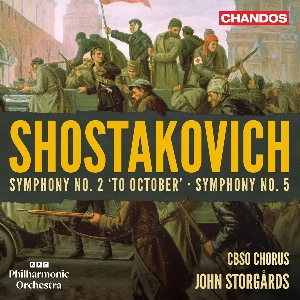
Dmitri Shostakovich (1906–1975)
Symphony No. 2 in B major, Op. 14, ‘To October’ (1927)
Symphony No. 5 in D minor, Op. 47 (1937)
CBSO Chorus
BBC Philharmonic Orchestra/John Storgårds
rec. 2025, MediaCityUK, Salford, Manchester, UK
Russian text and English translation
Chandos CHSA5378 SACD [67]
It was encountering two works by Dmitri Shostakovich at about the same time that prompted my long and deep association with his music. I was startled by the opening of the Fifth Symphony, and the rest of the work did not disappoint. His Cello Concerto No. 1 had a similar effect. In more than 50 years since then I have listened to and studied as much of his music as I have been able to, always with the deepest admiration and appreciation. I wish I could say that this applies to each of his 15 symphonies, but this would not be quite true. Opinions change, with certain works moving into and out of favour, but the view that the second and third symphonies are less valuable than the others seems to persist. Reviewing this disc has convinced at least one listener that such an assessment needs to be revised.
Shostakovich’s Second Symphony, ‘To October’, was composed to a commission for a work to celebrate the anniversary of the Bolshevik Revolution of October 1917. Its playing time is just short of 20 minutes, and its single movement falls into three main sections (though David Fanning, in a superb booklet note, prefers to subdivide one of them, making four). The turbid multiple-voiced string counterpoint that opens the work makes clear that a highly advanced musical language is being employed. A trumpet solo and a lugubrious tuba contribute to a mood that is dark yet curiously without emotion. The agitated march that follows is abruptly cut short by a sudden major chord, fortissimo, before a solo violin launches a passage of near-manic polyphony totally bereft of melodic content. The violin then brings the passage to an uneasy end, with what little calm there is immediately shattered by the sound of a factory hooter, allotted to brass instruments in the score and memorably supplemented by a claxon in this performance. The final section of the work is a choral setting of a semi-official proletarian text on the subject of the October Revolution. ‘We marched’, it begins, ‘we asked for work and bread.’ Then, ‘We knew, Lenin, that our fate bears a name: Struggle … You led us to the final battle … the victory of labour.’ The final affirmation is not sung, but shouted, and is followed by a thunderous final coda. This is choral music of brute power rather than subtlety, and much might be said of the whole work. Knowing how Shostakovich’s life and career was to develop, we can only wonder how something so uncompromisingly modernistic could really serve the message intended. The composer claimed otherwise, but this is hardly music for mass appreciation, though significantly the choral writing, whilst short on melodic distinction, is largely tonal.
The performance is very fine. Storgårds seems to be searching for, and finds, more refinement that Vasily Petrenko with Royal Liverpool Philharmonic forces on Naxos (8.572708). He is helped by a Chandos recording that is both analytical and rich, thanks to the team of Mike George, Stephen Rinker and Simon Highfield. The City of Birmingham Symphony Chorus yell out the climactic lines just as forcefully as do the Liverpool singers, yet the latter sound both more revolutionary and more joyous. Petrenko makes rather more of the raucous climaxes too. Storgårds, on the other hand, achieves great clarity of texture, and his attention to detail reminds us that this is a symphonic work. Getting to know any of Shostakovich’s magisterial symphonies requires listening to more than one interpretation. Rudolf Barshai’s performance, part of an unmissable integral set on Brilliant Classics, adds further elements which will contribute to any listener’s appreciation of this remarkable and neglected work.
The opening of Shostakovich’s Fifth Symphony is as striking and as celebrated as that of Beethoven’s: a daring statement, true, but I stand by it. It is trenchant and dramatic here, the bows digging deep into the strings. As the opening gestures are transformed into an accompanying pattern, the first violins intone the first theme in a distant, mysterious piano. They are similarly reticent in the second theme where Storgårds ensures that the gentle, chugging accompaniment has its own significance and meaning. When this too dies away to pass into the piano-led faster section we are aware, and not for the first time, how faithful Storgårds is to the score’s numerous yet subtle tempo changes. The horns and trumpets are as baleful here as we are likely to here anywhere, and when the heavy brass are given long notes over the opening dotted figure Storgårds gives prominence to the woodwind, creating a shrillness of sound that is most exciting. The huge unison climax is striking, though perhaps less crushing than the terrific build-up has led us to expect, but the gradual resolution to the return of the second main theme is superbly done, and that theme itself, shared between first flute and first horn, is genuinely sunny and smiling. Listen out for an upward slide from the violins and violas a minute or so before the end, an example of Storgårds’s facility at bringing out details that we may have missed in other performances. The first flute stuttering deliciously shortly after the solo violin passage in the scherzo is another golden moment. The slow movement is beautifully done, though Storgårds’s insistence on precision can sometimes take away a little of the music’s natural spontaneity. The meandering repeated-note first violin phrase at figure 83 (5:10) sounds too literal, for instance, though the climax of the movement is fine, and in the extraordinary passage that follows Storgårds has the two clarinets buzzing away powerfully in a way that is both surprising and convincing.
With playing as brilliant as this from the BBC Philharmonic these are obviously highly recommendable performances of both symphonies. Only the finale of the Fifth do I find marginally less satisfying than the rest. It opens superbly, with the timpani banging away, Shostakovich surely cocking a snook at his critics within the regime: ‘The Philistines will like this!’ But the merry-go-round music at 1:10 is not very gay and the gradual build-up to the climax of the movement is short on excitement, as if the players and conductor are less than totally engaged, not quite committed, to it. Once that is over, however, Storgårds leads us through the different moods of the rest of the movement in convincing fashion, before the closing passage that is taken at a very deliberate tempo. He does not slow down in the final seconds, preferring to press on relentlessly to a conclusion that pretends to be joyous and victorious yet is anything but, the sudden arrival of the bass drum truly shocking as it should be.
William Hedley
Other reviews: Dominic Hartley and Ralph Moore
Buying this recording via the link below generates revenue for MWI, which helps the site remain free













