
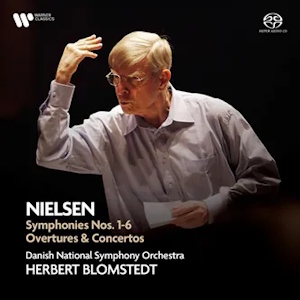
Carl Nielsen (1865-1931)
Symphonies 1-6, Overtures and Concertos
Danish National Symphony Orchestra/Herbert Blomstedt
rec. 1973-75, Danmarks Radio Concert Hall, Copenhagen, Denmark
Warner Classics 2173295777 SACD [5 discs: 355]
I have very fond memories of these recordings. I bought the set – comprising six LPs, I think – when it was first issued and these performances, together with Jascha Horenstein’s Unicorn-Kanchana recording of the Fifth symphony, were my serious introduction to the music of Carl Nielsen. The LPs are long gone and for some reason I didn’t replace them with CDs (probably because by that time I had multiple CD versions of the symphonies in my collection). Those other versions included Blomstedt’s Decca remakes of the symphonies, which he set down between 1987 and 1989, during his time as Music Director of the San Francisco Symphony Orchestra (review): I think I’m right in saying that those Decca recordings are now available only as downloads, though I have them on CD from when Decca reissued them as a pair of two-fers in 1999. The EMI cycle has appeared in various CD reincarnations (review ~ review) but, as I say, those discs have been absent from my shelves. I’m delighted, therefore, that Warner Classics have not only reissued them but also have gone to the trouble of remastering them as hybrid SACDs. The remastering, in HD 192kHz /24-bit from original tapes, has been carried out by Studio Circé.
These recordings were made in association with Danmarks Radio; the Danish National Symphony Orchestra (DNSO) is the principal orchestra of the Danish national broadcaster. Though the orchestra was founded as long ago as 1925, I’ve read that when Herbert Blomstedt was appointed as its principal conductor in 1967, he was the first conductor to have such a title; he served the orchestra for a decade and these recordings were made during his time with them.
As a general comment, I think that though the remastering of the original analogue recordings is a success, collectors who have the San Francisco digital recordings of the symphonies may find, as I have done when making A/B comparisons, that there’s a greater depth and richness to the Decca sound. Interestingly, during those San Francesco sessions Blomstedt added a couple of orchestral works which he did not set down for EMI: the Maskarade Overture and the Aladdin Suite. Of course, you get a significantly greater amount of music with the Warner set which, unlike the Decca, includes the composer’s three concertos and a goodly selection of shorter orchestral works.
I really enjoyed reacquainting myself with these EMI recordings. In the first two symphonies, for example, both of which were recorded in August 1974, there’s a freshness to the performances which is most appealing although the San Franciso remakes are at least as good and, arguably, a bit better. ‘Sinfonia espansiva’ was the first Nielsen recording that Blomstedt made with the DNSO; it was set down in September 1973. Here, I very much appreciated the excellent energy at the start of the symphony – Blomstedt repeats that energy in San Francisco – and also the pastoral delicacy that he brings to the second subject. At the start of the Andante pastorale second movement the Danish performance, though very good, has to yield to the wonderful tranquillity of the San Francisco remake. Later in the movement, in an inspired move, Nielsen introduces two wordless vocal soloists, a soprano and a tenor. Inexplicably, I can’t find Blomstedt’s soloists credited in the Warner booklet. Fortunately, they were named in the previous EMI issue so I’ve been able to take them from Rob Barnett’s review; Kirsten Schulz and Peter Rasmussen sing very well. The finale of ‘Sinfonia espansiva’ includes a super ‘big tune’, which we hear right at the start. In Blomstedt’s Danish performance it unfolds confidently, in sturdy strides, but this is one place where I strongly prefer the more sonorous sound that Decca achieved in California.
The Fourth and Fifth symphonies were recorded respectively in March 1974 and December 1973. The big-hearted Fourth is my favourite among the six, though, as a work of art, the Fifth is the one for which I have even greater admiration. Both go well in these Danish recordings. In the third movement of ‘The Inextinguishable’, the string players really dig deep at the start and Blomstedt builds the movement very well indeed towards its climax. The transition to the finale is exciting and the opening of that movement is full of fire. As the movement runs its course the conductor and his orchestra make the most of all the dynamic contrasts and the duel between the two sets of timpani and the rest of the orchestra is very well done. The ending of the work sounds, as it should do, like the triumph of an indomitable spirit. Warner very helpfully divide the Fifth symphony into six separate tracks (as did Decca for the San Francisco recording). The first movement has two tracks; the second one begins at the start of the Adagio non troppo. There are four tracks for the second movement, including one for the quick fugue and one for the slower fugue. Blomstedt is very controlled in the first section of the first movement. He then unfolds the Adagio non troppo with what I might call spacious momentum. As the movement’s crisis approaches, his side drummer is a disruptor, but for my taste his playing is a bit too disciplined. (Is this, I wonder, Ib Jarlkov, who later features in the Clarinet Concerto?) In the San Franciso remake, there’s a bit more of a sense of abandon from the drummer. In the movement’s hushed coda, the DNSO’s solo clarinettist plays with great poetry. Blomstedt does the second movement well; there’s commendable clarity in both fugues. Either side of the fugues, the opening music, to which Nielsen returns at the end, is delivered with great vigour. This is a fine version of the Fifth but I can’t help feeling that Blomstedt’s interpretation was done even greater justice by the Decca engineers just over a decade later.
With a good number of other pieces to consider, I hope readers will excuse me if I refrain from commenting on the performance of ‘Sinfonia semplice’, which was set down in November 1973. Candidly, this is a work which I’ve always struggled both to understand and to enjoy; consequently, I’m not ideally placed to judge Blomstedt’s recording.
The remaining two discs are devoted to pieces to which I don’t believe Blomstedt ever returned in the recording studio. I’m sure that’s true of the three concertos. Of these, my favourite is the Violin Concerto. This is another case where Warner do us a favour by splitting each of the two movements into two tracks. Before I go any further, I must mention something which I learned from David Fanning’s very useful booklet essay. I was astonished to learn that on one occasion Nielsen conducted a performance of the concerto and between its two movements he conducted Saga-Drøm. Fanning says that this was “an acknowledgment that the two parts of [the concerto] inhabit very different worlds”. I wonder what the soloist thought at being asked to kick his or her heels midway through the concerto. On this occasion the (uninterrupted) soloist is the Norwegian, Arve Tellefsen (b 1936). He’s marvellous. He delivers all the nimble virtuosic passages with seeming ease but what I especially value in his performance is the poetry that he brings to the opening Praeludium. Largo and to the Intermezzo. Poco Adagio. Blomstedt and the orchestra support Tellefsen very well indeed and this performance makes me realise that we ought to hear the concerto much more often. The recording dates from March 1975. The Flute Concerto features as soloist Frantz Lemmser (b 1934). He had been a member of the DNSO since 1963 and he was the orchestra’s first solo flute from 1968. On the evidence of this performance Lemmser was a considerable player. Nielsen gives his soloist a mixture of nimble display passages and episodes requiring poetic playing. Lemmser is equally successful in both aspects and, of course, he is not put off his stride by the deliberately rude interventions of the trombonist. There’s also a disruptor at work in the Clarinet Concerto and, arguably, on a greater scale. This time it’s a side drum, played by Ib Jarlkov who, I presume, was a member of the percussion section of the DNSO. The main soloist is the Swedish clarinettist, Kjell-Inge Stevensson (1951-2010). The concerto is rather wild in nature; it’s certainly unconventional. Stevensson is an excellent soloist, who is equal to all the athletic demands that Nielsen places on him. I especially enjoyed his lyrical playing in the Poco adagio section. Incidentally, the four sections of the work, which plays without a break, are all separately tracked. Both of these concertos were set down in the same sessions during April 1975.
Blomstedt also offers us a selection of seven shorter works, all of which were recorded in one set of sessions in February 1975. The Symphonic Rhapsody is the earliest piece in the whole set. David Fanning draws attention to the music’s “melodic freshness and energy”. I don’t think it’s played all that often but it’s worth hearing. By contrast, the Helios Overture is one of Nielsen’s best-known works, and rightly so. It’s very well done here; the DNSO horn section audibly relishes its place in the sun (pun intended). Saga-Drøm is an interesting piece, especially in the unusual cadenza-like section (5:58-7:02) which features primarily the woodwind principals. I listened to it with fresh attention once I’d read David Fanning’s comment, previously referenced, about the Violin Concerto; frankly, I simply don’t ‘get’ what led Nielsen to experiment with the two pieces in the way that he once did. Pan and Syrinx and the Rhapsody Overture: An Imaginary Trip to the Faroe Islands are both well worth hearing but the Bohemian-Danish Folk Songs, written for Danish Radio in 1928, need not detain us long.
This is a valuable collection. If it were simply a question of choosing a set of the six symphonies, Blomstedt’s later San Francisco cycle probably has the edge, not least because the recorded sound is superior. However, the earlier DNSO cycle is anything but negligible and the other pieces included in the set add significantly to its attractions. Furthermore, so far as I am aware, if you want to collect Herbert Blomstedt’s interpretations of the symphonies in disc form this is currently your only option. Throughout the set, the DNSO plays very well indeed for him, though in the symphonies I feel that the San Francisco orchestra is an even more accomplished ensemble.
The set includes a useful essay about the music written by David Fanning in 2008; this is provided in English and in French and German translation.
John Quinn
Buying this recording via the link below generates revenue for MWI, which helps the site remain free

Contents
Symphony No 1 in G minor, Op 7 (1890-92)
Symphony No 2, Op 16 ‘The Four Temperaments’ (1901-02)
Symphony No 3, Op 27 ‘Sinfonia espansiva’ (1910-11)
Symphony No 4, Op 29 ‘The Inextinguishable’ (1914-16)
Symphony No 5, Op 50 (1921-22)
Symphony No 6, ‘Sinfonia semplice’ (1924-25)
Symphonic Rhapsody, FS7 (1888)
Helios Overture, op.17 FS32 (1903)
Saga-Drøm, op.39 FS46 (1907-08)
Andante lamentoso, ‘At the Bier of a Young Artist’ for string orchestra (1910)
Pan and Syrinx, op.49 FS87 (1918)
Rhapsody Overture: An Imaginary Trip to the Faroe Islands, FS123 (1927)
Bohemian-Danish Folk Songs, FS130 (1928)
Violin Concerto, op.33 (1911)
Clarinet Concerto, op.57 FS129 (1926)
Flute Concerto, FS119 (1928)
Soloists
Arve Tellefsen (violin); Frantz Lemmser (flute); Kjell-Inge Stevensson (clarinet); Ib Jarlkov (side drum); Kirsten Schulz (soprano); Peter Rasmussen (tenor)














If you can still find copies, you could have the best of both worlds – the two Double Deccas of the Six Symphonies with the Aladdin Suite and Maskarade Overture, as mentioned, and the EMI Forte double of the Concertos and shorter works. No duplication of works across six discs, and, although you lose the Andante Lamentoso and Danish Folksongs included in the box set under review, you gain the Little Suite and Hymnus Amoris conducted by Ulf Schirmer on Decca, which I think is a pretty good trade-off.