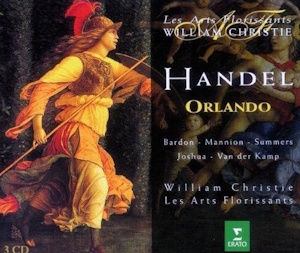
George Frideric Handel (1685 – 1759)
Orlando (1732)
Orlando – Patricia Bardon (mezzo-soprano)
Angelica – Rosemary Joshua (soprano)
Medoro – Hilary Summers (contralto)
Dorinda – Rosa Mannion (soprano)
Zoroastro – Harry van der Kamp (bass)
Les Arts Florissants/William Christie
rec. 1996, Salle Wagram, Paris
Libretto in Italian with German, French and English translations
Erato 2564 67743-0 [3 CDs: 179]
Back in 2011, two MusicWeb colleagues both very positively reviewed the later Warner budget issue of this recording (review; review), which did not have the quadrilingual libretto of the original here but that was available online. I refer you to both reviews for background information regarding the composition and performance history of Orlando, the last opera Handel wrote for Senesino.
I am often in two minds about most Handel operas – not because they do not contain some marvellous music – they almost invariably do – but because they are long, the plots are usually tedious or over-complicated with lots of mythological and classical nonsense and I often prefer not to sit through reams of recitative and some humdrum da capo arias, preferring to listen to compilations of the best numbers by great Handel singers such as Janet Baker, David Daniels, Marilyn Horne, Lorraine Hunt Lieberson, Ewa Podleś et al. Indeed, Podleś devoted half her Handel recital album to arias from this opera and she and conductor Constantine Orbelian perform them with rather more verve and animation than the more placid Bardon and Christie. Of course, there are exceptions and some, such as Giulio Cesare – perhaps his most celebrated opera – Serse, Semele and the other two operas based on Ariosto’s Orlando furioso, Alcina and Ariodante – all sustain my interest throughout, so my expectations of Orlando were similarly high. That was, however, a hope only partially fulfilled.
This was Christie’s first Handel opera recording and does not necessarily boast the starriest, “big name” cast, but he has fine singers and it is vividly, closely recorded. The period instrument orchestra is virtuosic and invariably well-tuned. Bass Harry van der Kamp has a warm, agile tone and sings his divisions without aspirates. Patricia Bardon’s grave, dark timbre suits the role ideally; it rarely rises above the stave and she could easily be mistaken for a countertenor. She has a trill and is able to span long phrases effortlessly. Rosa Mannion is charming as Dorinda – fleet and silvery without any hint of shrillness – and she has the lion’s share of long, lyrical arias. Rosemary Joshua as Angelica is similarly voiced and just as charming; the under-recorded Hilary Summers completes a line-up without weakness; she has a steady, honeyed contralto you can drink in. My only reservation concerns the music itself: despite obvious highlights, I do not find it to be as consistently inspired as Handel’s greatest operas, some arias are a little formulaic and while Orlando’s mad scene concluding Act II might have been dramatically innovative, musically it is decidedly anticlimactic. Nonetheless, the showpieces – perhaps fewer than Senesino demanded, hence his subsequent resignation from Handel’s opera company – are highly entertaining; Bardon makes the most of pieces such as “Fammi combattere” towards the end of Act I, which closes with a beautiful extended trio “Consolati, o bella”. The centrepiece of the second act is Summers’ long, plaintive aria “Verdi allori” (Green laurels) – the equivalent in this opera, perhaps, of another, better-known “tree aria”, “Ombra mai fu” from Serse, and exquisitely sung. Unfortunately, for reasons of the plot, Summers as Medoro is absent throughout nearly all of Act III but there is some great singing from the others, especially from Rosa Mannion and I particularly like the passage where the magician Zoroastro cures Orlando of his delusions; it is a close cousin of similar music in the concerti grossi and van der Kamp sings cleanly and nimbly with nice, nut-brown tone. More famous is the very unusual and atmospheric instrumentation for Orlando’s “sleep aria”, “Già l’ebro mio ciglio”, using two violette marine – a type of viola d’amore – pizzicato cello, harpsichord and theorbo.
I do not rank this among Handel’s very best operas any more than did his contemporaries and to some extent I well understand why it lay dormant for almost two centuries before its revival in 1922 in Halle, Handel’s birthplace, but it is certainly as well sung and played here as one could wish and there is still much to enjoy.
Ralph Moore