
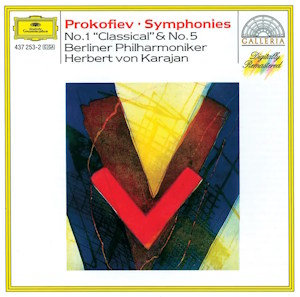
Sergei Prokofiev (1891-1953)
Symphony No. 1 in D major, Op. 25 “Classical”
Symphony No. 5 in B flat major, Op. 100
Berliner Philharmoniker/Herbert von Karajan
rec. 1968 (No. 5), Jesus Church, Berlin (ADD); 1981 (No. 1), Great Philharmonic Hall, Berlin (DDD)
Deutsche Grammophon 437 253-2 [57]
I had hitherto listened to these symphonies via the vintage 1955 recording of the “Classical” by Nicolai Malko conducting the Philharmonia and 1987 recording of the Fifth by Mariss Jansons and the Leningrad Philharmonic. Both are excellent but the sheer verve, energy, precision and sonority of the two Karajan performances – separated by thirteen years – make both compelling and the Jansons’ Fifth, in particular, pales by comparison: Jansons is neat and effective; Karajan is absolutely thrilling, whipping up the kind of torque and tension in the ostensibly slow Adagio that Jansons does not approach. Likewise, Jansons’ finale fails to ignite the way Karajan’s does – and it does not help that, surprisingly, the Chandos sound is a bit gluey and generic compared with the brilliance and clarity of the DG engineering; the other advantage to Karajan’s recording is the sheer impact of the tam-tam at the climax of the coda to the first movement and the wallop delivered by the low strings and percussion in general – not always a virtue in Karajan’s performances, which could sometimes be too smooth. The scherzo is crisp and sharp, and time and again in that last movement, whereas I feel as if Jansons lets the momentum drop with just a fraction too much rubato or pause, Karajan gives us a ride to the abyss. The direction may be “giocoso” but there is no room for relaxation in this pell-mell riot and I experience nothing like the release Karajan generates in the last couple of minutes of Jansons’ account.
Regarding the charming little “Classical” symphony, I am so imprinted with the Malko I have to make an effort to listen to any other. There is in fact very little difference in affect between his and Karajan’s performances but I have to admit that the BPO strings are neater and better tuned in the first movement and the DG sound is richer, less papery. However, I find Malko to be more elegant in the second movement minuet, whereas Karajan is just a touch too brisk there and a little leaden and heavy-handed in the gavotte, compared with the spring of Malko’s direction. This is reflected in the fact that Karajan takes a considerable fifteen seconds longer over it – which doesn’t sound like much but makes a difference in such a tiny movement of around a minute and a half. There is less disparity in their respective approaches to the finale as both are fleet and mercurial, and their timings are identical, but overall Malko finds more wit and mischief in the music whereas Karajan delivers an immaculately sleek and cultivated account – the wind playing is especially beguiling.
On balance, then, as a pair this makes a great bargain but I recommend it principally for the incandescent Fifth Symphony while my loyalty to the classic Malko recording of the First remains unchallenged, good as Karajan’s is.
(This is available either in the “Galleria” series, catalogue no. as above, or the Japanese DG “Best 1200” issue, no. F35G 20084, which is what I listened to for this review.)
Ralph Moore
Buying this recording via the link below generates revenue for MWI, which helps the site remain free













