
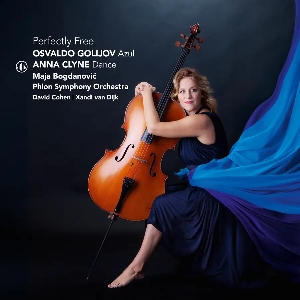
Perfectly free
Osvaldo Golijov (b. 1960)
Azul for cello, obbligato group and orchestra (2006, rev. 2007)
Anna Clyne (b. 1980)
Dance for cello and orchestra (2019)
Maja Bogdanović (cello)
Robbrecht van Cauwenberghe (bayan, Azul)
Phion Symphony Orchestra/David Cohen (Azul), Xandi van Dijk (Dance)
rec. live, 2024/25, Muziekcentrum Enschede, Stiftfestival, The Netherlands
Challenge Classics CC720054 [55]
This disc brings together two twenty-first century cello concertos, championed here by the cellist Maja Bogdanović. They have some incidental features in common, but the main point is that they are both fine works. These are not first recordings.
Osvaldo Golijov, born in Argentina of Jewish parents, became familiar with klezmer, tango and Jewish liturgical music, and with classical music. He studied for a time in Israel and then in the United States, where he finally settled. He is currently composer in residence at the College of the Holy Cross, in Worcester, Massachusetts. His breakthrough was the 1994 work for clarinet and string quartet The Dreams and Prayers of Issac the Blind. This was a runaway success: it has had a dozen recordings. For about fifteen years afterwards, Golijov could do no wrong. He was commissioned all over the place and had a contract with DG. His recorded works included the oratorio La Pasión segun San Marcos, and the opera Ainadamar. Around 2010, something went wrong. He failed to complete several important commissions, which included an opera for the Met. More recently there has been a return to form, with the violin concerto The Given Note, and the song cycle Laika, as well as music for films.
The cello concerto Azul (Blue) comes from the period of Golijov’s early success. After the premiere in 2006, he reworked and expanded it into its definitive form, first performed the following year. It is in four movements, each with a title. The orchestra includes a bayan (chromatic accordion) and a large array of South American percussion.
The opening Paz Sulfúrica features a dialogue between the cello and the accordion; after a climax, it leads to a burst of percussion. Silencio, slow and quiet, is a chaconne with the cello soaring above in a long line. Transit is an elaborate cadenza for the cello with the support of the accordion and the percussion. Finally, we have Yrushalem, a prayer. The composer said of this movement that he “wanted to write a piece that could be listened to from different perspectives […] music that would sound as an orbiting spaceship that never touches ground”. Two astronomically named codas, Pulsar and Shooting Stars, conclude the work. It is varied, engaging and often very beautiful.
Anna Clyne, born in England and based in the USA, studied in Edinburgh and then at the Manhattan School of Music. In her earlier years, she was particularly interested in works which involved tapes. More recently, she has worked with visual artists and with sonic manipulation using computers, assisted by her husband, the sound engineer Jody Elff. Her breakthrough came with the 2012 orchestral work Night Ferry, which has already been recorded twice. She is widely commissioned and frequently recorded.
Dance is a cello concerto in five movements with titles taken from the Persian poet Rumi. Clyne wrote: “I knew that I wanted to write a multi-movement work in which each movement had its own personality, its own character. I’ve known this Rumi poem for a while and always thought it would be a good source of inspiration – it’s short, has repetition, a clear form of five lines and a strong physicality (for example, ‘broken open’, ‘in your blood’). It also has a sense of urgency that I found compelling for this piece. It was a great way to structure the piece – to break it up into the five lines of the poem.” The orchestra is standard, with extra percussion. No tape or electronic trickery is involved.
The first movement, Dance, when you’re broken open, is not dance-like at all, but slow and lyrical. The second, Dance, if you’ve torn the bandage off, is vigorous and rhythmic; woodwind and marimbas are prominent. The third movement, Dance, in the middle of fighting, is quiet again. The fourth, Dance, in your blood, begins with cello solo which leads to another wild dance full of virtuoso effects for the soloist. The finale, Dance, when you’re perfectly free, alternates wild passages and lyrical ones, with a hint of Jewish music towards the end.
I did not find the titles of the movements helpful, but the work itself is something else. I have heard a few other works by Anna Clyne, but this is much the finest I have come across. The writing is most imaginative, consistently varied and attractive.
Maja Bogdanović has a thriving career, with a particular emphasis on recent and contemporary music. She has a lovely tone and impeccable technique, and clearly is strongly committed to these works. She gets good support from the Phion Symphony Orchestra, with two conductors: David Cohen in Azul and Xandi van Dijk in Dance. The sound is excellent, the English-only booklet informative. Thanks are owed to the Stichting Stift International Music Festival, among others, for making this recording possible.
As I noted, both works have been recorded before, Azul by Yo-yo Ma, who premiered it (on Warner), and Dance by Inbal Segev (on Avie). I have not heard those performances but I am very happy with these. They should make new friends for both composers.
Stephen Barber
Buying this recording via the link below generates revenue for MWI, which helps the site remain free














Thanks for this review, Stephen! I had not encountered Golijov’s ‘Azul’, and it is now one of my favorite finds of this year. On paper, it does a lot of things that other orchestral works do: it features a long, steady build across the first movement, lots of sustained, ambient sounds in the slow movement, a highly-virtuosic scherzo with a driving pulse, and a ‘mystical’ finale. I was intrigued that Yo-Yo Ma has recorded it (with the Knights)– it seems that the piece was written with him in mind as the soloist!
Listeners might also be interested in knowing that the phrase ‘Paz Sulfúrica’ comes from a poem by Pablo Neruda, which inspired Golijov to put more passion and struggle into a work that he felt was originally a bit too contemplative. (“I put my forehead among the deep waves, I descended like a drop among the sulfuric peace, and, like a blind man, I returned to the jasmine of the exhausted human spring.”)
A lot of Azul is still very lyrical, but especially in movements 1 & 3 there’s serious drive and momentum. What a beautiful work!