
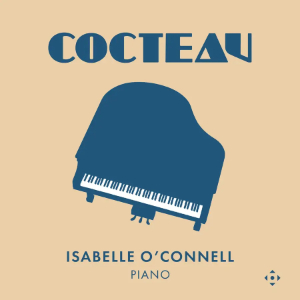
Cocteau
Isabelle O’Connell (piano)
rec. 2024, St Peter’s Church, Drogheda, Ireland
Divine Art Records DDX21141 [72]
For much of the twentieth century, Jean Cocteau (1889-1963) was a dominating figure in French culture. He was a visual artist, designer, writer, playwright, librettist and universal man of the arts. For a good recent survey, see Kenneth E. Silver (ed.), Jean Cocteau: the Juggler’s Revenge, Marsilio Arte 2024.
Cocteau also had a particular relationship with music, although he was not a professional performer. He was the presiding spirit of the group Les Six, and was friends with Erik Satie and Igor Stravinsky, among others. This cleverly designed disc celebrates those relationships. There are contributions from all those I have mentioned, plus a tribute by Rhona Clarke in its first recording.
Les Six were Georges Auric, Louis Durey, Arthur Honegger, Darius Milhaud, Francis Poulenc and Germaine Tailleferre. Cocteau wrote their artistic manifesto, Le Coq et l’Arlequin. He rejected Wagner’s romanticism and Debussy’s impressionism, and said that artists should take their inspiration from café concerts, cabaret, music hall, circus, ragtime and jazz.
Eric Satie was briefly associated with Les Six, but was not a member. His Rag Time Parade is a jolly inconsequential number, arranged from Cocteau’s ballet Parade. Then we have three works by Tailleferre. She was a member of the group, but one rather sees the influence of Ravel in these pieces, even if one of them is Hommage à Debussy.
Igor Stravinsky, Cocteau’s friend and occasional collaborator, makes two appearances. He wrote Ragtime for an ensemble of eleven players, including a cimbalon, but this is his own arrangement for piano. It is not exactly an exercise in ragtime, but has been described as its Cubist portrait. Anyway, it is a splendid piece. Cinq doigts is a teaching pieces he wrote for his children as duets, here transcribed for solo piano. Though tiny, they are characteristic of the composer.
Between Stravinsky’s works, we have Satie’s three Gnossiennes. Charming and melancholy, they are in my view the best of the composer. His other contribution, Rêverie de l’enfamce de Pantagruel, is much less interesting; I wish we had Stravinsky’s Piano-Rag-Music instead.
Milhaud’s Le Tango des Fratellini is an excerpt from his ballet Le Boeuf sur le Toit, transcribed for piano by Henri Mouton. It has all the verve and high spirits of that work.
Then we have a rarity, the complete suite L’Album des Six, the only work in which all the original members collaborated. The short pieces are not particularly remarkable but it is nice to hear them. In particular, I was glad to hear at last something by Louis Durey, the mystery man of the group. Even at that stage, you can hear that Honegger, in his Sarabande, was pulling away from their aesthetic.
Finally, we have Rhona Clarke’s Cocteau, a portrait of the artist in six numbers, with some titles from works of his. This is an attractively varied suite in an idiom which also is not that of Les Six. Rather, like Tailleferre’s piece, it is closer to Ravel. In fact, I found myself thinking of John Ireland, who also developed a similar idiom. Isabelle O’Connell, the pianist here, commissioned Clarke’s work. That gave rise to this programme.
O’Connell, of Irish origin but now based mainly in New York, is particularly active in promoting new music. Here, she plays fluently. The recording is good. This concept album has no obvious competition; it should appeal to fans of Les Six.
Stephen Barber
Buying this recording via the link below generates revenue for MWI, which helps the site remain free
Contents
Erik Satie (1866-1925)
Rag-Time Parade (1917) arr. ‘Hans Ourdine’, pseudonym of Stéphane Chapelier
Germaine Tailleferre (1892-1983)
Pas trop vite (1914)
Hommage à Debussy (1920)
Très vite (1920)
Igor Stravinsky (1882-1971)
Ragtime K030 (1919) arr. composer
Satie
Gnossiennes (1890-1893)
Stravinsky
Le cinq doigts
Darius Milhaud (1892-1974)
Le Tango des Fratellini from Le Boeuf sur le Toit (1919) arr. Henri Mouton, 1920
Satie
Rêverie de l’enfance de Pamtagruel from Trois petites pièces montées arr. composer (1920)
Les Six
L’Album de Six (1920)
Georges Auric (1899-1983)
Prélude
Louis Durey (1888-1979)
Romance
Arthur Honegger (1892-1955)
Sarabande
Milhaud
Mazurka
Francis Poulenc (1899-1963)
Valse
Tailleferre
Pastorale
Rhona Clarke (b. 1958)
Cocteau (2022)
The digital edition includes Satie’s Gymnopédies.













