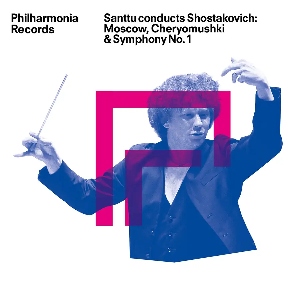
Dmitri Shostakovich (1906-1975)
Suite from Moscow, Cheryomushki, Op. 105 (1958, arr. Andrew Cornall 1997)
Symphony No. 1 in F minor, Op. 10 (1924-25)
Philharmonia Orchestra/Santtu-Matias Rouvali
rec. live, 1 December 2024 (suite), 10 April 2025 (symphony), Royal Festival Hall, South Bank Centre, London
Philharmonia Records SIGCD990 [61]
I gave Rouvali’s live recording of Shostakovich’s Tenth Symphony an appreciative welcome (review), despite finding that Barshai, Shipway and Karajan applied even more intensity to the music – so I was intrigued to hear whether he sustained that standard in this performance of the First. To begin: I know that timings never tell the whole story but, in this case, I find the contrast between those of three favourite versions and Rouvali’s new live recording quite revealing and even startling. I have arranged them in order of ascending length and quite clearly Rouvali is way out of line in three of the four movements especially in the first and the finale. No one was ever much surprised by Bernstein indulging in etiolated tempi – and he often got away with it – but Rouvali is over two minutes slower than Barshai, Ormandy and Bernstein in the first movement and fully three minutes slower than the first two in the final movement. There has always been controversy surrounding how best to pace these movements but it is surprising to find Rouvali bucking the modern trend and going for a weightier, “Mahlerian” approach, perhaps undercutting the sharper, youthful sarcasm. Overall, he takes nine minutes longer than Barshai, whose recordings of all Shostakovich symphonies have long been the standard, recommended reference versions.
| Barshai | Ormandy | Bernstein | Rouvali | |
| I | 8:10 | 8:28 | 8:23 | 10.30 |
| II | 4:45 | 4:36 | 4:35 | 5:25 |
| III | 7:43 | 8:20 | 9:42 | 10:27 |
| IV | 8:38 | 8:36 | 10:37 | 11:47 |
| Total | 29:16 | 30:00 | 33:17 | 38:05 |
I have to say that I find Rouvali’s more cautious, plodding and deliberate manner in the first movement rather effective at suggesting irony and mockery. The angular, pompous march tune responds well to that treatment and the Philharmonia play so well, savouring the abrupt switches of mood and tempo. At no point do I feel as if it is dragging. As a check, I played Barshai and Ormandy immediately after first listening to Rouvali – and as far as I am concerned both work; Barshai is chirpier and more aggressive, Rouvali slyly subversive. The Allegro is more conventionally timed but is powerfully played and emerges as highly sinister; I like it very much. The Lento stands comparison with Bernstein’s for yearning intensity and the haunting violin solo seven minutes in – presumably played by Concertmaster Zsolt-Tihamér Visont – is lovely. The danger of playing the finale more slowly is that it fragments, losing coherence and compatibility with what has preceded it but I find it to be beautifully gauged and its highly Romanticised delivery acts almost as a tribute to Borodin, Rimsky Korsakov and the Five.
I have in fact addressed this recording back to front, as the programme opens with the suite of four numbers from Shostakovich’s operetta Cheryomushki. He apparently was ashamed of it but with no cause; it is typical of his “light music”: tuneful, witty, catchy and colourful – nor is it without its more powerful and dramatic passages, such as the stirring conclusion to the waltz. Every section, but especially the brass, enjoys itself in the third “Dances” movement and it has a riotous ending. The ballet is more refined but no less cheerful – indeed, somewhat reminiscent of Offenbach at times. The suite makes both a pleasant prelude and contrast to the ensuing symphony.
The sound in both works is first-rate; there is absolutely no indication of their being live and they are indistinguishable from studio recordings.
I am puzzled by the very general nature of the booklet note by Joanna Wyld, which hardly discusses the First Symphony at all and makes absolutely no mention of Cheryomushki; instead, we have a brief contextualisation of the struggles Shostakovich had with Stalin and more about the Fourth Symphony. Peculiar.
Ralph Moore
Suite from Moscow
I. A spin through Moscow
II. Waltz
III. Dances
IV. Ballet
Buying this recording via a link below generates revenue for MWI, which helps the site remain free